

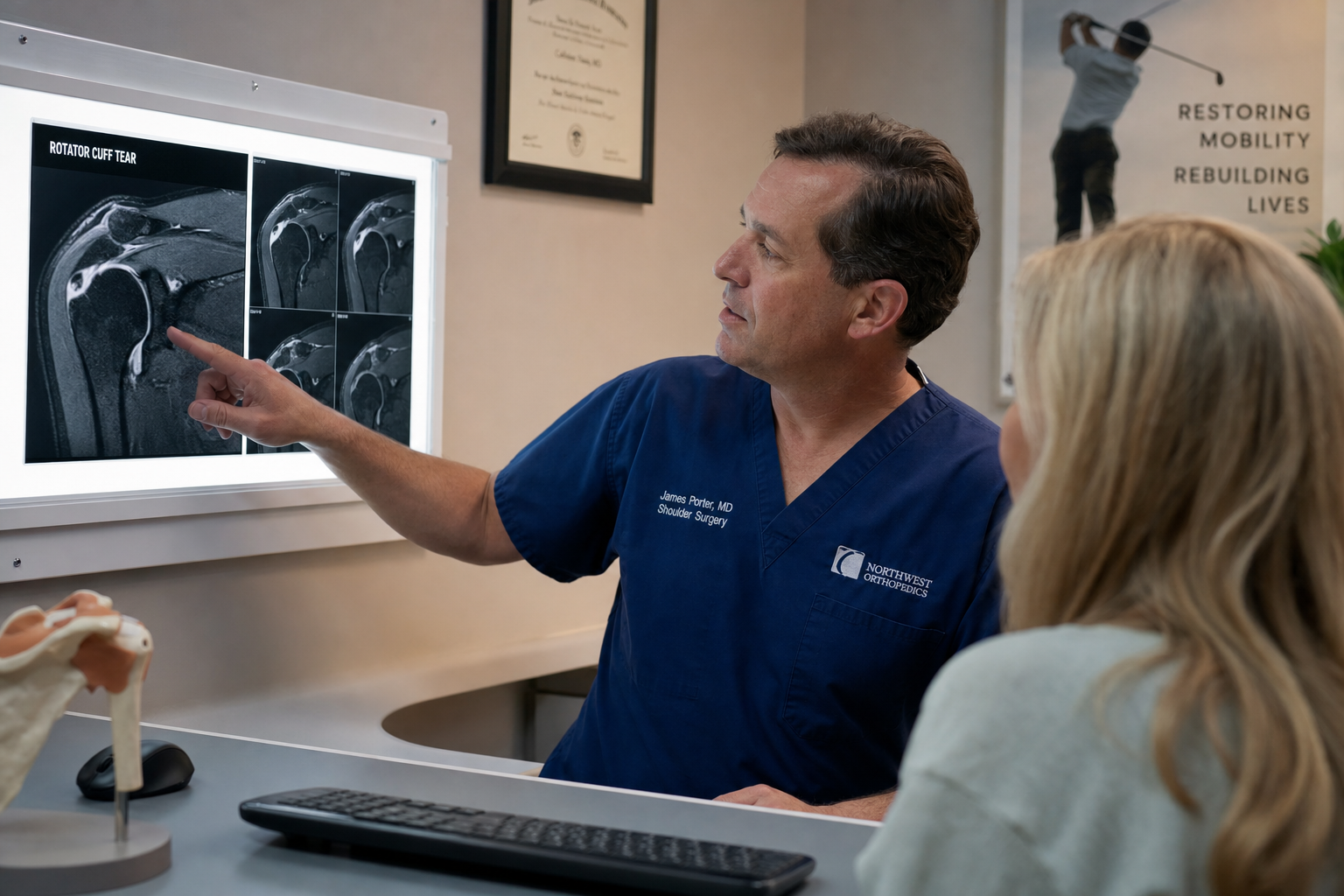
Rotator Cuff Tear Surgery in Clermont: When to Book
Rotator cuff tear surgery in Clermont is a decision that depends on the severity of your tear, how long symptoms have persisted, and whether conservative care has helped. At Varma Shoulder Institute, we help patients throughout Central Florida determine the right time to move from watchful waiting to surgical repair — so you can get back to the activities you love without unnecessary delay.
The rotator cuff is a group of four muscles and their tendons that stabilize the shoulder joint and allow you to lift and rotate your arm. When one or more of these tendons tears — whether from a sudden injury or gradual wear — the result is often pain, weakness, and limited range of motion. Understanding when to pursue surgical repair versus conservative care is one of the most important decisions in shoulder health.
What a Rotator Cuff Tear Is and Why Timing Matters
Rotator cuff tears are classified as partial-thickness or full-thickness. A partial tear means the tendon is damaged but not completely severed. A full-thickness rotator cuff tear means the tendon has torn all the way through, disconnecting it from the bone. Full-thickness tears are less likely to heal on their own and more likely to require surgical repair.
Timing matters because rotator cuff tendons that remain torn can retract — meaning the tendon pulls away from the attachment point over time. Once significant retraction occurs, the muscle can atrophy (weaken and shrink), making surgical repair technically more difficult and potentially less effective. Early evaluation gives you and your surgeon the most options.
At Varma Shoulder Institute, we evaluate rotator cuff tears using a combination of physical examination and advanced imaging to determine tear size, location, and tissue quality — all of which influence the timing recommendation.
Signs It May Be Time to Book a Surgical Consultation
Certain symptoms and circumstances suggest that a surgical consultation should not be delayed. These include:
- Persistent pain at rest or at night that does not improve with anti-inflammatory medication or physical therapy after several weeks.
- Significant shoulder weakness, especially difficulty lifting the arm overhead or rotating it outward.
- A confirmed full-thickness tear on MRI, particularly in an active patient under age 65.
- An acute traumatic tear — for example, a tear that occurred during a fall, collision, or heavy lift — which often benefits from prompt repair before retraction sets in.
- Failed conservative treatment after six to twelve weeks of physical therapy, rest, and/or corticosteroid injections.
If you are experiencing any of these signs, schedule a consultation at Varma Shoulder Institute to get a clear diagnosis and a personalized treatment plan from double-fellowship-trained shoulder surgeon Dr. Amit Varma.
When Non-Surgical Treatment May Be Tried First
Not every rotator cuff tear requires surgery. For partial-thickness tears, small full-thickness tears in older or less active patients, or patients with significant medical comorbidities, a structured course of nonoperative treatment is often the appropriate first step. This typically includes:
- Physical therapy focused on rotator cuff strengthening and scapular stabilization.
- Anti-inflammatory medications to reduce pain and swelling.
- Corticosteroid or PRP (platelet-rich plasma) injections to support healing and reduce inflammation.
- Activity modification to avoid movements that aggravate the tear.
Conservative treatment can be highly effective for the right patient. However, it is important to monitor progress. If symptoms plateau or worsen after a reasonable trial period, surgical evaluation becomes the logical next step.
What Happens If You Wait Too Long for Rotator Cuff Repair
Delaying rotator cuff repair when surgery is indicated carries real risks. Over time, a torn tendon can retract further from its attachment point on the humerus (upper arm bone). The muscle connected to that tendon may undergo fatty infiltration — a process where muscle tissue is gradually replaced by fat — which reduces the muscle’s ability to function even after a technically successful repair.
Large or massive tears that are left untreated can eventually become irreparable, meaning no surgical technique can restore the tendon to its original attachment. In these cases, the treatment options shift to pain management, reverse shoulder replacement, or other salvage procedures rather than a straightforward repair.
The American Academy of Orthopaedic Surgeons notes that rotator cuff problems can worsen over time without appropriate treatment. If you have been told you have a rotator cuff tear and are unsure whether to proceed with surgery, a second opinion from our Clermont shoulder team can help clarify your options before the window for repair narrows.
Who Is Most Likely to Benefit From Surgery
Rotator cuff repair tends to produce the best outcomes in patients who:
- Are younger and physically active, with higher functional demands on the shoulder.
- Have a full-thickness tear that occurred acutely (within weeks to a few months).
- Have good tissue quality — meaning the tendon has not retracted significantly and the muscle has not undergone fatty infiltration.
- Have failed a structured course of conservative treatment.
- Are in good enough overall health to tolerate surgery and commit to post-operative rehabilitation.
Older patients with smaller, chronic tears and minimal functional limitation may do well with non-surgical management. The decision is always individualized. At Varma Shoulder Institute, we take the time to review your imaging, assess your functional goals, and explain your options clearly — without pressure.
How Dr. Varma Evaluates a Suspected Rotator Cuff Tear
Dr. Amit Varma, a double-fellowship-trained shoulder surgeon who completed advanced training at the Rothman Institute under Dr. Michael Ciccotti and the Andrews Institute under Dr. James Andrews, uses a systematic approach to evaluate rotator cuff injuries. A typical evaluation at Varma Shoulder Institute includes:
- Detailed history: When did symptoms start? Was there a specific injury? What activities make it worse?
- Physical examination: Strength testing, range-of-motion assessment, and specific provocative tests to identify which tendons are involved.
- Imaging review: X-rays to assess bone structure and MRI to evaluate tendon integrity, tear size, retraction, and muscle quality.
- Shared decision-making: Dr. Varma reviews findings with you, explains the pros and cons of surgical versus non-surgical options, and helps you make an informed decision aligned with your goals.
Same-week appointments are available, and second opinions can typically be accommodated within 48 hours. You do not need to wait months to get clarity on your shoulder.
What to Expect From Rotator Cuff Surgery and Recovery
Most rotator cuff repairs performed at Varma Shoulder Institute are done arthroscopically — using small incisions and a camera — which minimizes tissue disruption and supports a smoother recovery compared to open surgery. During the procedure, the torn tendon is reattached to the bone using small anchors. Shoulder arthroscopy is a well-established technique for rotator cuff repair with a strong track record in appropriately selected patients.
Recovery typically follows this general timeline:
- Weeks 1 to 6: Arm in a sling; gentle passive range-of-motion exercises begin under physical therapy guidance.
- Weeks 6 to 12: Progressive active range-of-motion and early strengthening exercises.
- Months 3 to 6: Continued strengthening; most patients return to light daily activities.
- Months 6 to 12: Return to more demanding activities, sports, or overhead work, depending on tear size and individual progress.
Recovery timelines vary based on tear size, tissue quality, patient age, and adherence to physical therapy. Our team provides a personalized rehabilitation plan and monitors your progress throughout recovery.
When to Seek Shoulder Care in Clermont
Varma Shoulder Institute provides rotator cuff repair and comprehensive shoulder care for patients throughout Clermont, Orlando, and Central Florida. If you have been experiencing shoulder pain, weakness, or limited motion — whether from a recent injury or a problem that has been building for months — the right time to seek an evaluation is now, before the situation becomes more complex.
We accept Aetna, Cigna, Florida Blue/BCBS, UnitedHealthcare, Medicare, Tricare, and self-pay. Same-week appointments are available. Call (352) 404-8956 or request your consultation online to get started.
Patient Scenario: When Conservative Care Reaches Its Limit
Common Mistakes Patients Make With Rotator Cuff Tears
Avoiding these common errors can make a significant difference in your outcome:
- Waiting too long to seek evaluation. Many patients assume shoulder pain will resolve on its own. While some do, full-thickness tears rarely heal without intervention, and delay can reduce surgical options.
- Stopping physical therapy too early. Conservative treatment requires consistency. Dropping out after a few sessions before giving it a fair trial can lead to unnecessary surgery — or unnecessary suffering.
- Relying solely on pain medication. Pain relief is not the same as healing. Masking symptoms without addressing the underlying tear can allow it to worsen unnoticed.
- Ignoring nighttime pain and weakness. These are red-flag symptoms that suggest a more significant tear. They warrant prompt evaluation, not watchful waiting.
- Skipping a second opinion after a non-surgical recommendation. If you have been told surgery is not needed but your symptoms are not improving, a second opinion from a fellowship-trained shoulder specialist can provide important clarity.
Practical Steps: What to Do Next
If you suspect a rotator cuff tear or have already been diagnosed with one, here is a clear path forward:
- Document your symptoms — when they started, what makes them worse, and how they affect daily activities.
- Gather any existing imaging (X-rays, MRI) and prior treatment records.
- Call Varma Shoulder Institute at (352) 404-8956 or request a same-week appointment online.
- At your consultation, Dr. Varma will review your imaging, perform a physical examination, and discuss your options in plain language.
- If surgery is recommended, our team will walk you through the procedure, recovery timeline, and what to expect at every stage.
You do not have to navigate this alone. Our team is here to give you a clear diagnosis and a confident path forward. Learn more about shoulder and elbow surgery standards from the American Shoulder and Elbow Surgeons.
Frequently Asked Questions
How do I know if my rotator cuff tear needs surgery?
Surgery is typically recommended when a full-thickness tear is confirmed on MRI, when pain and weakness persist after six to twelve weeks of conservative treatment, or when an acute traumatic tear occurs in an active patient. Dr. Varma at Varma Shoulder Institute can evaluate your specific tear and give you a clear recommendation.
Can a rotator cuff tear heal without surgery?
Partial-thickness tears and small full-thickness tears in older, less active patients can sometimes be managed successfully with physical therapy, injections, and activity modification. Full-thickness tears in active patients rarely heal on their own and often require surgical repair for full function to be restored.
What happens if I delay rotator cuff surgery too long?
Delayed repair can allow the torn tendon to retract further and the attached muscle to undergo fatty infiltration, making repair more difficult or impossible. In some cases, a repairable tear can become irreparable if left untreated for too long.
Is rotator cuff surgery done arthroscopically?
Most rotator cuff repairs today are performed arthroscopically using small incisions and a camera, which reduces tissue disruption and supports faster recovery. At Varma Shoulder Institute, Dr. Varma performs arthroscopic rotator cuff repair for appropriately selected patients.
How long does recovery from rotator cuff surgery take?
Recovery typically spans six to twelve months depending on tear size and individual factors. Most patients begin physical therapy within the first few weeks and return to light daily activities by three to six months. Full return to demanding activities or sports may take up to a year.
Does Varma Shoulder Institute accept my insurance for rotator cuff surgery?
Varma Shoulder Institute accepts Aetna, Cigna, Florida Blue/BCBS, UnitedHealthcare, Medicare, Tricare, and self-pay. Coverage for rotator cuff repair varies by plan. Call (352) 404-8956 or contact our office to verify your specific benefits before scheduling.
Can I get a second opinion on my rotator cuff diagnosis in Clermont?
Yes. Varma Shoulder Institute offers second opinions, typically within 48 hours. If you have been told you need surgery — or told you do not — and want expert confirmation, call (352) 404-8956 to schedule a second opinion consultation with Dr. Varma.
Update Log
- May 2026: Article reviewed and updated to reflect current rotator cuff evaluation and surgical timing guidelines. Insurance plan list and contact information verified.