

Reverse Shoulder Replacement for Rotator Cuff Arthropathy
Reverse shoulder replacement for rotator cuff arthropathy is one of the most effective surgical solutions for patients who have lost meaningful shoulder function due to a massive, irreparable rotator cuff tear combined with arthritis. At Varma Shoulder Institute in Clermont, Florida, double-fellowship-trained shoulder surgeon Dr. Amit Varma evaluates and treats this complex condition with a personalized, precision-focused approach. If you have been told your shoulder is “bone on bone” and your rotator cuff is beyond repair, this guide explains what reverse total shoulder arthroplasty is, who qualifies, and what recovery looks like.
Cuff tear arthropathy is a progressive condition that develops when a long-standing, massive rotator cuff tear allows the humeral head to migrate upward, grinding against the acromion and eventually destroying the joint surface. The result is a painful, arthritic shoulder that also lacks the muscular support needed to lift the arm. Standard total shoulder replacement is not appropriate in this setting because it relies on an intact rotator cuff to function. Reverse total shoulder arthroplasty was engineered specifically to address this combination of problems.
What Is Reverse Shoulder Replacement for Rotator Cuff Arthropathy?
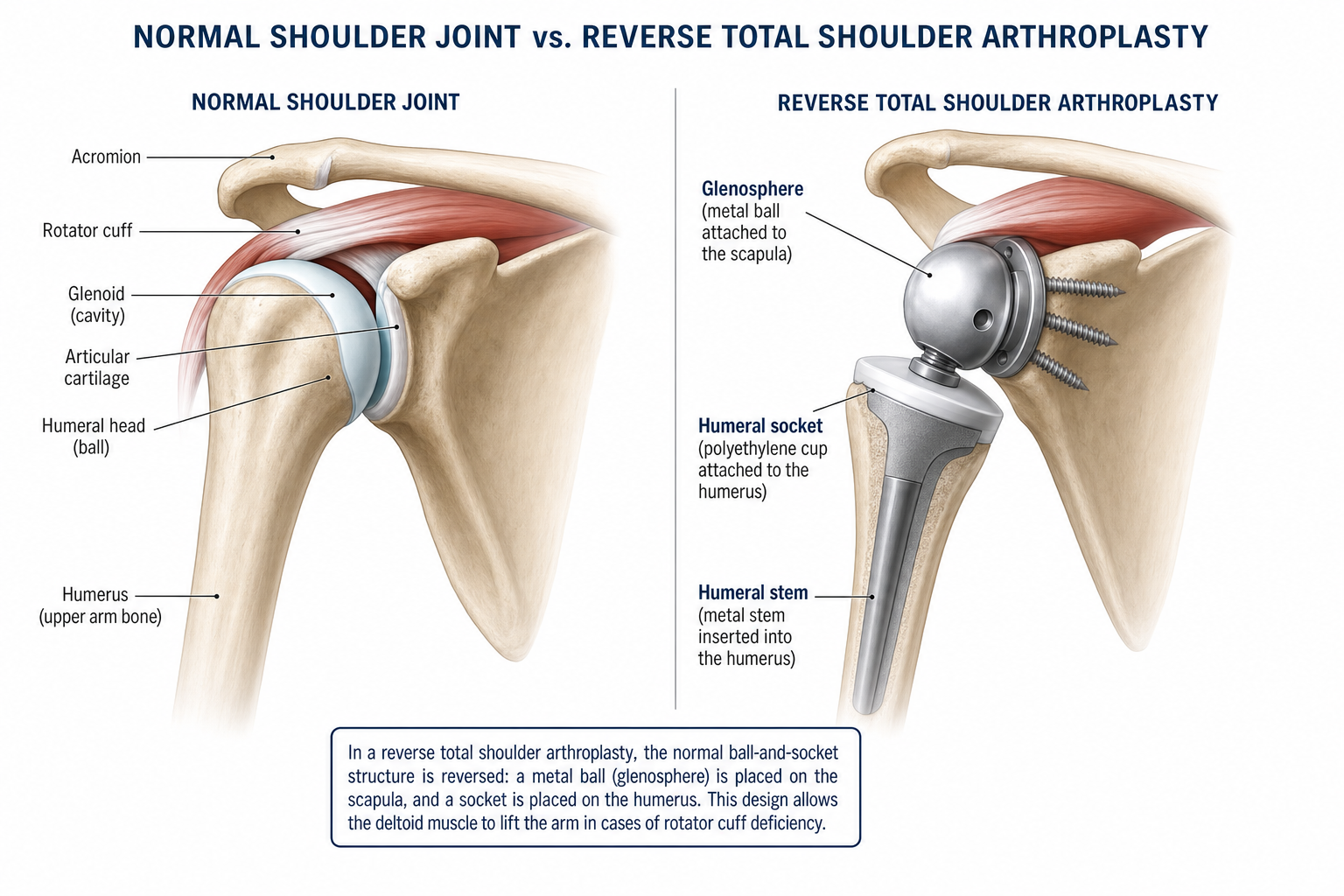
Reverse shoulder replacement — formally called reverse total shoulder arthroplasty — is a surgical procedure in which the normal ball-and-socket anatomy of the shoulder is intentionally inverted. A metal ball (glenosphere) is fixed to the shoulder blade (glenoid), and a socket component is placed at the top of the upper arm bone (humerus). This geometric reversal shifts the center of rotation of the joint, placing the deltoid muscle in a more mechanically advantageous position to lift the arm without any contribution from the rotator cuff tendons.
According to the American Academy of Orthopaedic Surgeons, reverse shoulder replacement was originally developed for patients with cuff tear arthropathy and has since expanded to other complex shoulder conditions. At Varma Shoulder Institute, we perform reverse total shoulder arthroplasty for carefully selected patients whose anatomy and functional goals align with what this implant can reliably deliver.
Who Is a Good Candidate for This Surgery?
Not every patient with a rotator cuff tear or shoulder arthritis needs — or benefits from — reverse shoulder replacement. The ideal candidate typically presents with all of the following: a massive, irreparable rotator cuff tear confirmed on MRI; significant glenohumeral arthritis visible on X-ray; meaningful loss of active arm elevation (often called pseudoparalysis); and failure of conservative management including physical therapy, anti-inflammatory medications, and corticosteroid injections.
Age and bone quality also factor into the decision. Most candidates are adults over 60, though younger patients with severe cuff tear arthropathy and no viable repair options may also be considered on a case-by-case basis. Patients with active shoulder infection, severe neurological conditions affecting the deltoid, or inadequate glenoid bone stock may not be appropriate surgical candidates. A thorough evaluation — including advanced imaging and a detailed physical examination — is essential before any surgical recommendation is made. You can schedule a shoulder consultation at Varma Shoulder Institute to find out whether you qualify.
Symptoms and Exam Findings That Suggest Cuff Tear Arthropathy
Cuff tear arthropathy produces a recognizable clinical picture. Patients typically report deep, aching shoulder pain that worsens with any attempt to lift the arm, difficulty with overhead activities, and a progressive inability to raise the arm above shoulder height. Night pain is common and often disrupts sleep. On physical examination, the hallmark finding is pseudoparalysis: the patient cannot actively elevate the arm, yet when the examiner passively lifts it, the range of motion is relatively preserved. This distinction — active loss without passive loss — points strongly toward a massive cuff tear rather than simple stiffness.
Imaging confirms the diagnosis. X-rays typically show superior migration of the humeral head, narrowing of the acromiohumeral interval, and arthritic changes at the glenohumeral joint. MRI reveals the extent of cuff tearing, muscle atrophy, and fatty infiltration of the remaining cuff musculature — all of which inform whether repair is feasible or whether replacement is the more appropriate path. Learn more about rotator cuff tears and their progression from OrthoInfo.
How Reverse Shoulder Replacement Works Differently
In a conventional total shoulder replacement, the implant mimics normal anatomy: a ball is placed on the humerus and a socket on the glenoid. This design depends on the rotator cuff to center the humeral head and guide movement. When the cuff is absent or non-functional, the ball migrates upward and the implant fails to restore meaningful motion.
Reverse shoulder replacement solves this by flipping the geometry. Placing the ball on the glenoid side lowers the center of rotation and lengthens the deltoid muscle’s moment arm. The deltoid — which is typically unaffected in cuff tear arthropathy — can then generate enough force to lift the arm without any cuff contribution. This biomechanical redesign is what makes reverse arthroplasty uniquely suited to the deltoid-driven shoulder replacement concept that defines cuff tear arthropathy treatment. The American Shoulder and Elbow Surgeons recognize reverse total shoulder arthroplasty as a standard-of-care procedure for this indication.
Benefits, Risks, and Expected Outcomes
The primary goals of reverse shoulder replacement for cuff tear arthropathy are pain relief and restoration of functional arm elevation. Most patients experience a significant reduction in pain and regain the ability to lift the arm to shoulder height or above — activities that were impossible before surgery. Improved sleep, greater independence with daily tasks, and better quality of life are commonly reported outcomes.
As with any major joint replacement, risks exist and should be discussed thoroughly before proceeding. These include infection, implant loosening over time, nerve injury, fracture, instability, and the possibility that the deltoid muscle may not generate sufficient strength to fully restore elevation. Revision surgery is more complex after reverse replacement than after primary repair, which is why careful patient selection and surgical planning are critical. Our team at Varma Shoulder Institute reviews each patient’s imaging, functional status, and health history in detail before recommending surgery.
What to Expect Before, During, and After Surgery
Preparation for reverse shoulder replacement begins with a comprehensive preoperative evaluation. This includes updated imaging, medical clearance from your primary care physician, and a detailed discussion of anesthesia options. Most patients receive a regional nerve block combined with general anesthesia to minimize postoperative pain. The procedure itself typically takes one to two hours. The surgeon makes an incision at the front of the shoulder, removes the damaged joint surfaces, and precisely implants the reverse components. Most patients are discharged the same day or after one overnight stay.
Immediately after surgery, the arm is placed in a sling. Pain is managed with a combination of nerve block, oral medications, and ice. Early passive motion exercises — guided by a physical therapist — typically begin within the first week to prevent stiffness while protecting the healing soft tissues.
Recovery Timeline and Physical Therapy Milestones
Recovery from reverse shoulder replacement follows a structured progression. During the first six weeks, the focus is on protecting the repair, controlling swelling, and beginning gentle passive range-of-motion exercises. The sling is typically worn for four to six weeks depending on the surgeon’s protocol and the patient’s tissue quality.
From weeks six through twelve, active-assisted motion is introduced and the physical therapist begins working on deltoid strengthening — the muscle that now drives the shoulder. By three to four months, most patients are performing light functional activities. Full recovery, including maximal strength and endurance, generally takes six to twelve months. Adherence to the physical therapy program is one of the strongest predictors of a good functional outcome. Explore what shoulder surgery recovery involves according to the AAOS for additional context.
When to Consider a Shoulder Specialist in Clermont
If you have been living with severe shoulder pain, cannot lift your arm, and have been told your rotator cuff is irreparable, it is time to consult a specialist who focuses exclusively on shoulder conditions. Varma Shoulder Institute provides reverse total shoulder arthroplasty and comprehensive cuff tear arthropathy treatment for patients throughout Clermont, Orlando, and Central Florida, with same-week consultation appointments available.
Dr. Amit Varma completed fellowships at the Rothman Institute under Dr. Michael Ciccotti and the Andrews Institute under Dr. James Andrews — two of the most respected shoulder and elbow training programs in the country. As Chief of Surgery at South Lake Hospital, Dr. Varma brings both subspecialty expertise and institutional resources to every case. If you are seeking a second opinion on a previous diagnosis or surgical recommendation, our team provides second-opinion consultations within 48 hours. Contact Varma Shoulder Institute to take the next step toward restoring your shoulder function.
A Closer Look: Cuff Tear Arthropathy in Practice
Common Mistakes Patients Make with Cuff Tear Arthropathy
- Delaying evaluation: Many patients assume that severe shoulder weakness is a normal part of aging and wait years before seeking care. Earlier evaluation allows more treatment options to be considered.
- Accepting pseudoparalysis as permanent: The inability to lift the arm is not irreversible. Reverse shoulder replacement can restore meaningful elevation in appropriate candidates.
- Skipping physical therapy after surgery: The deltoid must be retrained to drive the new joint. Patients who skip or abbreviate their therapy program often achieve inferior functional results.
- Self-diagnosing based on imaging alone: An MRI showing a large tear does not automatically mean surgery is needed — or that reverse replacement is the right surgery. A specialist examination is essential.
- Choosing a general orthopedic surgeon for a complex revision: Cuff tear arthropathy and reverse shoulder replacement require subspecialty expertise. A shoulder-focused surgeon with fellowship training provides the most appropriate care for this condition.
Frequently Asked Questions
What is the difference between reverse shoulder replacement and standard shoulder replacement?
Standard total shoulder replacement mimics normal anatomy and requires an intact rotator cuff to function properly. Reverse shoulder replacement flips the ball-and-socket geometry so the deltoid muscle — not the rotator cuff — powers arm movement, making it the appropriate choice when the cuff is massively torn and irreparable.
How do I know if I have cuff tear arthropathy?
Cuff tear arthropathy is diagnosed through a combination of physical examination and imaging. Key signs include the inability to actively raise the arm (pseudoparalysis), X-ray evidence of superior humeral head migration and joint space loss, and MRI confirmation of a massive, irreparable rotator cuff tear. A specialist evaluation is required for an accurate diagnosis.
Is reverse shoulder replacement a major surgery?
Yes, reverse total shoulder arthroplasty is a significant surgical procedure performed under anesthesia, typically lasting one to two hours. Most patients are discharged the same day or after one overnight stay, and full recovery takes six to twelve months with structured physical therapy.
What are the risks of reverse shoulder replacement?
Risks include infection, implant loosening, nerve injury, fracture, instability, and incomplete restoration of arm elevation. Careful patient selection, precise surgical technique, and adherence to postoperative rehabilitation significantly reduce the likelihood of complications.
Does Medicare cover reverse shoulder replacement?
Medicare generally covers reverse shoulder replacement when it is medically necessary and meets coverage criteria. Varma Shoulder Institute accepts Medicare, and our team can help verify your specific benefits before your consultation. Contact us at (352) 404-8956 for assistance.
How soon can I see Dr. Varma at Varma Shoulder Institute?
Varma Shoulder Institute offers same-week consultation appointments for new patients and second-opinion consultations within 48 hours. Call (352) 404-8956 or request an appointment online to get started.
Can physical therapy alone treat cuff tear arthropathy?
Physical therapy and conservative measures such as anti-inflammatory medications and corticosteroid injections are typically tried first. However, once significant arthritis and pseudoparalysis are present, conservative treatment rarely restores meaningful arm elevation, and reverse shoulder replacement is often the most effective long-term solution.
Update Log
- May 2026: Article published covering reverse shoulder replacement for rotator cuff arthropathy, including candidate criteria, surgical technique overview, recovery milestones, and common patient mistakes. Content reviewed for accuracy against current AAOS and ASES guidelines.