

Shoulder Arthroscopy for SLAP Tears
Shoulder arthroscopy for SLAP tears is one of the most precise tools available for restoring function in overhead athletes and active adults who have injured the superior labrum. A SLAP tear — damage to the top of the shoulder’s labral ring where the biceps tendon anchors — can sideline pitchers, tennis players, and swimmers for months if left untreated. At Varma Shoulder Institute in Clermont, Florida, our team evaluates and treats SLAP tears with both non-surgical and surgical approaches tailored to each patient’s activity level and goals.
SLAP tears are among the more nuanced shoulder injuries because they can mimic other conditions and require careful imaging and clinical examination to confirm. Understanding the anatomy, the mechanism of injury, and the full range of treatment options helps patients make informed decisions about their care.
What Is a SLAP Tear and Why Overhead Athletes Get Them
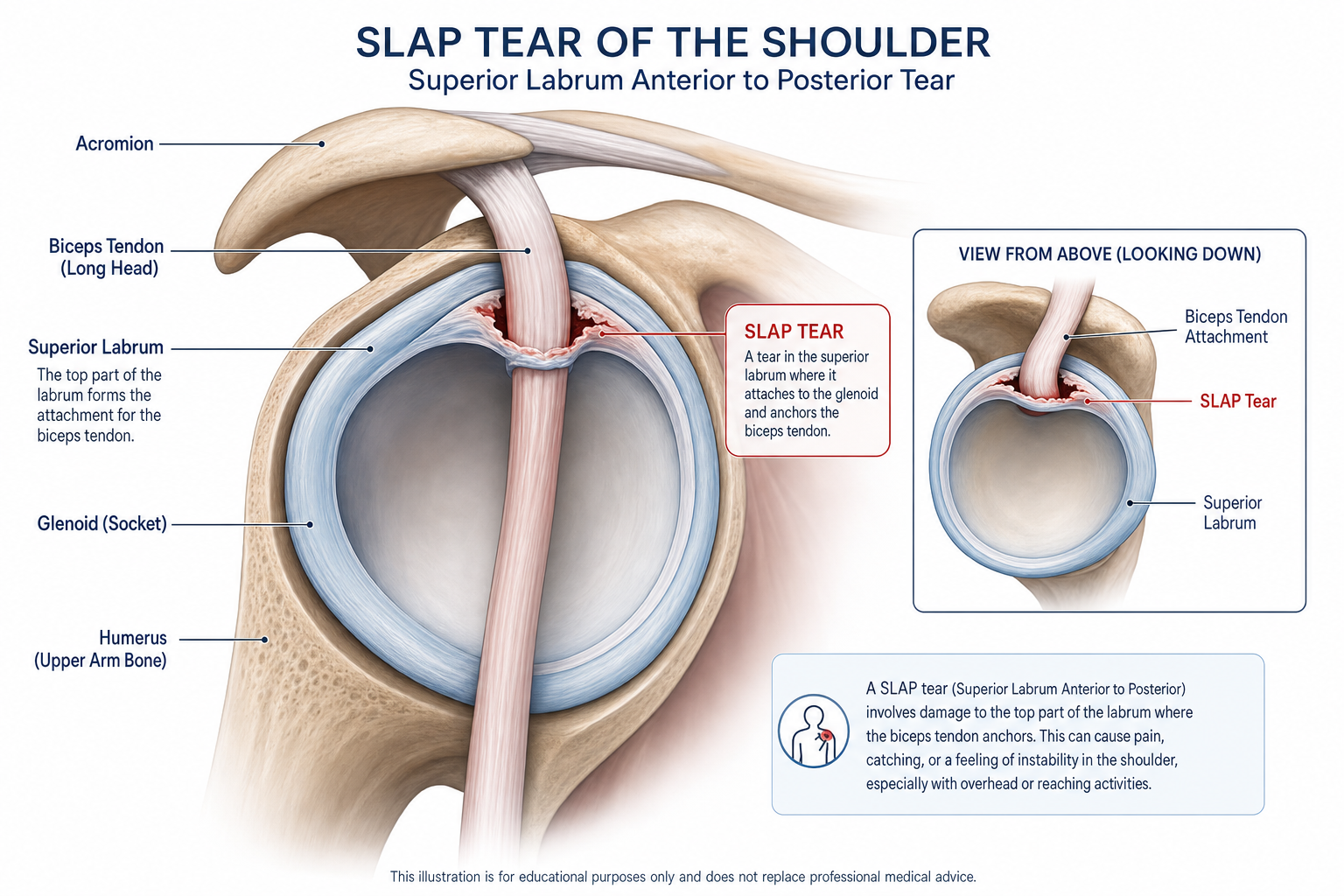
SLAP stands for Superior Labrum Anterior to Posterior — a description of where the tear occurs in the shoulder joint. The labrum is a ring of fibrocartilage that deepens the shoulder socket and provides stability. At the top of this ring, the long head of the biceps tendon attaches to the bone. When this anchor is torn or frayed, the result is a SLAP tear.
Overhead athletes are particularly vulnerable because the repetitive motion of throwing, serving, or swimming places enormous rotational stress on the biceps anchor. A single traumatic event — such as a fall on an outstretched arm or a sudden pull — can also cause a SLAP tear in non-athletes. According to OrthoInfo from the American Academy of Orthopaedic Surgeons, SLAP tears are classified into several types based on the extent and pattern of the labral damage, which influences treatment decisions.
If you are experiencing deep shoulder pain with overhead activity, schedule a consultation at Varma Shoulder Institute to determine whether a SLAP tear may be the cause.
Symptoms of a SLAP Tear in Throwers, Tennis Players, and Active Adults
SLAP tear symptoms can be subtle at first, which is why many patients delay seeking care. Common signs include:
- A deep aching pain in the front or top of the shoulder, especially with overhead motion
- A catching, clicking, or popping sensation inside the joint
- Decreased throwing velocity or loss of control in pitchers
- Pain when reaching across the body or lifting objects away from the side
- A sense of shoulder instability or “dead arm” feeling in throwers
- Biceps tendon pain or cramping with resisted elbow flexion
Because these symptoms overlap with rotator cuff impingement, biceps tendinitis, and shoulder instability, a thorough clinical evaluation is essential. Self-diagnosis based on symptoms alone is unreliable and can lead to delayed or incorrect treatment.
How a Shoulder Specialist Diagnoses a SLAP Tear
Diagnosing a SLAP tear requires a combination of physical examination maneuvers and advanced imaging. During a clinical exam, a shoulder specialist will perform tests such as the O’Brien active compression test, the Speed test, and the anterior slide test to assess the integrity of the biceps anchor and labrum.
MRI with intra-articular contrast (MR arthrogram) is the gold standard imaging study for SLAP tears, providing detailed visualization of the labral tissue and biceps anchor. Standard MRI without contrast may miss partial or subtle tears. In some cases, the diagnosis is confirmed during diagnostic arthroscopy when the joint is directly visualized.
At Varma Shoulder Institute, double-fellowship-trained shoulder surgeon Dr. Amit Varma — who completed fellowships at the Rothman Institute under Dr. Michael Ciccotti and the Andrews Institute under Dr. James Andrews — conducts a comprehensive evaluation to confirm the diagnosis and rule out concurrent injuries such as rotator cuff tears or shoulder instability.
When Shoulder Arthroscopy Is Recommended for a SLAP Tear
Not every SLAP tear requires surgery. Many patients, particularly those with low-grade tears or minimal mechanical symptoms, respond well to a structured physical therapy program focused on rotator cuff strengthening, scapular stabilization, and posterior capsule stretching. Conservative treatment is typically attempted for a minimum of three to six months before surgery is considered.
Shoulder arthroscopy for SLAP tears is generally recommended when:
- Conservative treatment has failed to relieve symptoms after an adequate trial
- The patient is a competitive overhead athlete who needs to return to high-level throwing or serving
- Imaging and clinical findings confirm a high-grade or unstable SLAP tear
- Mechanical symptoms (catching, locking) are significantly limiting daily function
- A concurrent injury such as a partial rotator cuff tear is present and requires arthroscopic treatment
What Happens During Arthroscopic SLAP Surgery
Arthroscopic SLAP repair is performed under general or regional anesthesia as an outpatient procedure. The surgeon makes two to four small incisions around the shoulder joint, inserts a small camera (arthroscope), and uses specialized instruments to visualize and repair the torn labrum.
During the procedure, the surgeon cleans up any frayed tissue, then reattaches the labrum to the glenoid rim using small suture anchors. These anchors are placed directly into the bone and hold the repaired tissue in position while it heals. The entire procedure typically takes one to two hours, and most patients go home the same day.
For more information on what arthroscopic shoulder surgery involves, OrthoInfo provides a detailed patient guide to shoulder arthroscopy that covers the procedure, anesthesia, and what to expect in the recovery room.
SLAP Repair vs Biceps Tenodesis: Which Option Fits the Patient
One of the most important decisions in treating a SLAP tear is whether to repair the labrum directly or to perform a biceps tenodesis — a procedure in which the biceps tendon is detached from its labral anchor and reattached to the humerus (upper arm bone) at a lower point, effectively eliminating the painful anchor site.
Arthroscopic SLAP repair is generally preferred for younger, competitive overhead athletes who need to preserve the natural biomechanics of the throwing shoulder. Biceps tenodesis is often a better choice for patients over 35 to 40, recreational athletes, or those with significant biceps tendon degeneration alongside the SLAP tear. The American Shoulder and Elbow Surgeons recognize both procedures as established treatments, with the optimal choice depending on patient age, activity demands, and tear characteristics.
Our team at Varma Shoulder Institute discusses both options in detail during the consultation, ensuring each patient understands the trade-offs before making a decision. To explore your options with a specialist, contact our Clermont shoulder team to book your evaluation.
Recovery Timeline After Shoulder Arthroscopy for SLAP Tears
Recovery after arthroscopic SLAP repair follows a structured, phased approach. While individual timelines vary based on the extent of the repair and the patient’s overall health, a general framework looks like this:
- Weeks 0 to 4: The arm is kept in a sling. Gentle pendulum exercises and elbow/wrist range-of-motion work begin early to prevent stiffness.
- Weeks 4 to 8: The sling is discontinued. Passive and active-assisted shoulder range-of-motion exercises begin under physical therapy guidance.
- Weeks 8 to 16: Progressive strengthening of the rotator cuff and scapular stabilizers. Overhead motion is gradually restored.
- Months 4 to 6: Sport-specific training begins for non-throwing athletes. Throwing athletes begin an interval throwing program.
- Months 6 to 12: Full return to competitive overhead sport for most patients who complete rehabilitation successfully.
Adherence to the physical therapy program is the single most important factor in achieving a full recovery. Patients who rush the return-to-sport timeline risk re-injury or incomplete healing of the repaired labrum.
Return to Throwing, Tennis, and Sports After Surgery
Return to overhead sport after arthroscopic SLAP repair is a gradual, milestone-based process. Pitchers and tennis players typically begin an interval throwing or hitting program between months four and six, progressing from short-distance, low-intensity throws to full-effort competitive throwing over several months.
Key benchmarks before returning to sport include full, pain-free range of motion, symmetric rotator cuff strength compared to the uninjured side, and the ability to perform sport-specific movements without pain or apprehension. Research published through PubMed supports a structured, criteria-based return-to-sport protocol rather than a fixed time-based approach for overhead athletes following labral repair.
Swimmers, volleyball players, and other overhead athletes follow similar principles, with sport-specific progressions designed in collaboration with the treating physical therapist and the surgical team.
Risks, Outcomes, and When to Seek a Shoulder Consultation
Arthroscopic SLAP repair is generally a safe procedure with a low complication rate when performed by an experienced shoulder surgeon. Potential risks include infection, stiffness (loss of external rotation), re-tear of the repaired labrum, and, in rare cases, nerve or blood vessel injury. Stiffness is one of the more common concerns after SLAP repair, which is why early range-of-motion work under physical therapy supervision is emphasized.
Outcomes are generally favorable for younger patients with isolated SLAP tears who undergo surgery and complete rehabilitation. Older patients or those with concurrent shoulder pathology may have more variable results, which is one reason biceps tenodesis is often preferred in that population. For a broader overview of shoulder conditions and treatment options, OrthoInfo’s shoulder pain resource provides reliable patient education.
If you have been experiencing persistent shoulder pain with overhead activity, a catching or clicking sensation in the joint, or a loss of throwing velocity, a consultation with a shoulder specialist is the appropriate next step. Varma Shoulder Institute provides arthroscopic SLAP repair and comprehensive shoulder care for patients throughout Clermont, Orlando, and Central Florida, with same-week consultation appointments available.
Patient Scenario: When Conservative Care Isn’t Enough
Common Mistakes Patients Make with SLAP Tears
Avoiding these common errors can significantly improve outcomes for patients with SLAP tears:
- Delaying evaluation: Waiting months or years before seeing a specialist allows the tear to worsen and can complicate surgical repair.
- Self-diagnosing based on internet searches: SLAP tear symptoms overlap with many other shoulder conditions. Accurate diagnosis requires imaging and clinical examination.
- Skipping physical therapy before surgery: Many SLAP tears respond to conservative treatment. Bypassing this step may lead to unnecessary surgery.
- Returning to sport too early after surgery: Rushing the return-to-throwing timeline before the labrum has healed is a leading cause of re-injury.
- Ignoring concurrent injuries: SLAP tears often occur alongside rotator cuff pathology or shoulder instability. Treating only the SLAP tear without addressing related problems can lead to incomplete recovery.
- Choosing a surgeon without shoulder-specific expertise: SLAP repair and biceps tenodesis require specialized training. Seek care from a fellowship-trained shoulder surgeon.
Practical Next Steps
If you suspect a SLAP tear or have already received a diagnosis and are weighing your treatment options, here is how to move forward:
- Schedule a shoulder evaluation. A clinical examination and MR arthrogram are the starting point for an accurate diagnosis.
- Discuss non-surgical options first. Physical therapy is appropriate for many SLAP tears and should be attempted before considering surgery.
- Ask about both repair and tenodesis. Understanding the trade-offs between arthroscopic SLAP repair and biceps tenodesis helps you make an informed decision with your surgeon.
- Commit to the rehabilitation program. Surgery is only part of the equation — structured physical therapy is essential for a full return to sport.
- Seek a second opinion if uncertain. Varma Shoulder Institute offers second-opinion consultations within 48 hours for patients who want additional perspective on their diagnosis or treatment plan.
Frequently Asked Questions
What is a SLAP tear and how is it different from a rotator cuff tear?
A SLAP tear involves the superior labrum — the cartilage ring at the top of the shoulder socket — and the biceps tendon anchor. A rotator cuff tear involves the tendons of the four muscles that stabilize and move the shoulder. Both can cause shoulder pain and weakness, but they affect different structures and may require different treatments.
Can a SLAP tear heal without surgery?
Many SLAP tears, particularly low-grade or partial tears, can improve significantly with physical therapy, activity modification, and anti-inflammatory treatment. Surgery is typically reserved for patients who fail conservative care or who have high-grade tears with significant mechanical symptoms.
How long does recovery take after arthroscopic SLAP repair?
Most patients wear a sling for four to six weeks after surgery and begin physical therapy shortly after. Return to overhead sport typically occurs between six and twelve months, depending on the extent of the repair and the demands of the sport.
What is the difference between SLAP repair and biceps tenodesis?
SLAP repair reattaches the torn labrum to the glenoid rim using suture anchors, preserving the natural biceps anchor. Biceps tenodesis detaches the biceps tendon from the labrum and reattaches it lower on the humerus, eliminating the painful anchor site. Tenodesis is often preferred for older or recreational athletes, while repair is more common in younger competitive throwers.
Is shoulder arthroscopy for SLAP tears performed as an outpatient procedure?
Yes. Arthroscopic SLAP repair is typically performed as an outpatient procedure, meaning most patients go home the same day. The surgery is performed under general or regional anesthesia and usually takes one to two hours.
How do I know if I need a SLAP tear evaluation at Varma Shoulder Institute?
If you are experiencing deep shoulder pain with overhead activity, a clicking or catching sensation in the joint, or a loss of throwing velocity that has not improved with rest, you should schedule an evaluation. Dr. Varma at Varma Shoulder Institute offers same-week appointments and can confirm whether a SLAP tear is present and recommend the appropriate treatment. Call (352) 404-8956 to book.
Does Varma Shoulder Institute accept insurance for SLAP tear surgery consultations?
Yes. Varma Shoulder Institute accepts Aetna, Cigna, Florida Blue/BCBS, UnitedHealthcare, Medicare, Tricare, and self-pay. Contact the office at (352) 404-8956 or info@varmashoulderinstitute.com to verify your specific benefits before scheduling.
Update Log
- May 2026: Article reviewed and updated to reflect current arthroscopic SLAP repair and biceps tenodesis decision-making guidelines, recovery protocols, and return-to-sport criteria for overhead athletes.