

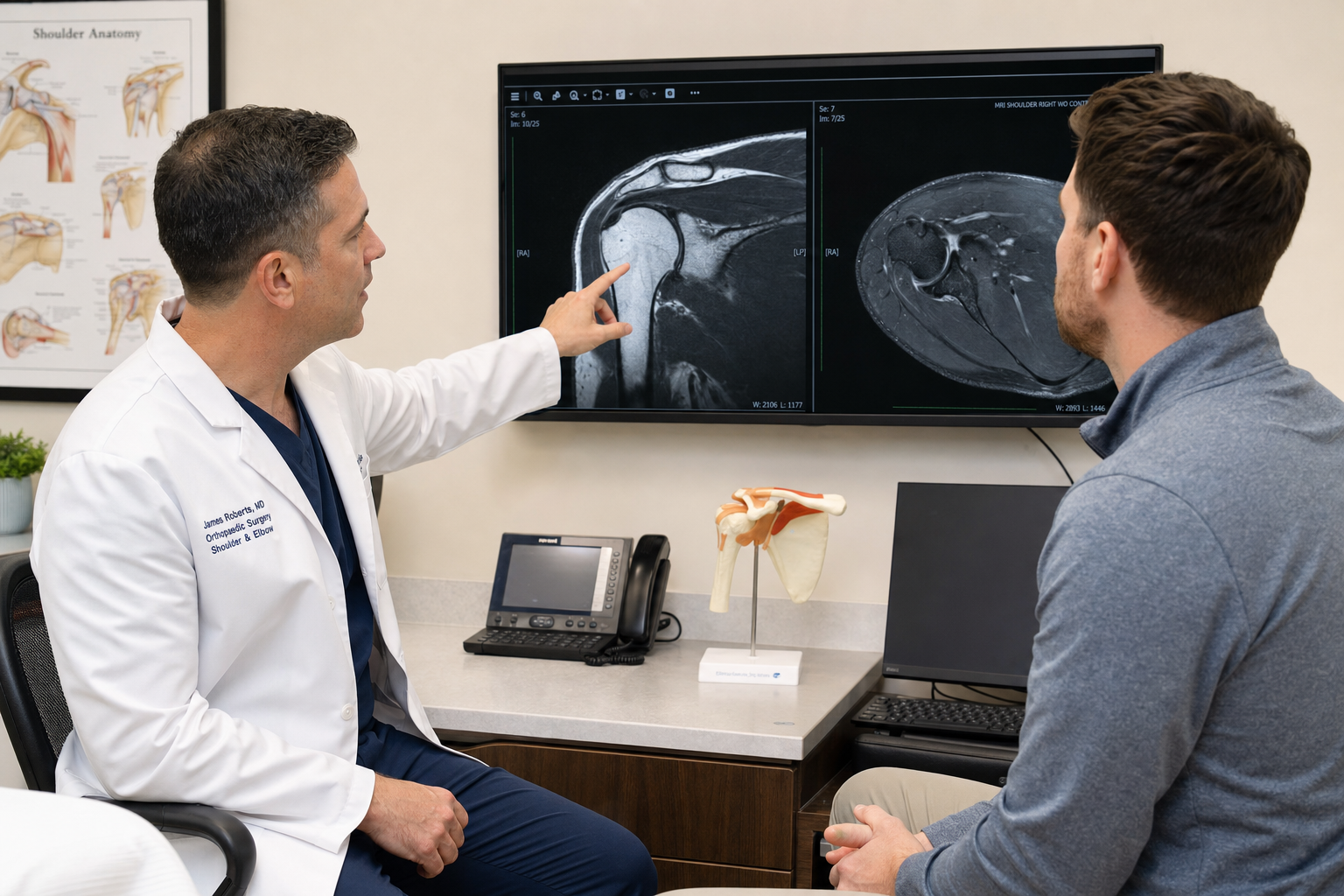
Shoulder MRI Results: When a Second Opinion Helps
A shoulder MRI second opinion can be one of the most valuable steps you take before committing to — or ruling out — surgery. MRI reports are detailed, technical documents, and interpreting them in the context of your symptoms, physical exam, and activity goals requires specialized expertise. At Varma Shoulder Institute, we help patients throughout Clermont and Central Florida understand exactly what their imaging means and what their real options are.
Shoulder MRI reports are written for radiologists and referring physicians, not for patients. When you receive a report filled with terms like “partial-thickness articular-sided tear,” “posterior labral fraying,” or “subacromial edema,” it is natural to feel uncertain about what comes next. The goal of this guide is to help you understand when seeking a shoulder MRI second opinion makes sense — and what that process looks like at a dedicated shoulder specialty practice.
Why Shoulder MRI Results Can Be Confusing
Shoulder MRI reports describe what the radiologist sees in the images, but they do not tell you whether those findings are causing your pain, how severe your functional limitation is, or whether you need surgery. A radiologist’s job is to document anatomy — not to create a treatment plan. That interpretation step requires a clinician who can combine imaging findings with your history, physical examination, and personal goals.
It is also common for two radiologists to describe the same MRI differently, or for a general orthopedic surgeon and a shoulder specialist to reach different conclusions about the same report. This is not a sign that something has gone wrong — it reflects the genuine complexity of shoulder pathology and the importance of subspecialty expertise. If you have received a shoulder MRI and feel uncertain about what it means, scheduling a shoulder second opinion consultation is a reasonable and proactive next step.
What an MRI Shows and What It Cannot Tell Us
An MRI provides detailed images of the soft tissues in and around your shoulder — including the rotator cuff tendons, labrum, biceps tendon, bursa, and cartilage. It can reveal tears, inflammation, fluid accumulation, and structural changes that do not appear on standard X-rays.
However, MRI has important limitations. It cannot directly measure your pain level, your functional strength, or how much a finding is actually affecting your daily life. Incidental findings — abnormalities visible on imaging that are not causing symptoms — are common, particularly in patients over 40. According to OrthoInfo from the American Academy of Orthopaedic Surgeons, rotator cuff tears are frequently found on imaging in people who have no shoulder pain at all. This is why a thorough physical examination by a shoulder specialist is essential before any treatment decision is made.
Common Shoulder MRI Findings That Often Raise Questions
Several MRI findings tend to generate the most confusion and anxiety for patients:
- Partial-thickness rotator cuff tears: These involve damage to part of a tendon but not a complete rupture. Treatment ranges from physical therapy and activity modification to arthroscopic repair, depending on tear size, location, and symptoms.
- Full-thickness rotator cuff tears: A complete tear through the tendon. Surgical repair is often considered, but not always required — particularly in older, lower-demand patients with manageable symptoms.
- Labral tears (SLAP tears): Tears of the cartilage ring around the shoulder socket. As noted by OrthoInfo on SLAP tears, many labral injuries respond well to non-surgical treatment, especially in patients who are not overhead athletes.
- Shoulder impingement / rotator cuff tendinitis: Inflammation and irritation of the rotator cuff tendons, often manageable without surgery.
- Shoulder arthritis: Degenerative joint changes that may or may not correlate with pain severity.
Each of these findings exists on a spectrum, and the appropriate response depends heavily on the clinical picture — not the MRI report alone.
When a Second Opinion Is Most Helpful
A shoulder MRI second opinion is particularly valuable in these situations:
- You have been told you need surgery but your symptoms feel manageable or have been improving.
- You have received different recommendations from two different providers and are not sure which path to follow.
- Your MRI report describes findings that sound serious, but your treating physician has not explained what they mean for your specific situation.
- You have been told surgery is not needed, but your pain and functional limitations are significantly affecting your quality of life.
- You are an athlete or active individual and want to understand all options before committing to a treatment plan.
Why Different Doctors May Recommend Different Treatments
It is not unusual for a general orthopedic surgeon, a sports medicine physician, and a shoulder subspecialist to look at the same MRI and reach different conclusions. This happens for several legitimate reasons: differences in training and subspecialty focus, differences in how aggressively a provider approaches surgical intervention, and differences in how much weight each clinician places on imaging versus clinical examination findings.
A shoulder subspecialist who performs shoulder surgery as the primary focus of their practice will typically have a more nuanced view of which findings warrant intervention and which do not. This is not a criticism of general orthopedic care — it simply reflects the value of subspecialty expertise when the decision is complex or the stakes are high.
What to Bring to a Shoulder Second Opinion Appointment
To get the most out of a second opinion visit, bring the following:
- Your actual MRI images on a CD or digital file — not just the written radiology report. The specialist needs to review the images directly.
- Any prior X-rays of the affected shoulder.
- A summary of your symptoms: when they started, what makes them better or worse, and how they affect your daily activities.
- A list of treatments you have already tried: physical therapy, injections, medications, and their outcomes.
- Any prior surgical records if you have had previous shoulder procedures.
- Your insurance card and a list of current medications.
Coming prepared allows the specialist to spend the appointment time on analysis and discussion rather than gathering background information.
How a Shoulder Specialist Reviews MRI Findings in Context
At Varma Shoulder Institute, our approach to reviewing MRI findings goes well beyond reading the radiology report. Double-fellowship-trained shoulder surgeon Dr. Amit Varma — who completed fellowships at the Rothman Institute under Dr. Michael Ciccotti and the Andrews Institute under Dr. James Andrews — reviews the actual MRI sequences directly, correlates them with a hands-on physical examination, and discusses your functional goals and activity level before forming any recommendation.
This integrated approach means that a finding like a partial rotator cuff tear is evaluated not just as an anatomical observation, but as a clinical problem: Is it causing your specific symptoms? Is it likely to progress? Would repair change your outcome meaningfully? These are the questions that determine whether surgery is the right answer — and they cannot be answered by imaging alone. You can schedule an evaluation with our Clermont shoulder team to get this level of individualized review.
When Surgery May Help and When Non-Surgical Care May Be Better
Not every MRI finding requires surgery, and not every painful shoulder can be resolved without it. The decision depends on a combination of factors: the type and severity of the structural problem, how long symptoms have been present, whether conservative treatment has been tried and failed, and what the patient’s functional goals are.
According to OrthoInfo on shoulder impingement and rotator cuff tendinitis, many patients with rotator cuff-related pain improve significantly with a structured physical therapy program, activity modification, and anti-inflammatory treatment. Surgery becomes a stronger consideration when conservative measures have been given adequate time and have not produced meaningful improvement, or when the structural damage is severe enough that non-surgical care is unlikely to restore function.
Questions to Ask Before Making a Treatment Decision
Before agreeing to surgery — or deciding against it — consider asking your provider these questions:
- Is this MRI finding definitely causing my symptoms, or could it be incidental?
- What happens if I choose non-surgical treatment first? What is the risk of waiting?
- If surgery is recommended, what type of procedure would be performed and why?
- What does recovery look like, and how long before I return to my normal activities?
- What are the risks if I do not have surgery?
- How many shoulder procedures of this type do you perform each year?
A confident, experienced shoulder specialist will welcome these questions and provide clear, specific answers. If you feel your questions are being dismissed or your concerns are not being addressed, that is another reason to seek a second opinion.
Getting a Shoulder Second Opinion in Clermont and Central Florida
Varma Shoulder Institute provides shoulder second opinion consultations for patients throughout Clermont, Orlando, and Central Florida. We offer second opinions within 48 hours for patients who need timely clarity before making a treatment decision. Our team accepts Aetna, Cigna, Florida Blue/BCBS, UnitedHealthcare, Medicare, Tricare, and self-pay, and same-week appointments are available.
At Varma Shoulder Institute, we understand that receiving an MRI report with unfamiliar findings can be stressful. Our goal in every second opinion consultation is to give you a clear, honest assessment — whether that confirms a prior recommendation, suggests a different approach, or simply provides the reassurance that your current treatment plan is on the right track.
Common Mistakes Patients Make After Receiving MRI Results
- Acting on the written report alone: The radiology report is a starting point, not a treatment plan. Always have a clinician review the actual images in the context of your symptoms.
- Delaying evaluation because symptoms seem manageable: Some shoulder conditions — particularly large rotator cuff tears — can worsen over time if left untreated, making eventual repair more difficult.
- Assuming surgery is always the answer: Many MRI findings that sound alarming can be managed effectively without surgery, especially with a well-designed physical therapy program.
- Skipping physical therapy after a non-surgical recommendation: Non-surgical treatment only works if it is followed consistently. Skipping prescribed therapy is one of the most common reasons patients fail conservative management unnecessarily.
- Not seeking a second opinion due to cost or time concerns: A second opinion appointment is typically covered by most major insurance plans and can prevent a far more costly mistake — either an unnecessary surgery or a missed diagnosis. Learn more about shoulder and elbow surgery standards from the American Shoulder and Elbow Surgeons.
Practical Steps: What to Do Next
- Gather your MRI images (CD or digital file) and any prior imaging.
- Write down your symptoms, their timeline, and what treatments you have already tried.
- Contact Varma Shoulder Institute at (352) 404-8956 or email info@varmashoulderinstitute.com to request a second opinion appointment.
- Bring your insurance card and a list of current medications to your visit.
- Come prepared with your questions — our team will take the time to answer each one clearly.
Frequently Asked Questions
How do I get a shoulder MRI second opinion?
Contact a shoulder subspecialist directly and request a second opinion consultation. Bring your actual MRI images (not just the written report), any prior X-rays, and a summary of your symptoms and treatments. Varma Shoulder Institute offers second opinions within 48 hours — call (352) 404-8956 to schedule.
Is a shoulder MRI second opinion covered by insurance?
Most major insurance plans, including Medicare, cover second opinion consultations for orthopedic conditions. Varma Shoulder Institute accepts Aetna, Cigna, Florida Blue/BCBS, UnitedHealthcare, Medicare, and Tricare. Verify your specific benefits with your carrier before your appointment.
Can an MRI miss a shoulder problem?
MRI is highly sensitive for soft tissue injuries, but it is not perfect. Some early cartilage changes, small labral tears, or dynamic instability patterns are better assessed through physical examination or additional imaging such as MRI arthrography. A thorough clinical evaluation by a shoulder specialist complements imaging findings.
What does a partial rotator cuff tear on MRI mean for my treatment?
A partial-thickness rotator cuff tear does not automatically require surgery. Many patients improve with physical therapy, activity modification, and targeted injections. Surgical repair is considered when conservative treatment has failed or when the tear is large and significantly affecting function. A shoulder specialist can help determine the right path for your specific situation.
How long does a shoulder second opinion appointment take?
A thorough second opinion consultation typically takes 30 to 60 minutes, including a review of your imaging, a physical examination, and a detailed discussion of your options. At Varma Shoulder Institute, we allocate sufficient time to answer all of your questions before you leave.
Should I get a second opinion before shoulder surgery?
Yes, seeking a second opinion before elective shoulder surgery is a reasonable and widely accepted practice. It helps confirm that surgery is truly indicated, that the proposed procedure is appropriate, and that non-surgical alternatives have been adequately considered. Dr. Varma at Varma Shoulder Institute welcomes patients seeking pre-surgical second opinions.
What is the difference between a radiologist reading an MRI and a shoulder surgeon reviewing it?
A radiologist describes the anatomical findings visible on the images. A shoulder surgeon interprets those findings in the context of your symptoms, physical examination, and functional goals to determine whether and how they should be treated. Both roles are important, but clinical decision-making requires the surgeon’s integrated assessment.
Update Log
- May 2026: Article published by Varma Shoulder Institute. Content reviewed for accuracy against current AAOS guidelines and VSI clinical practice standards. Second opinion availability and insurance acceptance information verified.