

SLAP Tear Surgery vs Rehab for Overhead Athletes
Deciding between SLAP tear shoulder surgery or rehab for overhead athletes is one of the most nuanced choices in sports orthopedics — and getting it right can determine whether a pitcher, tennis player, or volleyball athlete returns to full competition. At Varma Shoulder Institute, we evaluate superior labral tears with a structured, athlete-specific approach so that every treatment plan is matched to the individual’s sport, age, and injury severity. If you are dealing with shoulder pain during throwing or overhead activity, this guide will help you understand your options.
Superior labral tears — commonly called SLAP tears — sit at the intersection of shoulder anatomy and athletic demand. Understanding the injury, the diagnostic process, and the evidence behind each treatment path is essential for any overhead athlete facing this diagnosis.
What Is a SLAP Tear and Why It Matters in Overhead Sports
SLAP stands for Superior Labrum Anterior to Posterior. The labrum is a ring of fibrocartilage that deepens the shoulder socket and serves as the anchor point for the long head of the biceps tendon. When this superior portion tears — either from a single traumatic event or from repetitive overhead stress — the result is a biceps anchor injury that can destabilize the entire throwing mechanism.
Overhead athletes place extraordinary rotational forces on the shoulder during the late-cocking and deceleration phases of throwing, serving, or spiking. These forces concentrate at the superior labrum, making baseball pitchers, tennis players, and volleyball athletes disproportionately susceptible. According to OrthoInfo from the American Academy of Orthopaedic Surgeons, SLAP tears are classified into multiple types based on the extent and pattern of labral involvement, which directly influences treatment decisions.
At Varma Shoulder Institute, we see overhead athletes across Central Florida who have been managing shoulder pain for months before seeking a specialist evaluation. Early, accurate diagnosis is the foundation of an effective treatment plan — whether that plan involves rehab, surgery, or a combination of both. You can schedule a SLAP tear evaluation with our team to get a clear picture of your injury.
Symptoms of a SLAP Tear in Baseball, Tennis, and Volleyball Athletes
SLAP tear symptoms can be subtle and are frequently mistaken for rotator cuff tendinitis or general shoulder impingement. The most common complaints among overhead athletes include:
- A deep aching pain in the front or back of the shoulder, often worsening with overhead activity
- A catching, clicking, or popping sensation during the throwing or serving motion
- Loss of velocity or power in throwing athletes — sometimes called “dead arm”
- Pain at the end range of shoulder external rotation during the late-cocking phase
- Biceps tendon pain or weakness with resisted elbow flexion or forearm supination
These symptoms overlap with several other shoulder conditions, which is why a thorough clinical examination by a fellowship-trained shoulder specialist is essential before any treatment decisions are made. Learn more about common shoulder problems and their symptoms from the AAOS.
How a Shoulder Specialist Diagnoses a Superior Labral Tear
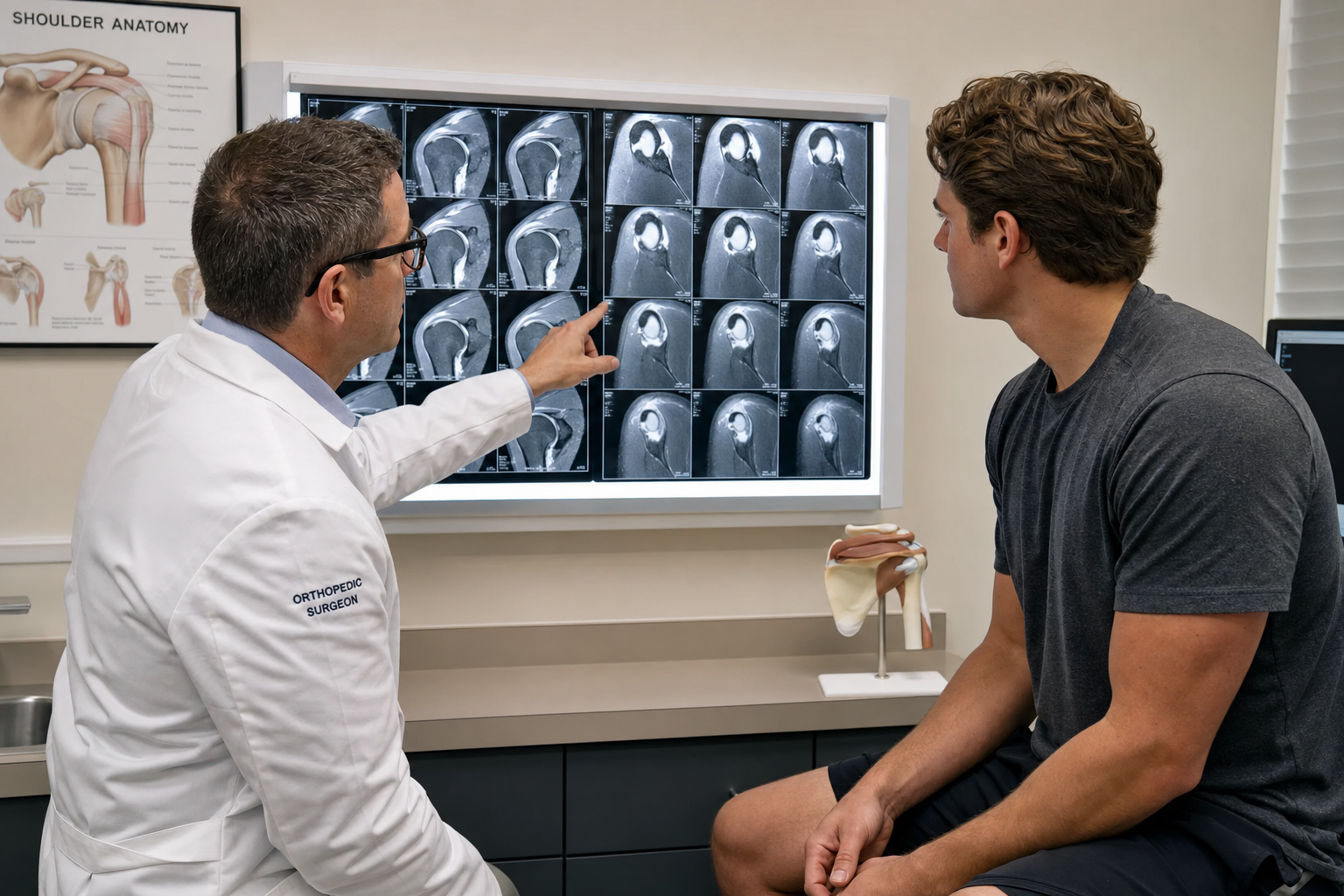
Diagnosing a SLAP tear requires combining a detailed history, physical examination, and advanced imaging. No single clinical test is definitive on its own. Dr. Amit Varma — a double-fellowship-trained shoulder surgeon who completed training at the Rothman Institute and the Andrews Institute — uses a combination of provocative physical exam maneuvers alongside MRI arthrography (MRI with contrast injected into the joint) to characterize the tear pattern and guide treatment planning.
Standard MRI without contrast can miss subtle labral pathology, particularly in athletes with high-grade partial tears. MRI arthrography improves diagnostic accuracy by distending the joint and highlighting labral detachments. In some cases, the definitive diagnosis is only confirmed arthroscopically at the time of surgery.
When Non-Surgical Rehab May Be the Best First Step
Not every SLAP tear requires surgery, and for many overhead athletes — particularly those with lower-grade tears or significant posterior capsule tightness — a structured rehabilitation program is the appropriate first step. Non-surgical SLAP tear rehab for overhead athletes typically focuses on:
- Restoring full glenohumeral internal rotation deficit (GIRD) through posterior capsule stretching
- Strengthening the rotator cuff and periscapular muscles to offload the labrum
- Correcting scapular dyskinesis and thoracic mobility deficits
- Gradual return-to-throwing or return-to-sport progression under therapist supervision
Rehab is most likely to succeed in athletes with Type I or Type II SLAP tears without significant mechanical instability, in recreational athletes whose sport demands are lower, and in older athletes for whom surgical recovery timelines are a significant concern. A well-designed program typically spans three to six months before outcomes are assessed.
When SLAP Tear Surgery Is Recommended for Overhead Athletes
Surgical intervention is typically recommended when a structured non-surgical program has not restored acceptable function after three to six months, when imaging and examination confirm a mechanically unstable tear, or when a competitive overhead athlete requires a reliable return to high-level sport. Specific indications that favor surgery include:
- Type II SLAP tears with confirmed biceps anchor detachment on MRI arthrography
- Persistent “dead arm” or velocity loss despite adequate rehabilitation
- Concurrent rotator cuff pathology requiring arthroscopic treatment
- Younger competitive athletes with high sport-specific demands
Shoulder arthroscopy allows the surgeon to directly visualize the labrum, confirm the tear pattern, and perform the appropriate repair or tenodesis through small incisions. The Arthroscopy Association of North America recognizes arthroscopic labral repair as a well-established technique for superior labral pathology in athletes.
Our team at Varma Shoulder Institute provides arthroscopic SLAP repair and biceps tenodesis for overhead athletes throughout Clermont, Orlando, and Central Florida, with same-week consultation appointments available for athletes who need timely answers.
SLAP Repair vs Biceps Tenodesis: Which Procedure Fits Which Athlete
When surgery is indicated, the choice between SLAP repair and biceps tenodesis is one of the most important decisions in the treatment plan. These two procedures address the same problem — a compromised biceps anchor — through different mechanisms.
SLAP repair reattaches the torn labrum to the glenoid rim using suture anchors, restoring the native anatomy. It is generally preferred in younger competitive throwing athletes (typically under 35) who require the full mechanical function of the superior labrum for high-velocity throwing.
Biceps tenodesis detaches the long head of the biceps from the superior labrum and reattaches it lower on the humerus, eliminating the labral tear as a pain source without repairing the labrum itself. This approach is often preferred in recreational athletes, masters-level competitors, or athletes over 35 where the demands on the superior labrum are lower and the risk of re-tear after repair is higher.
The decision is individualized and depends on age, sport, competitive level, tear pattern, and the presence of associated biceps tendon pathology. You can request a surgical consultation with Dr. Varma to discuss which approach is appropriate for your specific situation.
Recovery Timeline: Rehab, Surgery, and Return to Sport
Recovery timelines differ substantially between non-surgical and surgical pathways, and athletes should plan accordingly before committing to a treatment approach.
Non-surgical rehab pathway: A structured program typically runs three to six months. Athletes who respond well may begin a sport-specific return-to-throwing or return-to-overhead program at the three-month mark, with full return to competition possible by four to six months if progress is consistent.
SLAP repair (surgical): Following arthroscopic repair, the shoulder is typically immobilized for four to six weeks. Formal physical therapy begins shortly after, with a return-to-throwing program starting around four to five months post-operatively. Full return to competitive overhead sport generally requires nine to twelve months.
Biceps tenodesis (surgical): Recovery is often somewhat faster than SLAP repair, with return-to-sport timelines in the range of six to nine months for most overhead athletes, depending on sport demands and individual healing.
For peer-reviewed context on shoulder labral conditions and treatment, the PubMed database contains extensive research on SLAP tear outcomes across both surgical and non-surgical pathways.
How to Decide Between SLAP Tear Surgery and Rehab in Clermont
The decision between SLAP tear surgery and rehab is not one-size-fits-all. The right path depends on your age, sport, competitive level, tear type, and how your shoulder has responded to any prior treatment. At Varma Shoulder Institute, we walk every overhead athlete through a structured decision-making process that includes a thorough physical examination, review of imaging, and an honest conversation about realistic outcomes for each pathway.
We do not default to surgery, and we do not delay necessary intervention. Our goal is to match the treatment to the athlete — not the other way around. Same-week appointments are available, and we offer second opinions within 48 hours for athletes who have already received a diagnosis elsewhere and want expert confirmation before proceeding.
Common Mistakes Overhead Athletes Make with SLAP Tears
Avoiding these errors can significantly improve outcomes regardless of whether you pursue surgical or non-surgical treatment:
- Delaying evaluation: Continuing to throw or compete through significant shoulder pain allows compensatory movement patterns to develop, which can complicate both rehab and surgical recovery.
- Accepting a generic diagnosis: “Shoulder tendinitis” or “rotator cuff irritation” are not the same as a SLAP tear. If overhead pain persists beyond four to six weeks, imaging and a specialist evaluation are warranted.
- Skipping the full rehab program: Athletes who return to sport before completing a structured return-to-throwing progression — whether after rehab or surgery — face a significantly higher risk of re-injury.
- Choosing surgery prematurely: For many athletes, especially recreational players, a well-executed non-surgical program produces excellent results. Surgery carries real recovery demands and should not be the default first step.
- Ignoring the kinetic chain: SLAP tears in throwers are often linked to hip, core, or lower extremity deficits that increase shoulder load. Rehab that addresses only the shoulder frequently produces incomplete results.
Practical Next Steps: Getting Your SLAP Tear Evaluated
If you are an overhead athlete experiencing shoulder pain, catching, or loss of velocity, the most important next step is an accurate diagnosis from a fellowship-trained shoulder specialist. Bring any prior imaging, describe your sport and position, and be prepared to discuss how long symptoms have been present and what activities aggravate them.
At Varma Shoulder Institute, we offer same-week appointments for overhead athletes who need timely answers. Call (352) 404-8956 or request an appointment online. Second opinions are available within 48 hours for athletes who have already received a SLAP tear diagnosis and want expert confirmation before committing to a treatment plan.
For additional background on shoulder arthroscopy as a treatment approach, OrthoInfo provides a thorough patient-friendly overview of what the procedure involves and what to expect.
Frequently Asked Questions
Can a SLAP tear heal without surgery?
Some SLAP tears — particularly lower-grade tears without significant mechanical instability — can improve substantially with structured physical therapy. However, high-grade tears with biceps anchor detachment in competitive overhead athletes often require surgical intervention to restore full function.
How long does SLAP tear surgery recovery take for a baseball pitcher?
Return to competitive pitching after arthroscopic SLAP repair typically requires nine to twelve months, including immobilization, formal physical therapy, and a structured return-to-throwing program. Individual timelines vary based on tear severity and surgical findings.
What is the difference between SLAP repair and biceps tenodesis?
SLAP repair reattaches the torn labrum to the glenoid using suture anchors, preserving native anatomy. Biceps tenodesis relocates the biceps tendon attachment lower on the humerus, eliminating the labral tear as a pain source. The choice depends on age, sport, and tear pattern.
Is MRI enough to diagnose a SLAP tear?
Standard MRI can miss subtle labral pathology. MRI arthrography — MRI with contrast injected into the joint — provides significantly better visualization of the superior labrum and is the preferred imaging study for suspected SLAP tears in overhead athletes.
Can I see Dr. Varma at Varma Shoulder Institute for a SLAP tear second opinion?
Yes. Varma Shoulder Institute offers second opinions within 48 hours for patients who have received a SLAP tear diagnosis and want expert confirmation before proceeding with treatment. Call (352) 404-8956 or request an appointment online.
What sports most commonly cause SLAP tears?
Baseball pitchers, tennis players, volleyball athletes, swimmers, and quarterbacks are among the most commonly affected due to the repetitive high-velocity overhead and throwing motions their sports require. A single traumatic event such as a fall on an outstretched arm can also cause a SLAP tear.
Does Varma Shoulder Institute accept insurance for SLAP tear treatment?
Varma Shoulder Institute accepts Aetna, Cigna, Florida Blue/BCBS, UnitedHealthcare, Medicare, Tricare, and self-pay. Contact our office at (352) 404-8956 to verify your specific benefits before scheduling.
Update Log
- May 2026: Article published covering SLAP tear surgery versus rehab decision-making for overhead athletes, including updated guidance on SLAP repair versus biceps tenodesis selection criteria and return-to-sport timelines.