

Reverse Shoulder Replacement for Rotator Cuff Arthritis Symptoms: A Patient Guide
Reverse shoulder replacement for rotator cuff arthritis symptoms is one of the most important treatment advances in modern shoulder surgery, offering relief to patients who have lost both comfort and function due to end-stage joint damage. At Varma Shoulder Institute in Clermont, Florida, we evaluate and treat patients with rotator cuff tear arthropathy using a precise, individualized approach. If you are experiencing severe shoulder weakness, pain, and limited motion, this guide will help you understand what is happening and what your options are.
What Is Rotator Cuff Arthropathy?
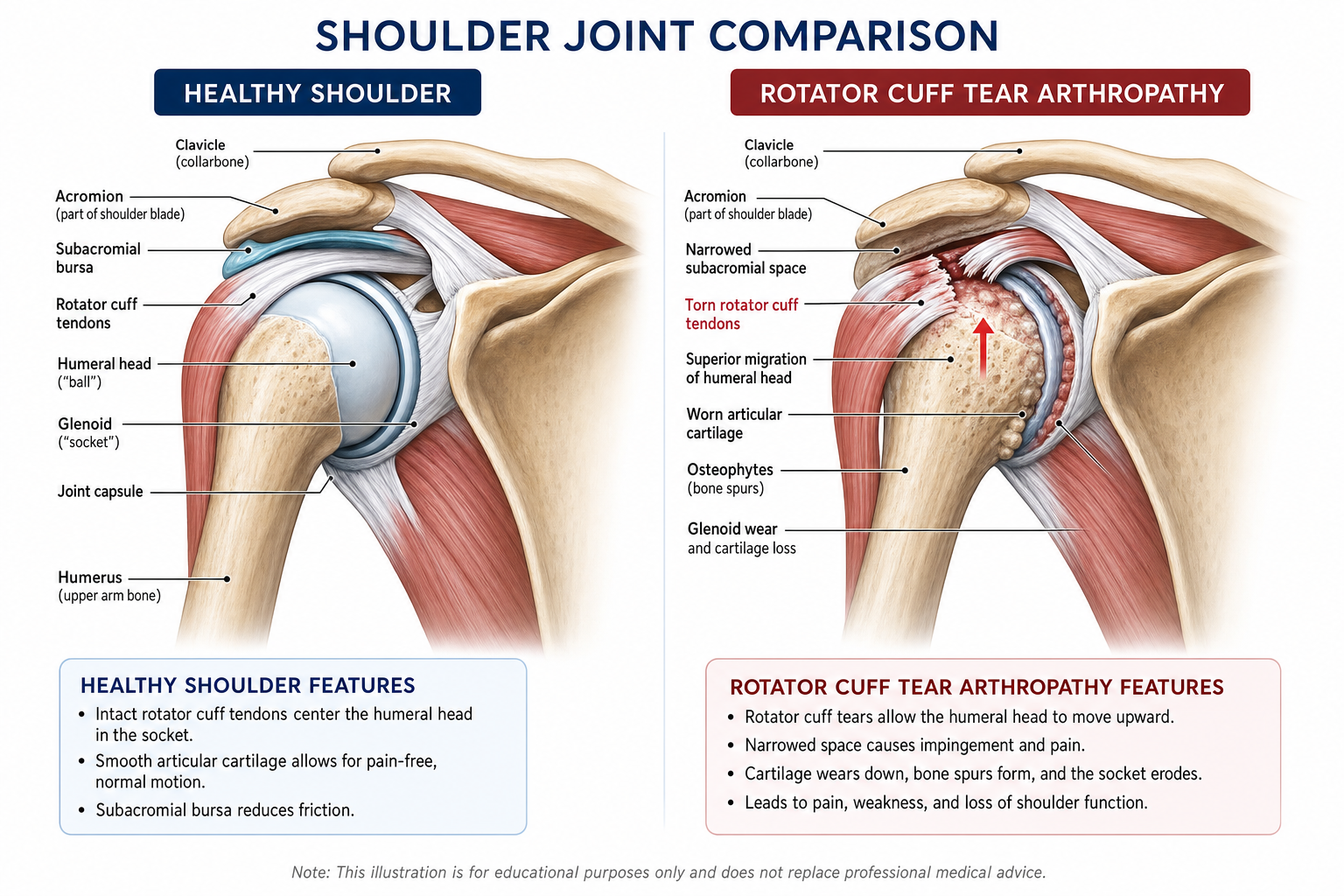
Rotator cuff arthropathy — also called cuff tear arthropathy — is a specific and advanced form of shoulder joint disease. It develops when a massive, long-standing rotator cuff tear allows the humeral head (the ball of the shoulder) to migrate upward and rub abnormally against the acromion and surrounding structures. Over time, this abnormal contact destroys the cartilage lining the joint, leading to a combined condition: both a non-functional rotator cuff and significant arthritis.
This is not the same as ordinary shoulder arthritis. The loss of the rotator cuff changes the entire biomechanics of the shoulder, making standard treatments — including conventional total shoulder replacement — less effective or inappropriate. The American Academy of Orthopaedic Surgeons recognizes rotator cuff tear arthropathy as a distinct clinical entity requiring specialized surgical planning.
At Varma Shoulder Institute, we see patients with this condition who have often been managing symptoms for years before seeking a definitive evaluation. Early recognition of the symptom pattern is critical to preserving function and quality of life.
Symptoms That Suggest Reverse Shoulder Replacement May Be Needed
The symptom profile of rotator cuff arthropathy is distinctive. Patients typically report a combination of the following:
- Severe, constant shoulder pain that is not adequately controlled by anti-inflammatory medications, injections, or physical therapy
- Profound arm weakness — difficulty lifting the arm above waist height, or complete inability to raise the arm overhead
- Pseudoparalysis — the arm hangs at the side and cannot be actively elevated, even though there is no neurological injury
- Grinding or crepitus felt or heard with any shoulder movement
- Loss of sleep due to nighttime shoulder pain
- Functional decline — inability to perform basic daily tasks such as reaching a shelf, dressing, or lifting a cup
Pseudoparalysis of the shoulder is one of the most telling signs. When the rotator cuff is completely non-functional and arthritis has destroyed the joint surface, the deltoid muscle alone cannot generate enough force to lift the arm. This is the mechanical problem that reverse total shoulder arthroplasty is specifically engineered to solve.
If you are experiencing these symptoms, our team at Varma Shoulder Institute encourages you to schedule a consultation rather than continuing to manage pain without a clear diagnosis. Contact Varma Shoulder Institute to arrange a same-week evaluation.
Why Severe Weakness Happens With Cuff Tear Arthropathy
Understanding why the arm becomes so weak helps explain why reverse shoulder replacement works. In a healthy shoulder, the rotator cuff muscles compress the humeral head into the glenoid socket, creating a stable fulcrum. The deltoid muscle then uses that stable base to lift the arm. When the rotator cuff is massively torn and no longer functional, the humeral head escapes upward — there is no stable pivot point for the deltoid to work against. The result is pseudoparalysis: the deltoid contracts but the arm does not rise.
Arthritis compounds the problem. Bone-on-bone contact causes pain that further inhibits muscle activation. The joint becomes stiff, swollen, and mechanically disorganized. At this stage, no amount of physical therapy or injection therapy can restore meaningful function because the underlying structural problem — the absent cuff and destroyed joint — cannot be addressed non-surgically.
Who Is a Good Candidate for Reverse Shoulder Replacement?
Reverse shoulder replacement is not appropriate for every patient with shoulder pain. Candidacy depends on a careful evaluation of several factors:
- Confirmed rotator cuff tear arthropathy — imaging must demonstrate both a massive, irreparable cuff tear and significant glenohumeral arthritis
- Failed conservative treatment — physical therapy, anti-inflammatory medications, and corticosteroid or PRP injections have not provided adequate relief
- Functional limitation — the patient’s daily life is meaningfully impaired by pain and weakness
- Adequate bone stock — sufficient glenoid and humeral bone must be present to support implant fixation
- Medical fitness for surgery — the patient must be healthy enough to undergo general or regional anesthesia and tolerate a rehabilitation program
Age is a consideration but not an absolute barrier. Reverse shoulder replacement has historically been recommended for older, lower-demand patients, though surgical techniques and implant designs continue to evolve. Double-fellowship-trained shoulder surgeon Dr. Amit Varma — who completed training at the Rothman Institute under Dr. Michael Ciccotti and the Andrews Institute under Dr. James Andrews — evaluates each patient individually to determine the most appropriate treatment path.
How Reverse Shoulder Replacement Differs From Other Treatments
Conventional (anatomic) total shoulder replacement replaces the ball and socket with components that mimic normal anatomy. It works well when the rotator cuff is intact. In rotator cuff arthropathy, however, the cuff cannot be restored, so an anatomic replacement would still leave the patient without a functional fulcrum — and pseudoparalysis would persist.
Reverse shoulder replacement solves this by switching the positions of the ball and socket. A metal hemisphere (glenosphere) is fixed to the shoulder blade, and a socket component is placed on the upper arm bone. This geometry moves the center of rotation downward and inward, lengthening the deltoid muscle’s mechanical arm and allowing it to lift the arm without any contribution from the rotator cuff.
Other treatment options — such as arthroscopic debridement, partial cuff repair, or tendon transfer — may be appropriate in earlier-stage disease, but they are generally not effective once true cuff tear arthropathy with pseudoparalysis has developed. The American Shoulder and Elbow Surgeons and orthopedic literature consistently identify reverse total shoulder arthroplasty as the preferred surgical option for this specific condition.
Varma Shoulder Institute provides reverse shoulder replacement for patients throughout Clermont, Orlando, and Central Florida, with same-week consultation appointments available. Schedule your shoulder evaluation to discuss whether this procedure is right for your situation.
What to Expect From Evaluation and Imaging
A thorough evaluation for reverse shoulder replacement begins with a detailed history and physical examination. Dr. Varma assesses active and passive range of motion, strength testing, and specific provocative maneuvers to characterize the degree of functional loss. The presence or absence of pseudoparalysis is documented carefully.
Imaging typically includes:
- X-rays — to assess joint space, humeral head migration, acromion morphology, and bone quality
- MRI — to evaluate the extent of rotator cuff tearing, muscle atrophy, and fatty infiltration of the cuff muscles
- CT scan — sometimes used to assess glenoid bone stock and plan implant positioning
The degree of fatty infiltration of the rotator cuff muscles on MRI is particularly important. Advanced fatty infiltration indicates that the cuff muscles are unlikely to recover function even if a repair were attempted, which supports the decision to proceed with reverse replacement rather than a repair-based approach. The peer-reviewed orthopedic literature consistently uses fatty infiltration grading as part of surgical decision-making for this condition.
Expected Results, Recovery, and Limitations After Surgery
Patients who undergo reverse shoulder replacement for cuff tear arthropathy can generally expect meaningful improvement in pain and the ability to raise the arm. Most patients regain the ability to perform daily activities such as reaching forward, dressing, and light lifting. Pain relief is typically the most consistent outcome.
Recovery involves a structured rehabilitation program. The arm is typically immobilized in a sling for several weeks, followed by a progressive physical therapy program focused on restoring deltoid strength and shoulder motion. Full recovery and return to daily activities generally takes several months, and the timeline varies by individual health status and surgical complexity.
It is important to set realistic expectations. Reverse shoulder replacement is not designed to restore the shoulder to a pre-injury state or to support high-demand overhead athletic activity. Rotation — particularly internal rotation — may remain limited compared to a healthy shoulder. Our team at Varma Shoulder Institute discusses these realistic outcomes with every patient before surgery so that decisions are fully informed.
For more information on what shoulder joint replacement involves, the AAOS OrthoInfo shoulder joint replacement page provides a reliable patient-friendly overview.
When to Schedule a Shoulder Consultation in Clermont
If you have been living with severe shoulder pain, arm weakness, or the inability to raise your arm, do not wait for symptoms to worsen further. Rotator cuff arthropathy is a progressive condition, and delayed evaluation can result in additional bone loss and muscle atrophy that complicates surgical planning.
You should schedule a consultation promptly if you experience any of the following:
- Inability to lift the arm above shoulder height despite trying
- Constant shoulder pain that disrupts sleep
- A known massive rotator cuff tear that has not been surgically addressed
- Prior shoulder surgery that has not resolved your symptoms
- A diagnosis of shoulder arthritis combined with rotator cuff disease
Varma Shoulder Institute offers same-week appointments and second opinions within 48 hours for patients who need timely answers. Call (352) 404-8956 or visit our office in Clermont, FL 34711 to take the next step toward restoring your shoulder function.
Patient Scenario: Recognizing the Right Time for Evaluation
Common Mistakes Patients Make With Cuff Tear Arthropathy
Patients with rotator cuff arthropathy symptoms frequently make decisions that delay appropriate care. The most common mistakes include:
- Attributing all shoulder pain to “normal aging” — while some shoulder changes are age-related, pseudoparalysis and severe functional loss are not normal and warrant evaluation.
- Continuing injections without reassessment — cortisone injections can provide temporary relief but do not address the underlying structural problem. Repeated injections without a clear treatment plan can delay definitive care.
- Avoiding surgery out of fear — reverse shoulder replacement has a well-established track record for this specific condition. Avoiding evaluation based on fear of surgery can result in further bone and muscle deterioration that makes eventual surgery more complex.
- Self-diagnosing based on internet searches — rotator cuff arthropathy requires imaging and clinical examination to diagnose accurately. Symptoms overlap with other conditions, and only a qualified shoulder specialist can determine the correct diagnosis and treatment path.
- Delaying a second opinion — if you have been told nothing can be done, or if your current treatment is not working, a second opinion from a fellowship-trained shoulder surgeon is always appropriate.
Frequently Asked Questions
What is the difference between reverse shoulder replacement and regular shoulder replacement?
In a conventional (anatomic) shoulder replacement, the ball and socket are replaced in their natural positions and the rotator cuff must be intact to function. In a reverse shoulder replacement, the ball and socket positions are switched, allowing the deltoid muscle to power arm elevation without a functioning rotator cuff. This makes reverse replacement the appropriate choice for rotator cuff tear arthropathy.
What does pseudoparalysis of the shoulder mean?
Pseudoparalysis refers to the inability to actively raise the arm despite no neurological injury. It occurs in cuff tear arthropathy when the rotator cuff can no longer stabilize the humeral head, leaving the deltoid without a stable fulcrum to lift the arm. It is one of the key symptoms that may indicate a need for reverse shoulder replacement.
How long does recovery from reverse shoulder replacement take?
Most patients are in a sling for several weeks after surgery, followed by a structured physical therapy program. Meaningful functional improvement is typically seen over three to six months, though full recovery can take up to a year depending on individual factors. Our team at Varma Shoulder Institute provides a personalized rehabilitation plan for every patient.
Is reverse shoulder replacement covered by Medicare or private insurance?
Reverse shoulder replacement is generally covered by Medicare and most major insurance plans when medical necessity criteria are met, including documented failed conservative treatment and appropriate imaging findings. Varma Shoulder Institute accepts Medicare, Aetna, Cigna, Florida Blue/BCBS, UnitedHealthcare, Tricare, and self-pay. Verify your specific benefits directly with your carrier and our office before scheduling.
Can physical therapy fix rotator cuff arthropathy without surgery?
Physical therapy and conservative measures can help manage symptoms in early or moderate rotator cuff disease, but once true cuff tear arthropathy with pseudoparalysis has developed, non-surgical treatment cannot restore the structural integrity of the joint. Surgery is typically the only option that can meaningfully restore arm function at that stage.
How do I know if I need a second opinion about my shoulder?
If your shoulder pain and weakness have not improved with current treatment, if you have been told nothing can be done, or if you have a known massive rotator cuff tear with worsening function, a second opinion is appropriate. Dr. Varma at Varma Shoulder Institute offers second opinions within 48 hours — call (352) 404-8956 to schedule.
Update Log
- May 2026: Article reviewed and updated to reflect current clinical guidance on reverse total shoulder arthroplasty candidacy, imaging criteria, and recovery expectations for patients with rotator cuff tear arthropathy.