


Shoulder Replacement Second Opinion for Arthritis
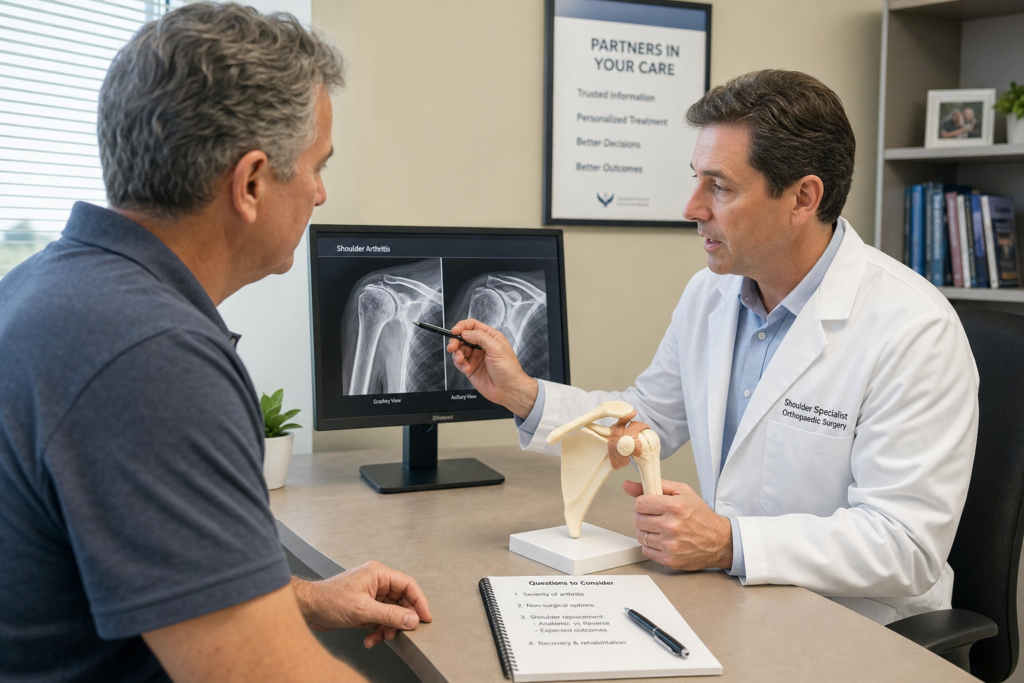
A shoulder replacement second opinion can help confirm whether arthritis is truly the main pain source, whether surgery is the right next step, and which procedure best matches your shoulder anatomy. For patients trying to decide do I need shoulder replacement for arthritis, a focused second-opinion visit is less about repeating the same recommendation and more about verifying diagnosis, cuff status, bone wear, and whether reasonable nonoperative care has already been tried.
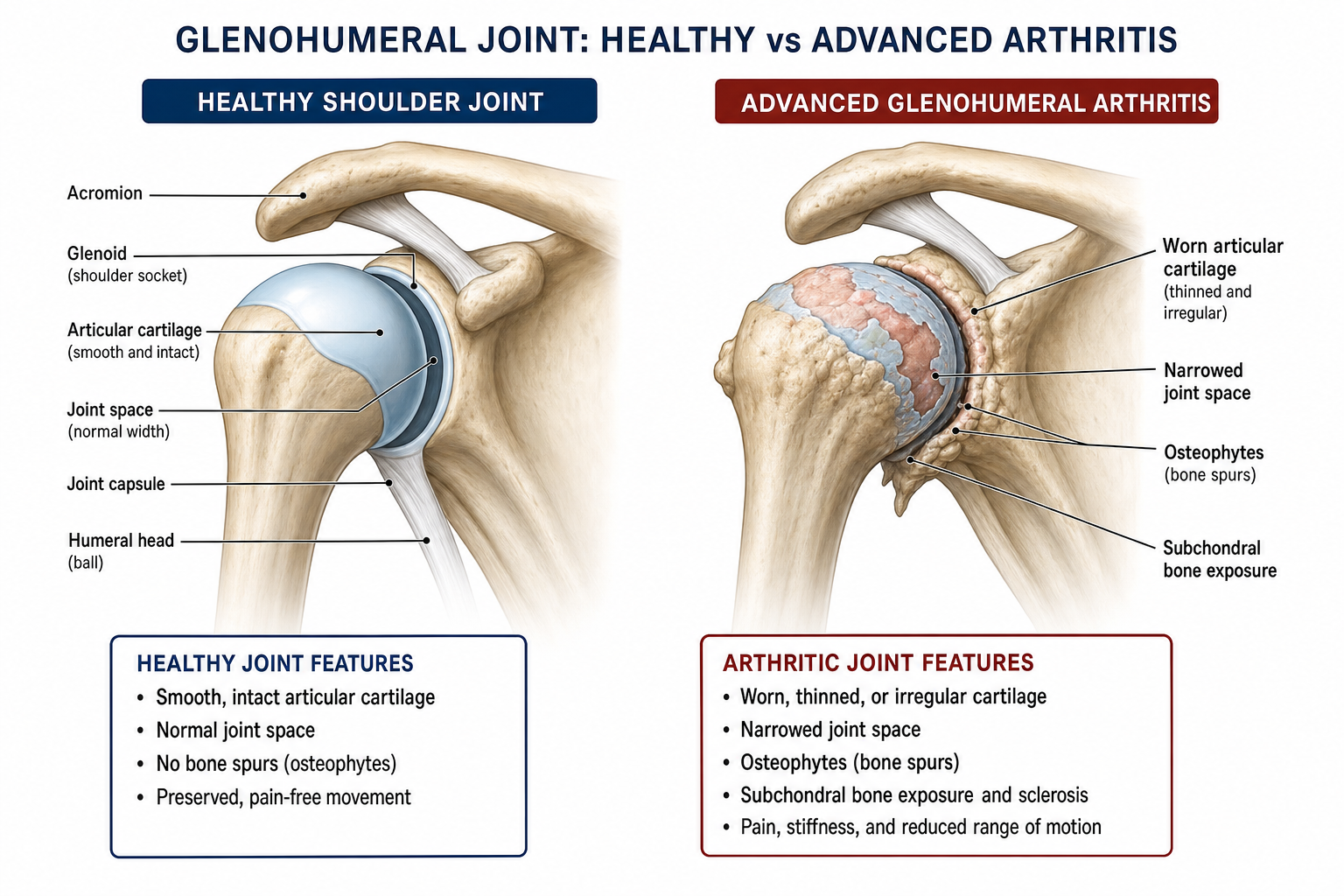
Patients with glenohumeral arthritis are often told they have “bone-on-bone” wear, but that alone does not answer every planning question. A useful shoulder second opinion looks at your symptoms, exam findings, X-rays, and sometimes advanced imaging to see whether the recommendation fits the whole picture. It can also clarify how a replacement plan relates to your shoulder arthritis, activity level, and recovery expectations.
When a Shoulder Replacement Second Opinion Makes Sense
A second opinion before shoulder replacement makes the most sense when you are unsure the pain is coming mainly from arthritis, when the explanation for surgery felt incomplete, or when you were told you need reverse or total shoulder replacement without a clear discussion of why. It is also reasonable when symptoms and imaging do not seem to match, when you have had prior shoulder surgery, or when you want to understand whether nonoperative treatment still has a realistic role.
This article is intentionally narrower than a general shoulder surgery second-opinion page. Its focus is pre-arthroplasty confirmation for arthritis: verifying the diagnosis, deciding whether replacement is appropriate now, and understanding which implant strategy is being recommended. For broader surgical decision support, patients may also find shoulder surgery second opinion helpful.

What a Second Opinion Should Confirm Before Arthritis Surgery
A meaningful shoulder arthroplasty evaluation should confirm more than the presence of arthritis on an X-ray. The AAOS plain-language summary for glenohumeral osteoarthritis notes that diagnosis and planning may involve physical examination, X-rays, and, when needed, MRI, CT, or ultrasound to assess structures around the joint such as the rotator cuff. It also explains that non-surgical treatment is commonly used first and that total shoulder arthroplasty may be considered when nonsurgical treatment does not provide enough pain relief.
A strong second-opinion visit should address:
- Diagnosis confirmation: Is glenohumeral arthritis the main pain generator, or are there overlapping problems such as rotator cuff disease, stiffness, or acromioclavicular joint symptoms?
- Rotator cuff integrity: Is the cuff intact, repairable, chronically deficient, or functioning poorly enough to change implant choice?
- Glenoid wear and bone loss: Does socket wear appear straightforward, or is there deformity that may affect component positioning, fixation, or the need for a different strategy?
- Prior treatment history: Have you already tried a reasonable course of medication, activity modification, shoulder physical therapy, or injection-based treatment?
- Surgical fit: Are your symptoms severe enough, consistent enough, and functionally limiting enough that replacement is likely to address the problem better than continued nonoperative care?
How Surgeons Decide Between Anatomic and Reverse Shoulder Replacement
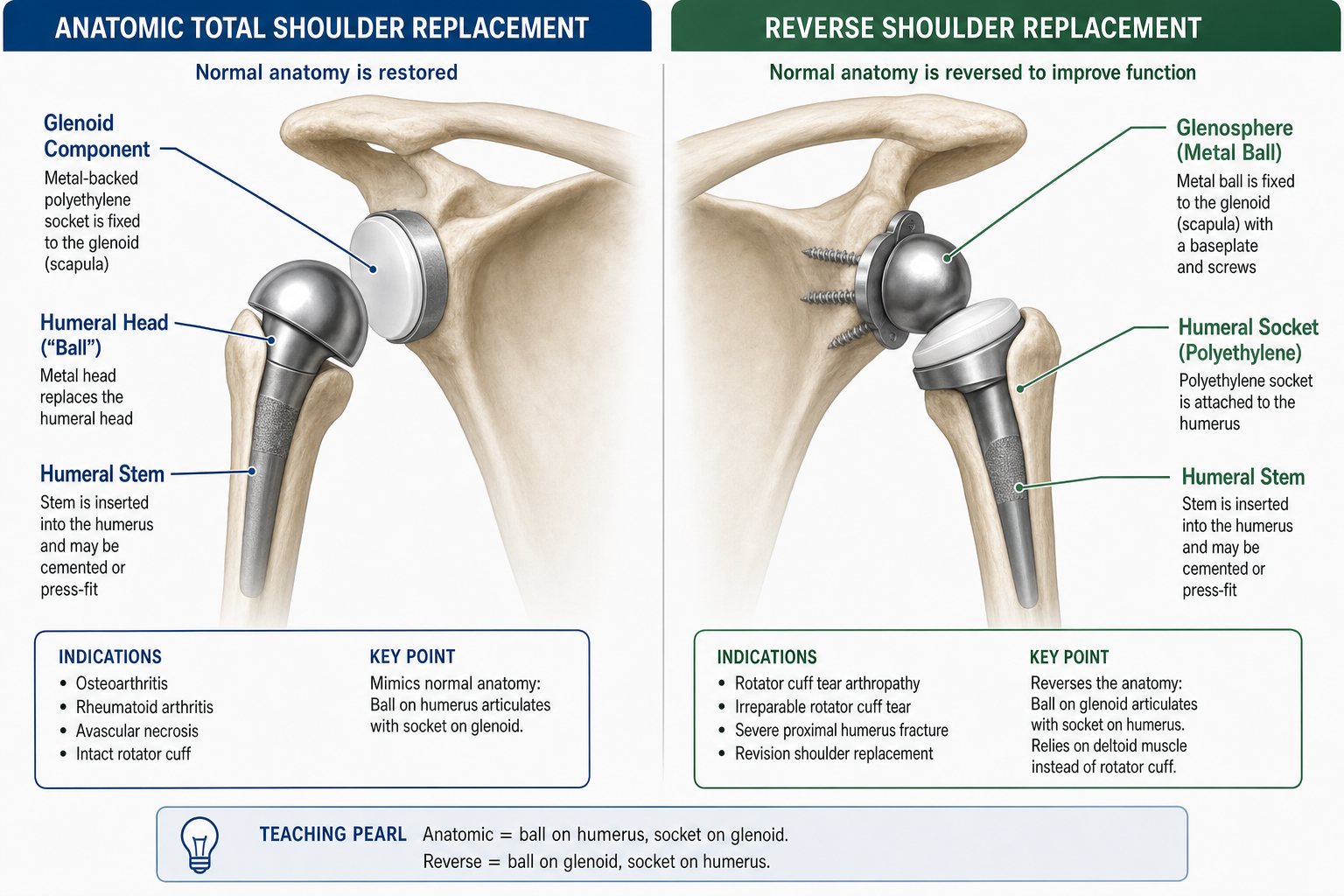
One of the main reasons patients seek a shoulder replacement second opinion for arthritis is to understand the difference between anatomic and reverse shoulder replacement. In simple terms, anatomic total shoulder replacement restores the joint in its usual ball-and-socket orientation and is traditionally used when the rotator cuff is functioning adequately. Reverse shoulder replacement changes that geometry so the deltoid can do more of the work, which can be useful when cuff function is severely compromised or when anatomy and bone wear make reverse a better reconstruction option.
The decision is not based on one detail alone. Surgeons often consider rotator cuff integrity, glenoid wear pattern, bone quality, stiffness, age-related demands, and prior surgery. Recent comparative meta-analyses show this remains an active area of study in cuff-intact osteoarthritis rather than a one-size-fits-all rule. That is one reason a shoulder replacement surgeon may recommend one approach over another even when two patients both have arthritis.
If you were told you need reverse replacement, it is reasonable to ask whether the recommendation is being driven mainly by cuff deficiency, glenoid deformity, prior surgery, instability concerns, or another factor. If you were told you need anatomic replacement, it is reasonable to ask what supports confidence in cuff function and implant durability for your specific case. Patients who want more background can also review reverse shoulder replacement for rotator cuff arthritis symptoms and shoulder replacement for arthritis pain.
When Non-Surgical Treatment Should Still Be Considered
Can shoulder arthritis be treated without replacement surgery first? Often, yes. The AAOS plain-language summary says early management commonly includes activity modification, exercise or physical therapy, acetaminophen or NSAIDs, and sometimes corticosteroid injection for short-term pain relief. It also states that strong evidence supports no benefit from hyaluronic acid injections for glenohumeral osteoarthritis. A review on surgical management similarly notes that patients with ongoing severe pain and functional restriction despite non-operative treatment are the ones more likely to become surgical candidates.
Depending on the case, nonoperative arthritis treatment may include:
- Activity modification and symptom-guided pacing
- Oral medications, if medically appropriate and approved by your treating clinician
- A structured course of physical therapy focused on motion, comfort, and compensatory strength
- Corticosteroid injection for short-term relief in selected patients
- Broader non-surgical shoulder treatment discussions when surgery is not yet clearly the best next step
Evidence for some biologic or complementary options remains limited or mixed in shoulder arthritis. A second opinion should describe that uncertainty clearly instead of implying proven benefit. If your pain is severe, sleep is consistently affected, motion is markedly limited, and conservative care has already been tried without enough relief, the balance may shift toward replacement planning.

Questions to Ask at a Shoulder Replacement Second Opinion Visit
If you are asking, “Should I get a second opinion before shoulder replacement for arthritis?” these questions can help make the visit practical:
- Do my symptoms and exam findings fit glenohumeral arthritis as the main problem?
- How do you know I really need shoulder replacement surgery now rather than later?
- What has to be true anatomically for anatomic replacement to be a good option for me?
- What findings would make reverse shoulder replacement the better choice?
- Do I need additional imaging such as MRI or CT before final planning?
- Have non-surgical treatments been tried enough to say surgery is the next step?
- What are the main risks in my case, including stiffness, instability, or revision risk?
- What would recovery and rehabilitation likely involve for me? See also shoulder replacement recovery timeline.
What Records and Imaging to Bring to Your Appointment
Patients often ask what to bring to a shoulder replacement second opinion visit. The most useful items are:
- Recent shoulder X-rays, ideally with the image disc or portal access if available
- MRI, CT, or ultrasound reports if they were already performed
- Prior operative notes if you have had shoulder surgery before
- Injection records and therapy notes when available
- A medication list and a short timeline of what has and has not helped
- Your written questions, especially if you want help comparing nonoperative care, anatomic replacement, and reverse replacement
If advanced imaging has already raised questions, a separate shoulder MRI second opinion may also help organize the discussion before final surgery planning.
Insurance coverage and out-of-pocket costs vary by plan and circumstance. Verify benefits directly with your insurer and the practice before treatment decisions are finalized.
Red Flags That Suggest You Need a More Detailed Surgical Review
You may need a more detailed surgical review if:
- You were told you need replacement based mainly on one imaging statement without much discussion of symptoms or function
- No one clearly explained your rotator cuff status or why it matters
- Anatomic versus reverse replacement was presented as interchangeable
- You have prior shoulder surgery, fracture history, or notable deformity that may affect planning
- You have persistent uncertainty about whether arthritis is the only source of pain
- You were not given a clear explanation of expected recovery, limitations, or possible revision considerations
Patients with ongoing pain after prior arthroplasty are a different group and may need targeted evaluation for failed shoulder replacement symptoms or possible shoulder revision surgery, rather than primary replacement planning.
How to Request a Shoulder Replacement Second Opinion in Clermont
Varma Shoulder Institute has published pages for shoulder second opinions and shoulder replacement. Its public team page for Dr. Amit Varma states that he is double fellowship-trained at the Rothman Institute and Andrews Institute and serves as Chief of Surgery at South Lake Hospital. The team page also states that the practice provides second opinions within 48 hours, while the second-opinion service page states that same-day appointments are available.
If you want to request a pre-arthroplasty confirmation visit, gather your records first, note whether the question is mainly diagnosis, implant choice, or whether surgery should happen now, and then use the practice contact page to schedule. Patients comparing cost or Medicare details may also want to review existing VSI pages on shoulder surgery cost and insurance and Medicare coverage for shoulder replacement in Florida.
If you have been told you need shoulder replacement for arthritis and want another review of the diagnosis, imaging, and treatment plan, request a second-opinion consultation. Bring your prior records and imaging so the visit can focus on whether surgery is needed now and which replacement strategy fits best.
Sources
- AAOS plain language summary for glenohumeral joint osteoarthritis
- AAOS clinical practice guideline for management of glenohumeral joint osteoarthritis
- Shoulder replacement for osteoarthritis: a review of surgical management
- Meta-analysis of reverse versus anatomic total shoulder arthroplasty in cuff-intact glenohumeral osteoarthritis
Frequently Asked Questions
Do I need a second opinion before shoulder replacement for arthritis?
It is not mandatory, but it can be very helpful when the diagnosis is unclear, the implant choice was not well explained, or you want confirmation that nonoperative treatment has been reasonably considered first.
How do I know if shoulder arthritis is bad enough for replacement?
Replacement is generally considered when pain, stiffness, sleep disruption, and function loss remain significant despite nonoperative treatment. Imaging matters, but symptoms and treatment response matter too.
What is the difference between total and reverse shoulder replacement?
Anatomic total shoulder replacement preserves the usual joint orientation and is commonly used when cuff function is adequate. Reverse shoulder replacement changes the mechanics so the deltoid can compensate more when cuff function is poor or other structural issues make reverse a better option.
Can physical therapy or injections still help before shoulder replacement?
They may. Physical therapy, medications, activity modification, and corticosteroid injection can still play a role for some patients with glenohumeral arthritis, especially before symptoms become severe enough that surgery is the clearest option.
What imaging should I bring for a shoulder replacement second opinion?
Bring your recent X-rays and any MRI, CT, or ultrasound reports you already have, along with prior operative notes and treatment records if available.
Will a second opinion delay needed shoulder surgery?
Usually not by much. Shoulder arthritis surgery is commonly an elective decision, so a short confirmation step is often worth it if it improves confidence in the diagnosis or implant plan.
Can another surgeon tell me if I am not a good candidate for replacement?
Yes. A second opinion may conclude that more nonoperative care, different imaging, or a different procedure is more appropriate before proceeding with replacement.
Update Log
- 2026-09-21: Article published and medically edited for source support, date accuracy, link verification, and narrower differentiation around arthritis-related pre-arthroplasty second opinions.