

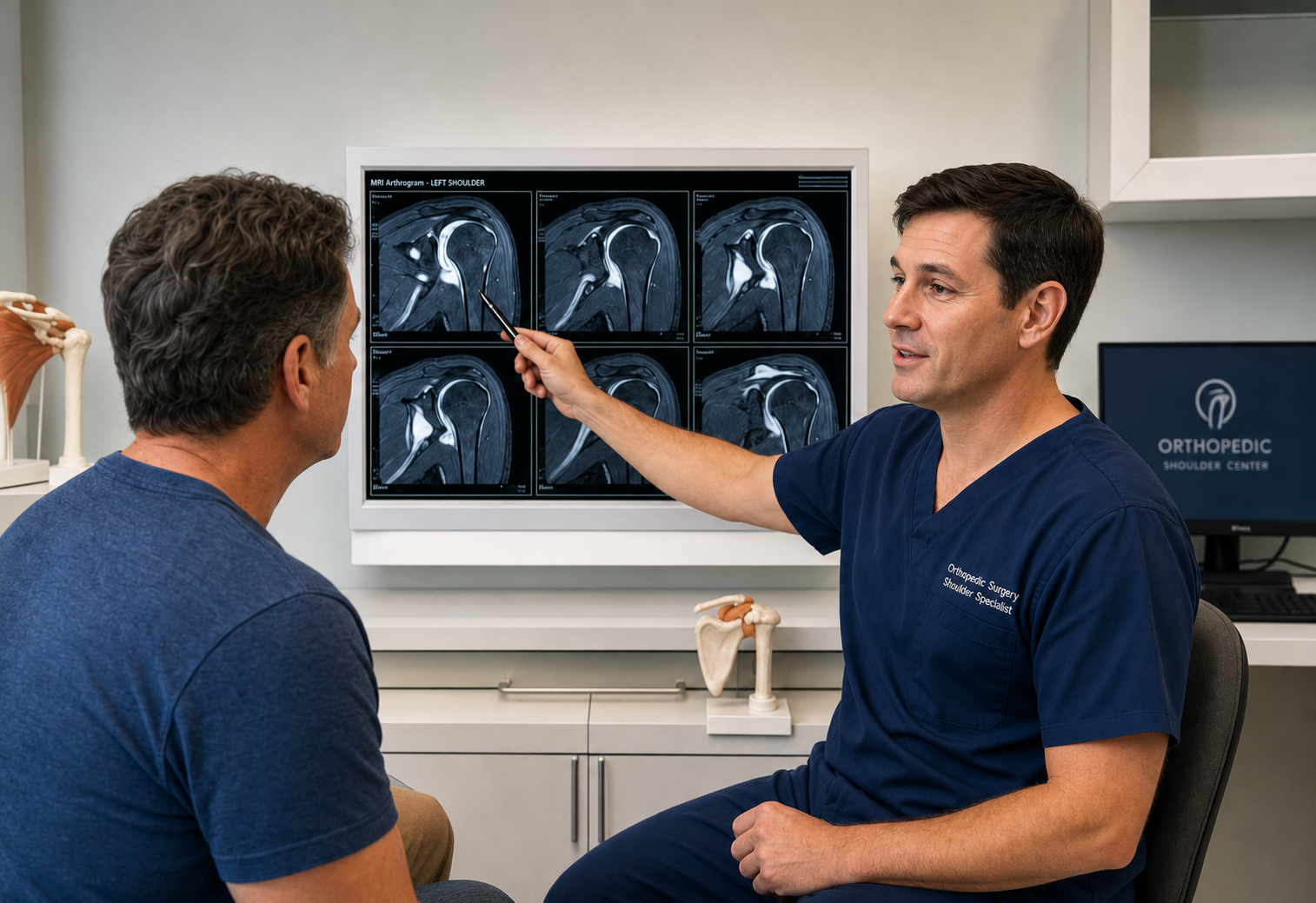
Shoulder Arthroscopy in Clermont for Labral Tears
Shoulder arthroscopy for labral tears in Clermont is a minimally invasive surgical option that can restore stability and relieve the catching, popping, or giving-way sensations that make daily life and sports difficult. At Varma Shoulder Institute, we evaluate and treat labral tears — including SLAP tears and Bankart lesions — using advanced arthroscopic techniques tailored to each patient’s anatomy and activity goals. If shoulder instability is limiting you, a precise diagnosis is the essential first step.
The shoulder labrum is a fibrocartilage rim that lines the glenoid socket, deepening it and helping anchor the ligaments that keep the humeral head in place. When the labrum tears — whether from a traumatic dislocation, repetitive overhead motion, or a fall — the shoulder can lose its mechanical stability. Understanding the type and severity of the tear guides every treatment decision that follows.
What a Labral Tear Is and Why It Causes Instability
The labrum acts like a gasket around the shallow ball-and-socket joint of the shoulder. It increases the effective depth of the socket by roughly 50 percent and serves as the attachment point for several key stabilizing ligaments. When this tissue is torn, the ball of the humerus can shift abnormally, producing the hallmark sensations of shoulder instability — catching, clicking, a feeling that the shoulder “slips” or “goes out.”
Two of the most common labral tear patterns are SLAP tears (Superior Labrum Anterior to Posterior), which occur at the top of the labrum where the biceps tendon attaches, and Bankart lesions, which involve the front-bottom portion of the labrum and are strongly associated with anterior shoulder dislocations. You can learn more about SLAP tears from the American Academy of Orthopaedic Surgeons (AAOS).
At Varma Shoulder Institute, we see both overhead athletes — pitchers, swimmers, tennis players — and non-athletes who sustain labral injuries from falls or repetitive work demands. Identifying the exact tear pattern on MRI and correlating it with your physical exam findings is essential before any treatment plan is formed. Schedule a shoulder evaluation at Varma Shoulder Institute to get an accurate diagnosis.
Symptoms That May Point to a Shoulder Labral Tear
Labral tear symptoms can overlap with other shoulder conditions, which is one reason a specialist evaluation matters. Common presentations include:
- Deep shoulder pain that is difficult to localize, often described as inside the joint
- Catching or clicking with certain arm movements, particularly rotation
- Shoulder instability — a sense that the shoulder might slip out of place
- Weakness with overhead activities or throwing
- Pain at night or with specific positions such as reaching behind the back
- Recurrent dislocations or subluxations after an initial traumatic event
Some patients describe a “dead arm” sensation after throwing — a temporary loss of strength and control that is a recognized sign of SLAP pathology in overhead athletes. If any of these symptoms sound familiar, a prompt evaluation can prevent the instability from worsening over time.
Who May Benefit From Shoulder Arthroscopy for Labral Tears
Arthroscopic labral repair is not automatically the first step for every labral tear. Candidates who tend to benefit most from surgery include:
- Patients with a Bankart lesion and recurrent shoulder dislocations, particularly younger, active individuals
- Overhead athletes with a confirmed SLAP tear who have not responded to structured physical therapy
- Patients with significant instability that interferes with work, sport, or daily function
- Individuals with associated injuries such as a Hill-Sachs defect or concurrent rotator cuff pathology
Conversely, older, less active patients with degenerative labral fraying and mild symptoms may do well with non-surgical management. The decision is always individualized. Our team at Varma Shoulder Institute reviews imaging, physical exam findings, and your personal activity goals before recommending any surgical intervention.
How Dr. Varma Evaluates Labral Tears in Clermont
Double-fellowship-trained shoulder surgeon Dr. Amit Varma — who completed fellowships at the Rothman Institute under Dr. Michael Ciccotti and the Andrews Institute under Dr. James Andrews — uses a systematic approach to labral tear evaluation. The process typically includes:
- Detailed history: Mechanism of injury, symptom onset, prior dislocations, sport or occupational demands
- Physical examination: Specialized provocative tests (O’Brien’s test, anterior apprehension, relocation test, Speed’s test) to localize labral pathology
- Imaging review: Plain X-rays to assess bony anatomy; MRI or MRI arthrogram to characterize the labral tear and evaluate surrounding structures
- Shared decision-making: A frank conversation about surgical versus non-surgical options, realistic recovery expectations, and return-to-activity timelines
Dr. Varma serves as Chief of Surgery at South Lake Hospital, and VSI patients benefit from that institutional relationship for surgical scheduling and post-operative care coordination. Contact our Clermont shoulder team to arrange your evaluation — same-week appointments are available.
What Happens During Arthroscopic Labral Tear Surgery
Shoulder arthroscopy is performed under general or regional anesthesia, typically as an outpatient procedure. Dr. Varma makes two to four small portal incisions around the shoulder — each roughly the size of a buttonhole — through which a thin camera (arthroscope) and specialized instruments are inserted.
For a Bankart repair, suture anchors are placed into the glenoid rim and used to reattach the torn labrum and capsule to their anatomic position, restoring the bumper effect that prevents anterior dislocation. For a SLAP repair, the torn superior labrum is similarly reanchored at the biceps attachment site. The AAOS provides a helpful overview of shoulder arthroscopy for patients who want to understand the general procedure.
The minimally invasive nature of arthroscopy means less disruption to the deltoid and surrounding muscles compared to open surgery, which generally translates to a more comfortable early recovery. The procedure typically takes one to two hours depending on the complexity of the tear and any concurrent findings addressed at the time of surgery.
Recovery Timeline After Shoulder Arthroscopy
Recovery after arthroscopic labral repair follows a staged progression. While individual timelines vary based on tear severity, repair complexity, and patient factors, a general framework looks like this:
- Weeks 1–4: Arm in a sling; gentle pendulum exercises; pain and swelling management
- Weeks 4–8: Sling discontinued; progressive passive and active-assisted range-of-motion exercises with a physical therapist
- Months 2–4: Strengthening of the rotator cuff and periscapular muscles; functional movement patterns introduced
- Months 4–6: Sport-specific or work-specific rehabilitation; gradual return to overhead activities
- Months 6+: Full return to contact sports or heavy labor, pending clearance from Dr. Varma
Adherence to the physical therapy protocol is one of the strongest predictors of a successful outcome. Patients who progress through rehabilitation consistently tend to regain stability and strength more reliably than those who skip or rush therapy sessions.
When Non-Surgical Treatment May Be Tried First
Not every labral tear requires surgery, and at Varma Shoulder Institute we take a conservative-first approach when the clinical picture supports it. Non-surgical management may be appropriate for:
- Partial or degenerative labral tears without significant instability
- SLAP tears in older, lower-demand patients where biceps tenodesis or conservative care may be preferable
- First-time dislocations in older adults where recurrence risk is lower
Non-surgical options include structured physical therapy focused on dynamic shoulder stabilization, activity modification, and in selected cases, image-guided corticosteroid or PRP injections to manage inflammation. The AAOS notes that the decision between surgical and non-surgical management for shoulder instability depends heavily on patient age, activity level, and the number of prior instability episodes. If conservative treatment does not produce meaningful improvement within a defined timeframe, surgery becomes a more compelling option.
Why Choose a Shoulder Specialist in Clermont for Labral Tear Care
Varma Shoulder Institute provides arthroscopic labral repair and comprehensive shoulder instability treatment for patients throughout Clermont, Orlando, and Central Florida, with same-week consultation appointments available. Choosing a dedicated shoulder specialist — rather than a general orthopedic surgeon — matters for labral tears because the diagnosis requires nuanced physical examination skills and familiarity with the full spectrum of labral pathology, from isolated SLAP tears to complex instability with bony deficiency.
Dr. Varma’s dual fellowship training at two of the most respected orthopedic programs in the country — the Rothman Institute and the Andrews Institute — means patients receive care informed by high-volume shoulder surgery experience and evidence-based technique. VSI accepts Aetna, Cigna, Florida Blue/BCBS, UnitedHealthcare, Medicare, Tricare, and self-pay, making specialist shoulder care accessible to most patients in the region. For patients who have already received a diagnosis elsewhere, we also offer second opinions within 48 hours. Learn more about common shoulder problems and when to seek specialist care from the AAOS.
A Hypothetical Patient Scenario
Common Mistakes Patients Make With Labral Tears
- Delaying evaluation after a dislocation: Each subsequent dislocation can cause additional labral and bony damage, making eventual repair more complex. Prompt evaluation after a first dislocation — especially in younger patients — is important.
- Assuming rest alone will heal the tear: The labrum has limited blood supply and does not reliably heal on its own, particularly with complete tears or Bankart lesions. Rest may reduce pain temporarily without addressing the underlying instability.
- Skipping physical therapy after surgery: Arthroscopic repair restores anatomy, but strength and neuromuscular control must be rebuilt through rehabilitation. Skipping PT significantly increases re-injury risk.
- Returning to sport too early: Premature return before the repaired labrum has adequately healed is one of the leading causes of surgical failure. Follow your surgeon’s clearance timeline, not your pain level alone.
- Self-diagnosing based on symptoms alone: Shoulder catching and popping can stem from multiple causes — labral tears, rotator cuff pathology, biceps tendon issues, or loose bodies. An accurate diagnosis requires imaging and a specialist examination.
Practical Next Steps
If you are experiencing shoulder instability, catching, or pain that has not resolved with rest or basic treatment, here is how to move forward:
- Request a specialist evaluation: Call Varma Shoulder Institute at (352) 404-8956 or use our online scheduling to book a same-week appointment with Dr. Varma.
- Bring your imaging: If you have had X-rays or an MRI, bring the images and reports to your appointment. If you have not had imaging, we can order the appropriate studies.
- Prepare your history: Note when symptoms started, what makes them worse, any prior dislocations, and your activity or sport demands. This helps Dr. Varma tailor the evaluation.
- Ask about second opinions: If you have already received a diagnosis or surgical recommendation elsewhere, VSI offers second opinions within 48 hours so you can feel confident in your treatment path.
Frequently Asked Questions
What is the difference between a SLAP tear and a Bankart lesion?
A SLAP tear involves the superior (top) portion of the labrum where the biceps tendon attaches and is common in overhead athletes. A Bankart lesion involves the anterior-inferior (front-bottom) labrum and is typically caused by a shoulder dislocation. Both are types of labral tears but occur in different locations and often require different surgical approaches.
Is shoulder arthroscopy for a labral tear an outpatient procedure?
Yes, arthroscopic labral repair is typically performed as an outpatient procedure, meaning most patients go home the same day. General or regional anesthesia is used, and the procedure usually takes one to two hours depending on the complexity of the repair.
How long does recovery take after arthroscopic labral repair?
Most patients wear a sling for four to six weeks and complete a structured physical therapy program over four to six months. Return to overhead sports or contact activities typically occurs between six and nine months post-operatively, depending on the repair and individual progress.
Can a labral tear heal without surgery?
Some partial or degenerative labral tears in lower-demand patients can be managed successfully with physical therapy and activity modification. However, complete tears — especially Bankart lesions associated with recurrent instability — generally do not heal on their own and often require surgical repair to restore stability.
Does Varma Shoulder Institute treat labral tears in Clermont, FL?
Yes. Dr. Amit Varma at Varma Shoulder Institute in Clermont, FL specializes in arthroscopic labral repair for SLAP tears, Bankart lesions, and shoulder instability. Same-week appointments are available — call (352) 404-8956 to schedule your evaluation.
What insurance plans does Varma Shoulder Institute accept for labral tear surgery?
VSI accepts Aetna, Cigna, Florida Blue/BCBS, UnitedHealthcare, Medicare, Tricare, and self-pay. Coverage for arthroscopic labral repair varies by plan, so it is advisable to verify your specific benefits with your insurance carrier and our office before scheduling surgery.
Can I get a second opinion on a labral tear diagnosis at Varma Shoulder Institute?
Absolutely. Varma Shoulder Institute offers second opinions within 48 hours for patients who have received a diagnosis or surgical recommendation elsewhere. Bring your imaging and prior records, and Dr. Varma will provide an independent assessment to help you make a confident treatment decision.
Update Log
- May 2026: Article published covering shoulder arthroscopy for labral tears in Clermont, FL, including SLAP tear and Bankart lesion evaluation, surgical technique overview, recovery timeline, and non-surgical alternatives at Varma Shoulder Institute.