

Rotator Cuff Repair Rehab Milestones: Your Week-by-Week Recovery Timeline
Understanding the rotator cuff repair recovery timeline is one of the most important steps you can take before and after shoulder surgery. At Varma Shoulder Institute, we guide every patient through a structured, milestone-based rehabilitation plan designed to protect the healing tendon while restoring strength and motion as safely as possible. Knowing what to expect at each stage reduces anxiety and helps you stay on track.
Rotator cuff repair is one of the most commonly performed shoulder surgeries in the United States. Whether your repair was performed arthroscopically or through a mini-open approach, the biological process of tendon healing follows a predictable sequence. The milestones below reflect general evidence-based rehabilitation principles. Your specific protocol at Varma Shoulder Institute will be tailored to your tear size, tissue quality, repair technique, and overall health.
What to Expect After Rotator Cuff Repair
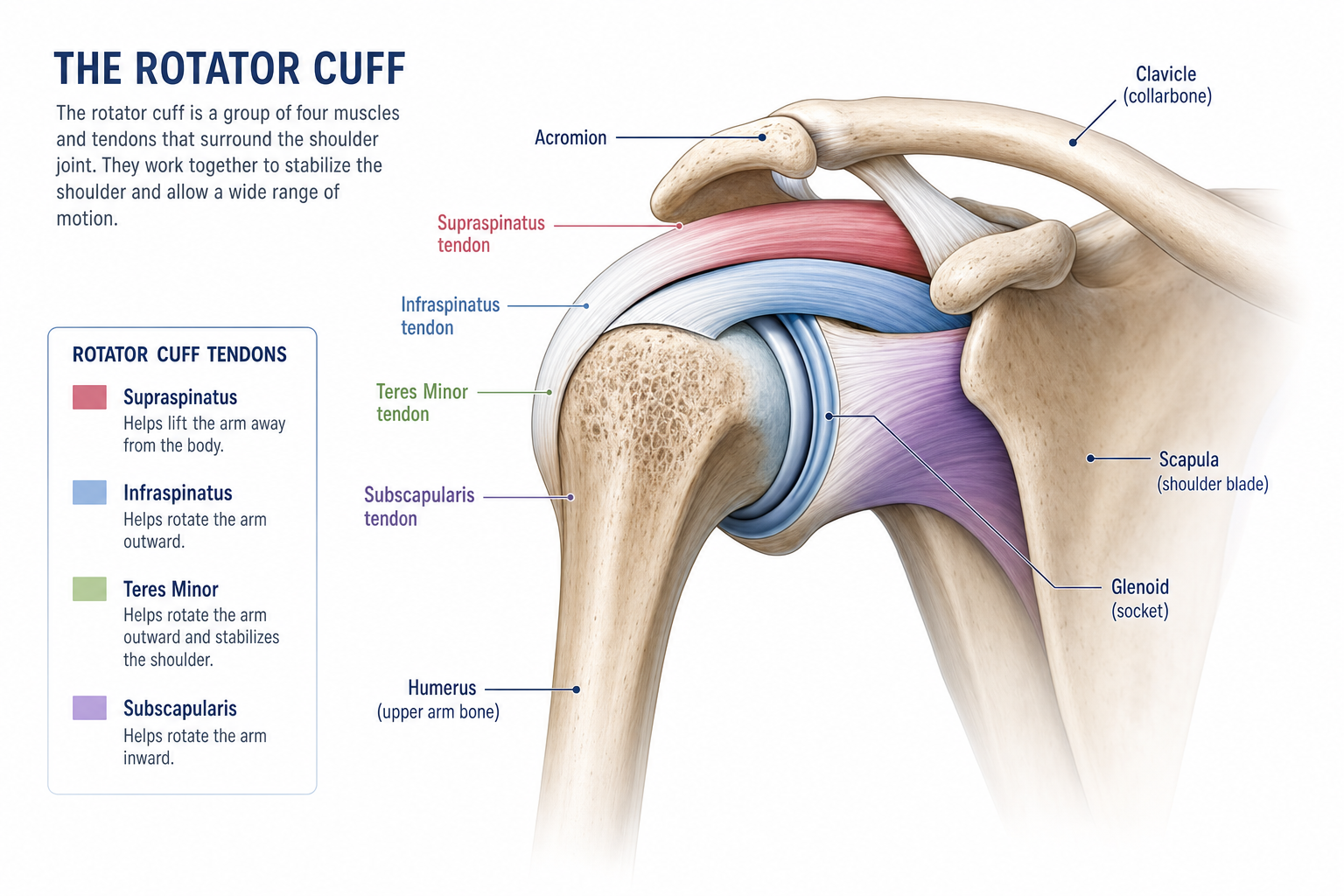
Immediately after surgery, your arm will be placed in a sling or abduction pillow brace. The goal during the earliest phase is simple: protect the repair. The rotator cuff tendons are reattached to bone using anchors, and the tissue must biologically integrate over several weeks before it can tolerate meaningful load. Swelling, soreness, and limited motion are all normal in the first days after surgery.
For patients seeking expert care, our rotator cuff repair consultations at Varma Shoulder Institute include a detailed pre-surgical education session so you understand every phase of recovery before your procedure date. Knowing the roadmap in advance makes the process far less stressful.
Learn more about rotator cuff anatomy and repair from the American Academy of Orthopaedic Surgeons (AAOS), a trusted patient education resource.
Recovery Timeline: Weeks 0 to 2
Primary goal: Protect the repair and manage pain and swelling.
- Wear your sling or abduction brace at all times, including sleep, unless instructed otherwise.
- Ice the shoulder for fifteen to twenty minutes several times daily to reduce swelling.
- Begin gentle pendulum exercises as directed — these use gravity, not muscle activation, to maintain minimal joint mobility.
- Elbow, wrist, and hand range-of-motion exercises are typically started immediately to prevent stiffness.
- Pain medication and anti-inflammatory management will be coordinated by your care team.
During this phase, the repaired tendon is at its most vulnerable. Avoid any active lifting, reaching, or pushing with the operative arm.
Recovery Timeline: Weeks 3 to 6
Primary goal: Begin passive and active-assisted range of motion.
Around week three, most patients begin formal physical therapy with a licensed therapist. The focus shifts to passive range of motion — your therapist moves your arm through a controlled arc while your rotator cuff muscles remain relaxed. This prevents postoperative shoulder stiffness without stressing the healing repair.
- Passive forward flexion and external rotation exercises begin.
- Sling use continues but may be reduced to specific activities (driving, sleeping, crowded environments).
- Scapular stabilization exercises begin to prepare the shoulder blade for later strengthening.
- Swelling and aching after therapy sessions is normal; sharp pain is not — report it to your therapist and surgeon.
Recovery Timeline: Weeks 7 to 12
Primary goal: Achieve full passive range of motion and begin active motion.
By weeks seven through twelve, most patients have discontinued sling use and are working toward full passive range of motion in all planes. Active-assisted exercises — where you use your non-operative arm or a pulley to assist the operative arm — transition into true active motion as tendon healing progresses.
- Active forward flexion and abduction exercises begin when cleared by your surgeon.
- Light isometric strengthening of the rotator cuff may begin toward the end of this phase.
- Functional activities such as light grooming, eating, and keyboard use typically resume.
- Overhead reaching remains restricted until tendon-to-bone healing is confirmed.
The AAOS shoulder arthroscopy patient guide provides additional context on what arthroscopic repair involves and what the healing process looks like from a tissue perspective.
Recovery Timeline: Months 3 to 6 and Beyond
Primary goal: Progressive strengthening and return to full activity.
Months three through six represent the strengthening and functional return phase. Tendon-to-bone healing is substantially more mature by this point, allowing progressive resistance training of the rotator cuff and surrounding shoulder musculature.
- Resistance band and light dumbbell strengthening exercises are introduced progressively.
- Sport-specific or occupation-specific training begins for athletes and manual laborers.
- Overhead activities, swimming, and racquet sports are typically cleared between months four and six depending on repair size and healing.
- Full recovery for large or massive tears may extend to nine to twelve months.
Patients who want to confirm their healing progress or who have concerns about their current recovery plan are welcome to request a second opinion evaluation at our Clermont shoulder practice — we offer second opinion appointments within 48 hours.
How Physical Therapy Supports Tendon Healing
Physical therapy after rotator cuff repair is not optional — it is a core component of a successful outcome. A structured rehabilitation program accomplishes several critical goals: it prevents excessive scar tissue formation, restores neuromuscular control of the shoulder, and progressively loads the healing tendon to stimulate proper collagen remodeling.
At Varma Shoulder Institute, we coordinate closely with physical therapists to ensure your rehab protocol aligns with the specifics of your repair. Tear size, anchor placement, tissue quality, and patient age all influence how aggressively therapy can progress. The Arthroscopy Association of North America (AANA) supports evidence-based rehabilitation protocols for arthroscopic shoulder procedures.
Patients who skip or delay physical therapy — even when they feel relatively comfortable — are at higher risk for re-tear, persistent weakness, and prolonged stiffness. Consistency with your therapy schedule is one of the most important things you can control during recovery.
Daily Activity Milestones: Sleeping, Driving, Work, and Exercise
Patients frequently ask about specific daily activities. Here is a general framework — your surgeon’s instructions always take priority over general guidelines:
- Sleeping: Most patients sleep in a recliner or propped upright for the first four to six weeks to reduce pressure on the repair. Side-lying on the operative shoulder is not recommended during early recovery.
- Driving: Return to driving after shoulder surgery typically occurs between weeks six and ten, once the sling is discontinued and you have sufficient active motion and reaction time. Never drive while taking narcotic pain medication.
- Desk work: Light keyboard and mouse use may resume around weeks six to eight for most patients, depending on arm position requirements.
- Manual labor or overhead work: Return to physically demanding occupations is typically cleared between months four and six, or later for large repairs.
- Exercise and sport: Low-impact cardiovascular activity (stationary bike, walking) can often resume within weeks two to four. Upper-body sport return is typically months four to six or beyond.
Common Setbacks and Warning Signs
Not every recovery follows a perfectly linear path. Knowing the difference between expected discomfort and a true warning sign is essential.
Expected during recovery: Aching after therapy sessions, mild swelling, nighttime discomfort in the first several weeks, and temporary stiffness plateaus.
Warning signs that require prompt contact with your surgeon:
- Sudden increase in pain after a period of improvement — this can indicate a re-tear.
- Significant swelling, redness, warmth, or fever — possible signs of infection.
- Numbness or tingling that is new or worsening.
- A “pop” or giving-way sensation in the shoulder during therapy or daily activity.
- Complete loss of motion that was previously improving.
The AAOS patient resource on rotator cuff tendinitis and impingement provides helpful context on distinguishing normal shoulder discomfort from symptoms that warrant evaluation.
Common Mistakes Patients Make During Recovery
Even motivated, compliant patients sometimes make avoidable errors during rotator cuff repair recovery. Here are the most common ones we see at Varma Shoulder Institute:
- Removing the sling too early: Feeling better does not mean the tendon has healed. The sling protects the repair during the most vulnerable biological window — removing it prematurely is one of the leading causes of re-tear.
- Skipping physical therapy sessions: Missed sessions allow scar tissue to accumulate and delay the progression of range of motion milestones.
- Progressing too aggressively: Patients eager to return to sport or work sometimes push through pain and advance exercises before their surgeon has cleared them, risking repair failure.
- Ignoring sleep position: Sleeping flat on the back or on the operative side places traction on the repair and increases nighttime pain, disrupting the rest needed for healing.
- Self-diagnosing a setback: Patients who notice a change in their recovery — increased pain, new weakness, a popping sensation — sometimes wait weeks before calling their surgeon. Early contact allows for prompt evaluation and, if needed, imaging to rule out re-tear.
When to Call Your Surgeon About Recovery Concerns
At Varma Shoulder Institute, we encourage patients to call our office any time they have a concern during recovery — no question is too small. Double-fellowship-trained shoulder surgeon Dr. Amit Varma, who completed fellowships at the Rothman Institute under Dr. Michael Ciccotti and the Andrews Institute under Dr. James Andrews, and our clinical team are available to address recovery questions, adjust your rehabilitation protocol, or order imaging if a setback is suspected.
Call us at (352) 404-8956 or email info@varmashoulderinstitute.com. Our office hours are Monday through Thursday, 8:30 AM to 4:30 PM. Same-week appointments are available for patients with urgent recovery concerns.
Frequently Asked Questions
How long does rotator cuff repair recovery take?
Most patients achieve functional recovery — meaning they can perform daily activities comfortably — between four and six months after surgery. Full recovery, including return to overhead sport or heavy labor, may take nine to twelve months for larger repairs. The tendon-to-bone healing process is biological and cannot be significantly accelerated.
When can I stop wearing my sling after rotator cuff surgery?
Sling use is typically required for four to six weeks, depending on the size of the tear and the repair technique used. Your surgeon will determine when it is safe to discontinue the sling based on your specific repair. Do not remove the sling without explicit clearance from your surgical team.
When does physical therapy start after rotator cuff repair?
Gentle pendulum exercises and elbow range-of-motion work typically begin within the first one to two weeks. Formal physical therapy with a licensed therapist usually starts around weeks three to four, beginning with passive range-of-motion exercises to protect the healing repair.
When can I drive after rotator cuff surgery?
Return to driving after shoulder surgery generally occurs between weeks six and ten, once the sling is discontinued and you have adequate active motion and reaction capability. You should never drive while taking narcotic pain medication. Your surgeon will provide specific clearance based on your progress.
What are the signs of a failed rotator cuff repair?
Warning signs of a possible re-tear include a sudden increase in pain after a period of improvement, a popping or giving-way sensation, and new or worsening weakness. If you experience any of these symptoms, contact Varma Shoulder Institute promptly at (352) 404-8956 so Dr. Varma can evaluate your shoulder and order imaging if needed.
Is postoperative shoulder stiffness normal?
Yes. Some degree of postoperative stiffness is expected and typically peaks around weeks three to six as scar tissue forms. Consistent physical therapy during this window is essential to prevent prolonged stiffness. If stiffness is severe or not improving with therapy, your surgeon may discuss additional interventions.
Can I get a second opinion on my rotator cuff repair recovery plan?
Absolutely. Varma Shoulder Institute offers second opinion appointments within 48 hours for patients who have concerns about their current recovery plan or surgical recommendation. Call (352) 404-8956 or visit our Clermont office to schedule your evaluation with Dr. Varma.
Update Log
- May 2026: Article reviewed and updated to reflect current rehabilitation milestone guidelines and Varma Shoulder Institute clinical protocols for rotator cuff repair recovery.