
Shoulder Arthroscopy Recovery for Golf and Tennis
Shoulder arthroscopy recovery and return to golf and tennis is one of the most common concerns we hear from active patients at Varma Shoulder Institute. Whether you play recreational weekend golf or compete in USTA tennis leagues, a shoulder injury can sideline you for months — and getting back safely requires a structured, sport-specific plan. The good news is that with the right surgical technique and rehabilitation protocol, most golfers and tennis players do return to full activity after shoulder arthroscopy.
What Shoulder Arthroscopy Treats in Golfers and Tennis Players
Golfers and tennis players place repetitive, high-demand stress on the shoulder joint. The rotational mechanics of a golf swing and the overhead serving motion in tennis both load the rotator cuff, labrum, biceps tendon, and AC joint in ways that can cause cumulative injury over time. Common conditions treated with shoulder arthroscopy in these athletes include rotator cuff tears, SLAP labral tears, shoulder impingement, biceps tendon pathology, and AC joint arthritis.
Arthroscopic surgery uses small incisions and a camera to repair or remove damaged tissue inside the shoulder joint. Because it avoids the larger incisions of open surgery, recovery is generally faster — but the biological healing of repaired tissue still takes time regardless of how the surgery was performed. At Varma Shoulder Institute, we evaluate each patient’s sport, position, and activity level before surgery to set realistic expectations for the recovery process.
A Typical Recovery Timeline After Shoulder Arthroscopy
Recovery after shoulder arthroscopy follows a predictable sequence of phases, though the exact duration depends on what was repaired. Here is a general framework our team uses at Varma Shoulder Institute:
- Weeks 1 to 4: Sling immobilization, pain management, and gentle pendulum exercises. No active shoulder use.
- Weeks 4 to 8: Passive and active-assisted range-of-motion exercises begin under physical therapy guidance. Swelling and stiffness gradually improve.
- Weeks 8 to 16: Strengthening of the rotator cuff and periscapular muscles. Sport-specific movement patterns are introduced in a controlled setting.
- Months 4 to 7+: Progressive return to sport, beginning with low-intensity practice and advancing to full competition based on milestone clearance.
According to the American Academy of Orthopaedic Surgeons, rotator cuff tissue requires several months to fully heal after repair, which is why rushing back to overhead or rotational sports carries real re-injury risk.
When You Can Return to Golf After Shoulder Arthroscopy
Golf is often considered a lower-demand sport, but the rotational torque through the lead shoulder during the downswing is significant. For most patients who undergo arthroscopic procedures such as labral debridement, subacromial decompression, or AC joint resection, a return to putting and chipping can begin around 3 months, with a full swing typically permitted between 4 and 6 months post-surgery.
Patients who undergo rotator cuff repair — even arthroscopic — generally need to wait longer, often 5 to 7 months before returning to a full golf swing, because the repaired tendon must achieve sufficient biological strength to tolerate the load. Our team at Varma Shoulder Institute recommends a graduated return: short irons and chipping first, then mid-irons, and finally driver swings, with each stage gated by pain-free motion and adequate strength.
If you are a golfer dealing with shoulder pain and wondering whether surgery is the right path, schedule a shoulder consultation at Varma Shoulder Institute to get a personalized evaluation from Dr. Varma.
When You Can Return to Tennis and Racquet Sports
Tennis and other racquet sports place greater demands on the shoulder than golf due to the overhead serving motion, which generates high rotational velocity and eccentric loading through the posterior rotator cuff. This means return-to-tennis timelines are generally longer than golf timelines for the same procedure.
For arthroscopic labral repair or SLAP repair, most tennis players can expect to return to baseline groundstrokes around 5 to 6 months, with overhead serving cleared closer to 6 to 8 months. For rotator cuff repairs, full return to competitive tennis may take 8 to 12 months depending on tear size and repair complexity. According to the American Shoulder and Elbow Surgeons, sport-specific rehabilitation is essential for overhead athletes to safely resume play after shoulder surgery.
We structure tennis return progressively: baseline rallying with a shortened backswing first, then full groundstrokes, then overhead volleys, and finally full serving — each stage requiring pain-free completion before advancing.
Key Rehab Milestones Before Returning to Play
Calendar time alone does not determine readiness to return to golf or tennis. At Varma Shoulder Institute, we use objective milestones to guide clearance decisions:
- Full pain-free range of motion in all planes, matching the unaffected side as closely as possible.
- Rotator cuff strength symmetry — typically at least 90% of the contralateral side on manual muscle testing or dynamometry.
- Sport-specific movement quality — the ability to perform a controlled golf swing or tennis groundstroke without compensatory mechanics.
- No pain or swelling during or after sport-specific practice sessions.
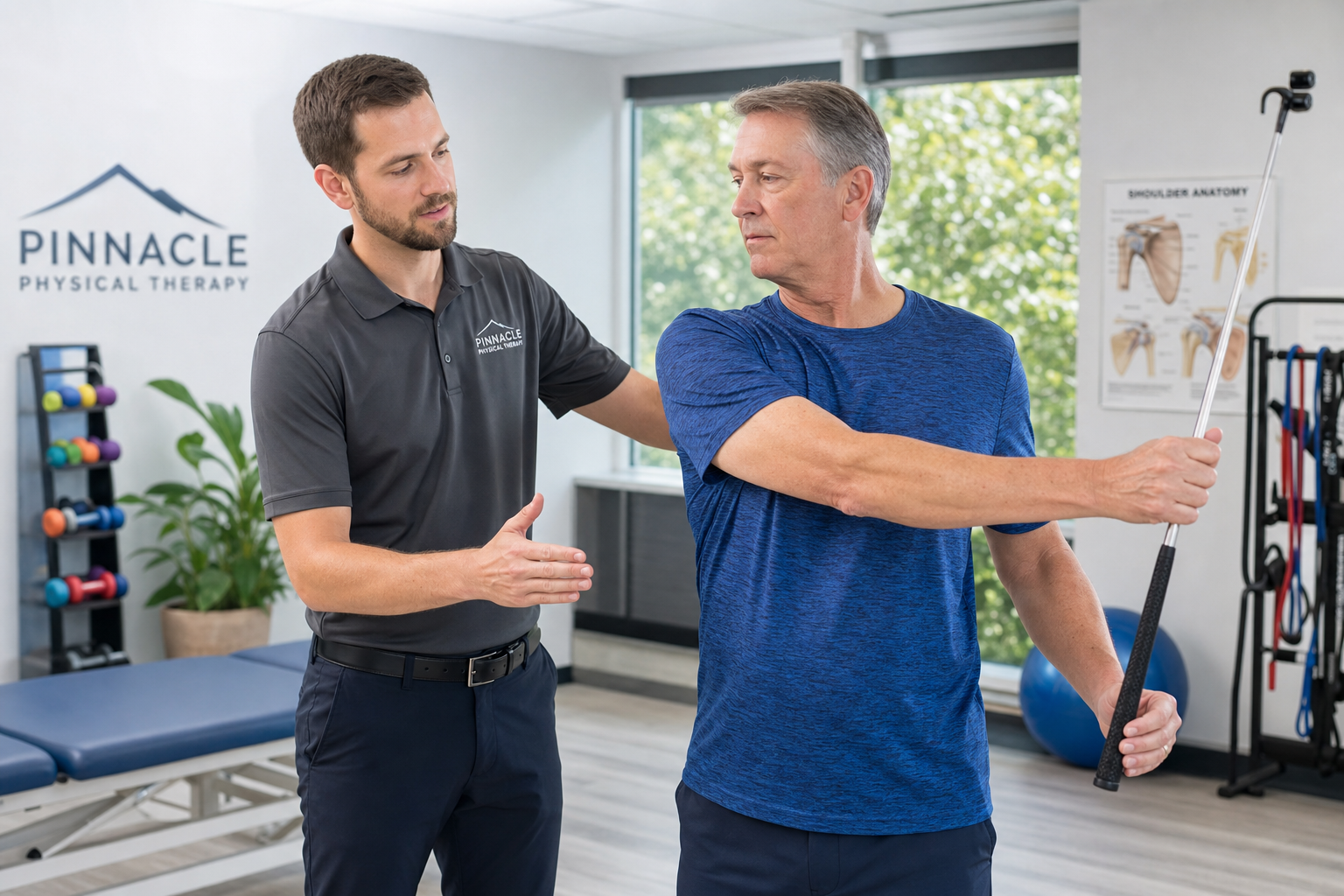
Physical therapy is not optional in this process. Patients who complete a structured, progressive rehabilitation program consistently achieve better outcomes and lower re-injury rates than those who self-direct their recovery.
Warning Signs You Are Returning Too Soon
Returning to sport before the shoulder is ready is the most common cause of setbacks after shoulder arthroscopy. Watch for these warning signs:
- Pain during or after swinging, serving, or throwing that was not present before the session.
- Swelling or warmth in the shoulder joint following activity.
- A sense of weakness or instability during sport-specific movements.
- Clicking, catching, or grinding sensations that are new or worsening.
- Compensatory pain in the neck, elbow, or wrist — often a sign the shoulder is not absorbing load properly.
If you experience any of these symptoms, stop activity and contact our office. Pushing through these warning signs risks re-tearing repaired tissue and may require revision surgery.
How the Procedure Type Changes Your Recovery Timeline
Not all shoulder arthroscopy procedures are equal in terms of recovery demand. Here is a general comparison:
| Procedure | Golf Return (Approx.) | Tennis Return (Approx.) |
|---|---|---|
| Subacromial decompression / debridement | 3 to 4 months | 4 to 5 months |
| AC joint resection (Mumford procedure) | 3 to 5 months | 4 to 6 months |
| Labral repair (SLAP or Bankart) | 5 to 6 months | 6 to 8 months |
| Partial rotator cuff repair | 5 to 6 months | 6 to 9 months |
| Full-thickness rotator cuff repair | 6 to 8 months | 8 to 12 months |
These ranges are general estimates. Individual factors — including tear size, tissue quality, patient age, and rehabilitation adherence — all influence actual timelines. For more information on rotator cuff conditions, the AAOS OrthoInfo resource on shoulder impingement and rotator cuff tendinitis provides reliable patient education.
How Dr. Varma Guides Safe Return to Sports in Clermont
Varma Shoulder Institute provides arthroscopic shoulder surgery and sport-specific return-to-play programs for golfers, tennis players, and other active patients throughout Clermont, Orlando, and Central Florida. Double-fellowship-trained shoulder surgeon Dr. Amit Varma — who completed advanced training at the Rothman Institute under Dr. Michael Ciccotti and the Andrews Institute under Dr. James Andrews — brings subspecialty expertise to every surgical and rehabilitation decision.
Our approach combines precise arthroscopic technique with a structured, milestone-based rehabilitation protocol developed in coordination with physical therapists who understand the biomechanical demands of golf and tennis. We do not use a one-size-fits-all timeline. Instead, we assess each patient’s strength, motion, and movement quality at every stage before advancing to the next phase of activity.
Same-week consultation appointments are available. If you are a golfer or tennis player dealing with shoulder pain, do not wait until the off-season to get evaluated. Early diagnosis and treatment consistently lead to better outcomes. Contact our Clermont shoulder team to schedule your evaluation today.
Common Mistakes Patients Make During Shoulder Arthroscopy Recovery
Even motivated athletes make avoidable mistakes during recovery that delay their return to golf or tennis:
- Stopping physical therapy too early. Once pain resolves, many patients assume they no longer need PT. Strength and movement quality deficits often persist well beyond pain resolution.
- Returning to sport based on calendar time alone. A four-month mark does not automatically mean clearance. Objective strength and motion testing must confirm readiness.
- Practicing at full intensity too soon. Hitting a bucket of balls at full swing speed before the shoulder is ready is a common cause of re-injury. A graduated return — starting with partial swings and short sessions — is essential.
- Ignoring compensatory pain. Elbow, wrist, or neck pain during recovery can signal that the shoulder is not functioning properly and is offloading stress to adjacent structures.
- Skipping the follow-up appointment. Post-operative visits allow Dr. Varma to assess healing progress and adjust the rehabilitation plan before problems develop.
Frequently Asked Questions
How long does shoulder arthroscopy recovery take for a golfer?
Most golfers can return to putting and chipping around 3 months after arthroscopic procedures such as subacromial decompression, with a full swing typically permitted between 4 and 6 months. Rotator cuff repairs generally require 6 to 8 months before a full golf swing is safe.
When can I return to tennis after shoulder arthroscopy?
Tennis players typically return to baseline groundstrokes around 5 to 6 months after labral repair, with overhead serving cleared closer to 6 to 8 months. Full-thickness rotator cuff repairs may require 8 to 12 months before returning to competitive tennis.
Is physical therapy required after shoulder arthroscopy?
Yes. Physical therapy is essential after shoulder arthroscopy, particularly for athletes returning to golf or tennis. A structured rehabilitation program restores range of motion, rebuilds rotator cuff strength, and prepares the shoulder for sport-specific loading demands.
What are the signs I am returning to sport too soon after shoulder surgery?
Warning signs include pain during or after sport activity, new swelling or warmth in the shoulder, a sense of weakness or instability, and compensatory pain in the neck, elbow, or wrist. If any of these occur, stop activity and contact your surgeon.
Does the type of shoulder arthroscopy procedure affect my return-to-sport timeline?
Yes, significantly. Simpler procedures like subacromial decompression allow earlier return than labral repairs or rotator cuff repairs. The size of a rotator cuff tear and the complexity of the repair also influence how long recovery takes.
Can Dr. Varma at Varma Shoulder Institute treat shoulder injuries in golfers and tennis players?
Yes. Dr. Amit Varma at Varma Shoulder Institute in Clermont, Florida specializes in arthroscopic shoulder surgery and sport-specific return-to-play rehabilitation for golfers, tennis players, and other active patients throughout Central Florida. Same-week appointments are available — call (352) 404-8956.
Will I need a second opinion before shoulder arthroscopy?
If you have received a shoulder surgery recommendation and want to confirm the diagnosis or explore your options, Varma Shoulder Institute offers second opinions within 48 hours. Call (352) 404-8956 or visit our Clermont office to speak with Dr. Varma directly.
Update Log
- May 2026: Article published with sport-specific return-to-play timelines for golf and tennis, procedure comparison table, and updated rehabilitation milestone guidance from Varma Shoulder Institute.