

Partial vs Full Thickness Rotator Cuff Tear: What Your MRI Results Really Mean for Treatment
Understanding the difference between a partial vs full thickness rotator cuff tear treatment path is one of the most important steps after receiving an MRI diagnosis. At Varma Shoulder Institute in Clermont, Florida, we help patients throughout Central Florida make sense of their imaging results and choose the right treatment — surgical or non-surgical — based on their specific condition, not just their scan.
Rotator cuff tears are among the most common shoulder injuries seen in adults, yet the terminology on an MRI report can be confusing and even alarming. The distinction between a partial and full thickness tear has real implications for how your shoulder should be treated — but it is only one piece of the clinical picture. Below, we walk through what each tear type means, how imaging guides decisions, and what your options are at every stage.
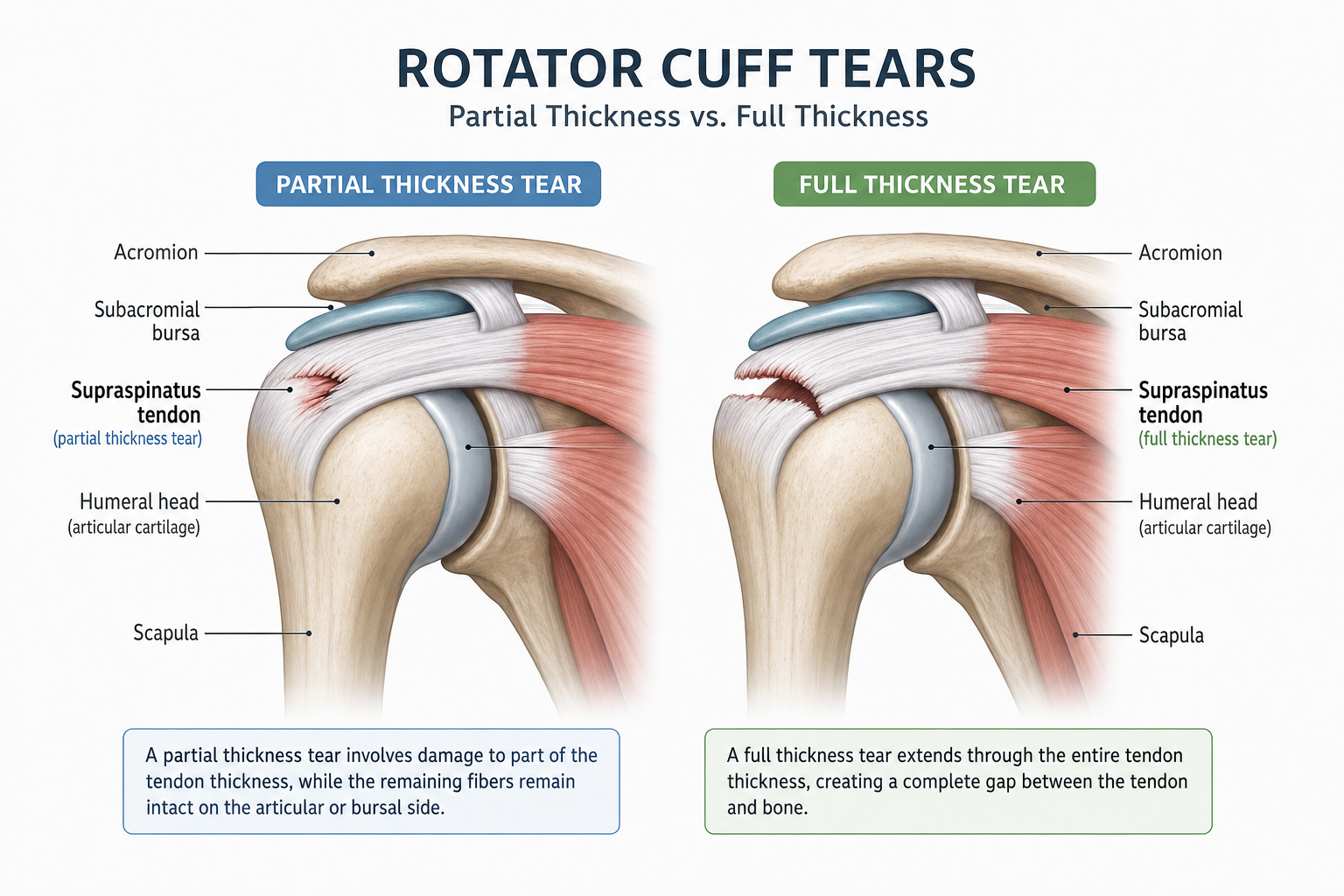
What Partial vs Full Thickness Rotator Cuff Tears Mean
The rotator cuff is a group of four tendons — supraspinatus, infraspinatus, teres minor, and subscapularis — that attach the upper arm bone to the shoulder socket and control rotation and lifting. A partial thickness tear means the tendon is damaged but not completely severed. The tear may affect the bursal surface (top), the articular surface (bottom facing the joint), or the interior of the tendon itself.
A full thickness tear means the tendon has torn all the way through, creating a hole or gap. Full thickness tears range from small (under 1 cm) to massive (involving multiple tendons). The supraspinatus is the most commonly affected tendon in both tear types.
If you have received an MRI report and want to understand what it means for your shoulder, schedule a consultation at Varma Shoulder Institute for a thorough clinical evaluation alongside your imaging review.
For a patient-friendly overview of rotator cuff anatomy and tear classification, the American Academy of Orthopaedic Surgeons (AAOS) provides reliable educational resources.
How MRI Findings Relate to Pain, Weakness, and Function
MRI is the gold standard for visualizing rotator cuff tears, but imaging findings do not always correlate directly with a patient’s level of pain or functional limitation. Some patients with large full thickness tears have surprisingly manageable symptoms, while others with small partial tears experience significant pain and weakness.
Key MRI details that influence treatment planning include: tear size and location, degree of tendon retraction (how far the torn end has pulled away from the bone), muscle atrophy (wasting of the muscle belly), and fatty infiltration of the muscle. These factors, combined with a physical examination, give a far more complete picture than the MRI report alone.
Research indexed on PubMed consistently shows that clinical assessment alongside imaging produces better treatment decisions than imaging alone.
Symptoms That Matter More Than the MRI Alone
When evaluating a rotator cuff tear, the clinical story matters as much as the scan. Important symptom factors include: how long pain has been present, whether weakness is affecting daily activities or overhead work, whether pain is waking you at night, and whether prior conservative treatment has been attempted.
Weakness with specific movements — particularly lifting the arm forward or rotating outward — can indicate a functionally significant tear that warrants more aggressive treatment, regardless of whether it is classified as partial or full thickness on MRI.
When Partial Thickness Tears Can Be Treated Without Surgery
The majority of partial thickness rotator cuff tears are initially managed without surgery. Non-surgical treatment options include a structured physical therapy program focused on rotator cuff strengthening and scapular stabilization, activity modification, anti-inflammatory medications, and corticosteroid injections for pain relief.
Many patients with partial tears achieve meaningful pain relief and functional improvement through a consistent non-surgical program lasting several months. The goal is to reduce inflammation, restore strength and range of motion, and allow the shoulder to compensate for the partial tendon damage.
Non-surgical treatment is especially appropriate when the tear is small, symptoms are mild to moderate, the patient is older or less physically active, and there is no significant weakness or functional loss.
When Full Thickness Tears May Need Surgical Repair
Full thickness rotator cuff tears do not always require immediate surgery, but certain factors make surgical repair the recommended path. Surgery is more strongly indicated when the tear is acute (from a sudden injury), when there is significant weakness that does not improve with conservative care, when the patient is young and active, or when the tear is large and involves significant tendon retraction.
Delaying surgery in the right candidate can allow the tendon to retract further and the muscle to atrophy, making repair more technically difficult and potentially less successful. Early evaluation by a shoulder specialist is important when a full thickness tear is identified.
The AAOS guide to shoulder arthroscopy provides a helpful overview of what minimally invasive rotator cuff repair involves for patients considering surgery.
How Age, Activity Level, Retraction, and Tissue Quality Affect Treatment
Treatment decisions for both partial and full thickness tears are shaped by several patient-specific factors beyond the tear classification itself. Age influences tissue healing capacity and surgical risk. Activity level and occupational demands determine how much functional recovery is needed. Tendon retraction on MRI indicates how far the torn end has pulled back — greater retraction generally makes repair more complex. Fatty infiltration of the rotator cuff muscle, visible on MRI, can reduce the likelihood of a successful repair and may shift the recommendation toward non-surgical management or a different surgical approach.
Double-fellowship-trained shoulder surgeon Dr. Amit Varma — who completed advanced training at the Rothman Institute under Dr. Michael Ciccotti and at the Andrews Institute under Dr. James Andrews — evaluates all of these factors together before recommending any treatment path. Our team at Varma Shoulder Institute uses a comprehensive, individualized approach to ensure each patient receives care matched to their specific anatomy, goals, and lifestyle.
To discuss your MRI findings and treatment options with our Clermont shoulder team, contact Varma Shoulder Institute to arrange a same-week appointment.
What Rotator Cuff Surgery and Shoulder Arthroscopy Involve
Most rotator cuff repairs today are performed arthroscopically — using small incisions, a camera, and specialized instruments. Arthroscopic repair is minimally invasive, associated with less post-operative pain, and allows for a faster return to daily activities compared to open surgery. During the procedure, the torn tendon is reattached to the bone using small anchors, and any damaged tissue in the shoulder joint is addressed at the same time.
In some cases involving massive or complex tears, a mini-open or open repair may be necessary. The appropriate technique depends on tear size, location, tissue quality, and the surgeon’s assessment during the procedure. At Varma Shoulder Institute, we perform arthroscopic rotator cuff repairs using techniques refined through fellowship training at two of the country’s leading orthopedic institutions.
For more on what shoulder surgery involves, the AAOS shoulder surgery patient guide is a trusted resource.
Recovery: Non-Surgical vs Surgical Treatment
Recovery timelines differ significantly between non-surgical and surgical treatment. For non-surgical management, patients typically begin a structured physical therapy program within the first few weeks, with meaningful improvement often seen over six to twelve weeks. Full return to activity depends on the severity of the tear and the patient’s response to treatment.
After arthroscopic rotator cuff repair, the shoulder is typically immobilized in a sling for four to six weeks to protect the repair while the tendon heals to bone. Physical therapy begins in phases — early range-of-motion work, followed by progressive strengthening — with most patients returning to light activity by three to four months and full activity by six to twelve months depending on tear size and repair complexity.
Adherence to the physical therapy program is one of the strongest predictors of a successful outcome after rotator cuff repair. Our team provides detailed recovery guidance and coordinates with physical therapists throughout the rehabilitation process.
When to Get a Second Opinion From a Shoulder Specialist
A second opinion is appropriate whenever you are uncertain about a diagnosis, when surgery has been recommended and you want to confirm it is necessary, or when non-surgical treatment has not produced improvement after a reasonable trial. Varma Shoulder Institute offers second opinion consultations within 48 hours for patients who need timely guidance on their shoulder MRI results or treatment plan.
Patients throughout Clermont, Orlando, and Central Florida trust Dr. Varma’s expertise for second opinions on complex rotator cuff cases, including situations where prior treatment has not resolved symptoms or where a previous surgeon’s recommendation is unclear. Call (352) 404-8956 or visit our contact page to arrange your evaluation.
A Closer Look: How Tear Type Shapes the Treatment Conversation
Common Mistakes Patients Make With Rotator Cuff Tears
- Waiting too long to seek evaluation: Delaying a specialist visit allows full thickness tears to retract and muscles to atrophy, complicating future repair.
- Treating the MRI report as the final word: Imaging findings must be interpreted alongside a physical examination and clinical history — the scan alone does not determine treatment.
- Skipping or stopping physical therapy early: Consistent rehabilitation is essential for both non-surgical recovery and post-surgical healing. Stopping early is one of the most common reasons for poor outcomes.
- Assuming all full thickness tears require immediate surgery: Many full thickness tears, particularly in older or less active patients, can be managed successfully without surgery.
- Not seeking a second opinion when uncertain: If a treatment recommendation does not feel right or your symptoms are not improving, a specialist second opinion is always appropriate.
What to Do Next: Your Path to Shoulder Relief
If you have received an MRI showing a partial or full thickness rotator cuff tear, the most important next step is a thorough evaluation with a shoulder specialist — not a general orthopedist, but someone whose practice is focused on shoulder conditions. Bring your MRI images and report, describe your symptoms clearly, and ask about both surgical and non-surgical options.
Varma Shoulder Institute provides rotator cuff evaluations and treatment for patients throughout Clermont, Orlando, and Central Florida, with same-week consultation appointments available. Whether you are exploring non-surgical options or need a second opinion before committing to surgery, our team is ready to help you move forward with confidence.
Frequently Asked Questions
What is the difference between a partial and full thickness rotator cuff tear?
A partial thickness tear damages the tendon but does not go all the way through it. A full thickness tear creates a complete hole or gap in the tendon. Full thickness tears are generally more likely to require surgical repair, though treatment depends on multiple clinical factors beyond the tear classification alone.
Can a partial thickness rotator cuff tear heal on its own?
Tendons have limited blood supply and do not fully regenerate on their own. However, many partial tears stabilize and become asymptomatic with appropriate physical therapy, activity modification, and time. The goal of non-surgical treatment is to reduce pain and restore function, not necessarily to heal the structural tear itself.
How does an MRI help determine rotator cuff tear treatment?
MRI reveals tear size, location, tendon retraction, muscle atrophy, and fatty infiltration — all of which influence treatment planning. However, MRI findings must be interpreted alongside a physical examination and the patient’s symptoms. A shoulder specialist like Dr. Varma at Varma Shoulder Institute integrates all of this information before recommending a treatment path.
When is surgery necessary for a full thickness rotator cuff tear?
Surgery is more strongly indicated when the tear is acute, large, or associated with significant weakness that does not improve with conservative care, or when the patient is young and physically active. Significant tendon retraction also favors earlier surgical intervention to prevent further muscle atrophy.
How long does recovery take after rotator cuff repair surgery?
Most patients wear a sling for four to six weeks after arthroscopic rotator cuff repair, followed by a phased physical therapy program. Light activity is typically possible by three to four months, with full recovery ranging from six to twelve months depending on tear size and individual healing.
Does Varma Shoulder Institute offer second opinions on rotator cuff tears?
Yes. Varma Shoulder Institute offers second opinion consultations within 48 hours for patients who want to confirm a diagnosis or treatment recommendation. Call (352) 404-8956 or visit our contact page to arrange your evaluation with Dr. Varma.
What insurance plans does Varma Shoulder Institute accept?
Varma Shoulder Institute accepts Aetna, Cigna, Florida Blue/BCBS, UnitedHealthcare, Medicare, Tricare, and self-pay. Contact our office at (352) 404-8956 to verify your specific benefits before scheduling.
Update Log
- May 2026: Article reviewed and updated to reflect current non-surgical and surgical treatment considerations for partial and full thickness rotator cuff tears, including MRI interpretation guidance and recovery timelines.