
Rotator Cuff Repair vs Therapy First: What Patients Need to Know
Deciding between rotator cuff repair vs physical therapy is one of the most common questions patients bring to Varma Shoulder Institute. The right answer depends on your specific tear, your symptoms, your activity level, and your goals — and getting that answer right from the start can save months of unnecessary pain or delay. Dr. Amit Varma, our double-fellowship-trained shoulder surgeon, helps patients navigate this decision every day.
Rotator cuff injuries range from mild inflammation to complete tendon tears, and the treatment path varies just as widely. Understanding the difference between conservative care and surgical repair — and knowing which applies to your situation — is the foundation of a good outcome. The sections below walk through the clinical reasoning our team uses every day.
When Physical Therapy Is a Reasonable First Step
For patients with partial-thickness rotator cuff tears, tendinitis, or mild impingement, structured physical therapy is often the appropriate starting point. The goal of conservative treatment is to reduce inflammation, restore shoulder mechanics, and strengthen the muscles that support the rotator cuff — particularly the periscapular stabilizers and the remaining intact cuff tissue.
Physical therapy works best when the tear is small, pain is manageable, and there is no significant loss of strength or function. A well-designed program typically includes range-of-motion exercises, rotator cuff strengthening, postural correction, and activity modification. Some patients also benefit from a corticosteroid injection to reduce acute inflammation before beginning rehabilitation.
According to OrthoInfo from the American Academy of Orthopaedic Surgeons, many patients with rotator cuff tears can manage symptoms effectively with non-surgical treatment, particularly when the tear is partial and the patient is willing to commit to a consistent therapy program.
At Varma Shoulder Institute, we support a therapy-first approach when the clinical picture supports it — but we also monitor progress closely. If you are not improving within six to eight weeks of structured therapy, that is important information that changes the conversation.
When Arthroscopic Rotator Cuff Repair May Be the Better Option
Certain presentations make early surgical intervention the more appropriate recommendation. These include:
- Full-thickness rotator cuff tears — especially those involving the supraspinatus or infraspinatus tendons
- Significant arm weakness that limits daily function or overhead activity
- Acute traumatic tears in younger or active patients
- Tears that have already failed a structured course of physical therapy
- Large or massive tears where delay risks further retraction and muscle atrophy
Arthroscopic rotator cuff repair is a minimally invasive procedure in which the torn tendon is reattached to the bone using small anchors, performed through tiny incisions with a camera and specialized instruments. Recovery requires commitment, but the procedure addresses the structural problem — something therapy alone cannot do when the tendon is fully torn.
If you are experiencing persistent weakness, night pain, or a significant loss of shoulder function, we encourage you to schedule a shoulder evaluation at Varma Shoulder Institute before the tear has a chance to worsen.
Key Factors That Influence the Decision
No two rotator cuff tears are identical. The decision between surgery and therapy depends on a combination of clinical and personal factors:
- Tear size and depth: Partial tears under 50% thickness often respond to therapy. Full-thickness tears, especially those larger than 3 cm, typically require repair.
- Muscle quality: MRI can reveal fatty infiltration of the rotator cuff muscles. Significant fatty infiltration reduces the likelihood of a successful repair and changes the surgical approach.
- Patient age and activity level: A 45-year-old who plays tennis three times a week has different functional demands than a 75-year-old with a sedentary lifestyle. Both deserve individualized plans.
- Duration of symptoms: Chronic tears with long-standing weakness are more likely to need surgery. Acute tears from a specific injury may benefit from earlier intervention.
- Patient goals: Return to overhead sport, manual labor, or simply pain-free daily living all influence the recommended path.
What Results Can You Expect from Therapy vs Surgery
Physical therapy for appropriate rotator cuff injuries can meaningfully reduce pain and improve function — particularly for partial tears and tendinitis. However, therapy does not repair torn tissue. If the structural integrity of the tendon is compromised, therapy can compensate for a period of time but may not provide lasting relief.
Arthroscopic rotator cuff repair addresses the underlying structural problem. Healing of the repaired tendon to bone takes time — typically three to six months for biological healing — but patients who complete the full rehabilitation process often regain significant strength and function. The American Shoulder and Elbow Surgeons recognize arthroscopic repair as a well-established treatment for full-thickness rotator cuff tears in appropriate candidates.
It is important to have realistic expectations for both paths. Therapy requires consistent effort over weeks to months. Surgery requires a longer recovery commitment but may be the only option that restores full function when the tendon is completely torn.
What Happens If Therapy Does Not Work
Failed physical therapy is one of the clearest indicators that surgical evaluation is warranted. If you have completed eight to twelve weeks of structured, supervised therapy and your pain, weakness, or function has not meaningfully improved, continuing the same approach is unlikely to produce different results.
At this stage, updated imaging — typically an MRI — is essential to understand whether the tear has changed in size, whether the muscle quality has deteriorated, and whether the anatomy is still favorable for repair. The longer a full-thickness tear goes unrepaired, the more the tendon can retract and the muscle can atrophy, which can make surgical repair more complex or, in some cases, less feasible.
Our team at Varma Shoulder Institute provides second opinions within 48 hours for patients who are unsure whether to proceed with surgery after a course of conservative treatment. You do not need to navigate this decision alone.
What Recovery Looks Like After Arthroscopic Rotator Cuff Repair
Recovery from shoulder arthroscopy for rotator cuff repair follows a structured, phased timeline:
- Weeks 0 to 6: The arm is protected in a sling. Passive range-of-motion exercises begin early to prevent stiffness, but the repaired tendon is protected from active loading.
- Weeks 6 to 12: Active-assisted motion begins. Physical therapy intensifies to restore range of motion and begin gentle strengthening.
- Months 3 to 6: Progressive strengthening of the rotator cuff and periscapular muscles. Most patients see meaningful functional improvement during this phase.
- Months 6 to 12: Return to full activity, including sport or manual labor, for appropriate patients. Tendon-to-bone healing is biologically complete by this stage.
Compliance with the rehabilitation protocol is one of the strongest predictors of a good outcome. Our team coordinates closely with physical therapists to ensure patients follow a program that matches the repair performed.
How a Shoulder Specialist Decides on the Right Treatment Plan
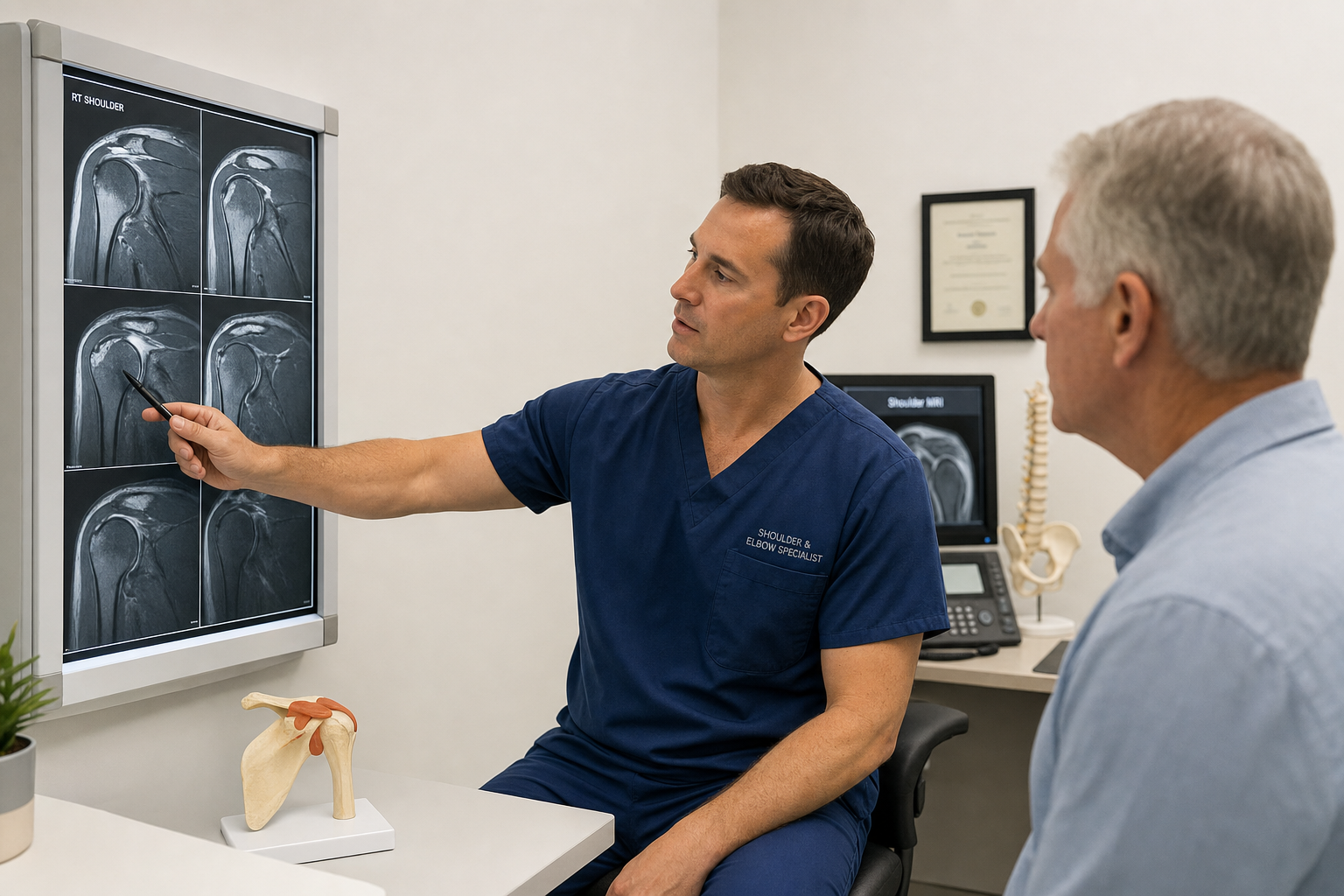
Double-fellowship-trained shoulder surgeon Dr. Amit Varma — who completed fellowships at the Rothman Institute under Dr. Michael Ciccotti and the Andrews Institute under Dr. James Andrews — evaluates each patient using a combination of physical examination, imaging review, and a detailed discussion of symptoms, history, and goals.
The evaluation typically includes assessment of shoulder strength, range of motion, impingement signs, and rotator cuff integrity. MRI is the gold standard for characterizing tear size, depth, and muscle quality. X-rays help rule out arthritis or bony abnormalities that might influence the treatment approach.
Varma Shoulder Institute provides comprehensive rotator cuff evaluations for patients throughout Clermont, Orlando, and Central Florida, with same-week consultation appointments available. Whether you are exploring therapy, considering surgery, or seeking a second opinion, our team will give you a clear, honest assessment of your options. Contact our Clermont shoulder team to get started.
For additional background on rotator cuff conditions, the NIH PubMed database contains peer-reviewed research on rotator cuff repair outcomes and conservative treatment protocols.
Common Mistakes Patients Make
Understanding what to avoid is just as important as knowing what to do. These are the most frequent missteps we see:
- Delaying evaluation entirely: Many patients wait months or years before seeing a specialist, hoping the pain will resolve on its own. For full-thickness tears, this delay can allow the tendon to retract and the muscle to atrophy, making repair more difficult.
- Assuming surgery is always the answer: Not every rotator cuff tear requires surgery. Pursuing an operation without a proper evaluation and a trial of appropriate conservative care can lead to unnecessary procedures.
- Stopping therapy too early: Patients who discontinue physical therapy after a few sessions because they feel better often experience a return of symptoms. Completing the full program is essential.
- Ignoring progressive weakness: Pain that improves but is accompanied by worsening arm weakness is a red flag. Weakness suggests ongoing structural compromise that therapy alone may not resolve.
- Self-diagnosing from imaging reports: MRI reports describe findings in technical language that requires clinical context. A radiologist’s report is not a treatment plan — a shoulder specialist’s evaluation is.
If you are weighing rotator cuff repair vs physical therapy and want a clear, expert answer for your specific situation, Dr. Varma and our team at Varma Shoulder Institute are ready to help — with same-week appointments and second opinions available within 48 hours. Call (352) 404-8956 or request your consultation online.
Frequently Asked Questions
Can a rotator cuff tear heal on its own without surgery?
Partial-thickness tears can sometimes stabilize and become less symptomatic with physical therapy and activity modification, but torn tendon tissue does not regenerate on its own. Full-thickness tears do not heal without surgical repair. A specialist evaluation with MRI is the only way to know which type of tear you have.
How long should I try physical therapy before considering rotator cuff surgery?
A structured course of six to twelve weeks is generally considered an adequate trial of conservative treatment for appropriate candidates. If pain, weakness, or function has not meaningfully improved by that point, surgical evaluation is warranted. Do not continue the same approach indefinitely if it is not working.
What is the difference between a partial and full-thickness rotator cuff tear?
A partial-thickness tear means the tendon is damaged but not completely severed — some fibers remain intact. A full-thickness tear means the tendon has torn all the way through, creating a hole. Full-thickness tears are more likely to require surgical repair, especially in active patients or when significant weakness is present. Learn more at OrthoInfo.
Is arthroscopic rotator cuff repair a major surgery?
Arthroscopic repair is minimally invasive — performed through small incisions using a camera and specialized instruments — which reduces tissue disruption compared to open surgery. However, it is still a surgical procedure requiring anesthesia and a structured rehabilitation period of several months. Recovery commitment is significant.
Does Varma Shoulder Institute offer second opinions for rotator cuff tears?
Yes. Dr. Varma and the team at Varma Shoulder Institute provide second opinions within 48 hours for patients who want clarity on their diagnosis or treatment options. Call (352) 404-8956 or visit varmashoulderinstitute.com to request an appointment.
What insurance plans does Varma Shoulder Institute accept?
Varma Shoulder Institute accepts Aetna, Cigna, Florida Blue/BCBS, UnitedHealthcare, Medicare, Tricare, and self-pay. Contact the office at (352) 404-8956 to verify your specific benefits before scheduling.
Can I get a same-week appointment to discuss my rotator cuff tear?
Yes. Varma Shoulder Institute offers same-week appointments for new patients in Clermont and throughout Central Florida. Call (352) 404-8956 or submit a request online to get scheduled quickly.
Update Log
- May 2026: Article reviewed and updated to reflect current clinical guidance on rotator cuff repair vs physical therapy decision-making, including updated outbound reference links and VSI service information.