

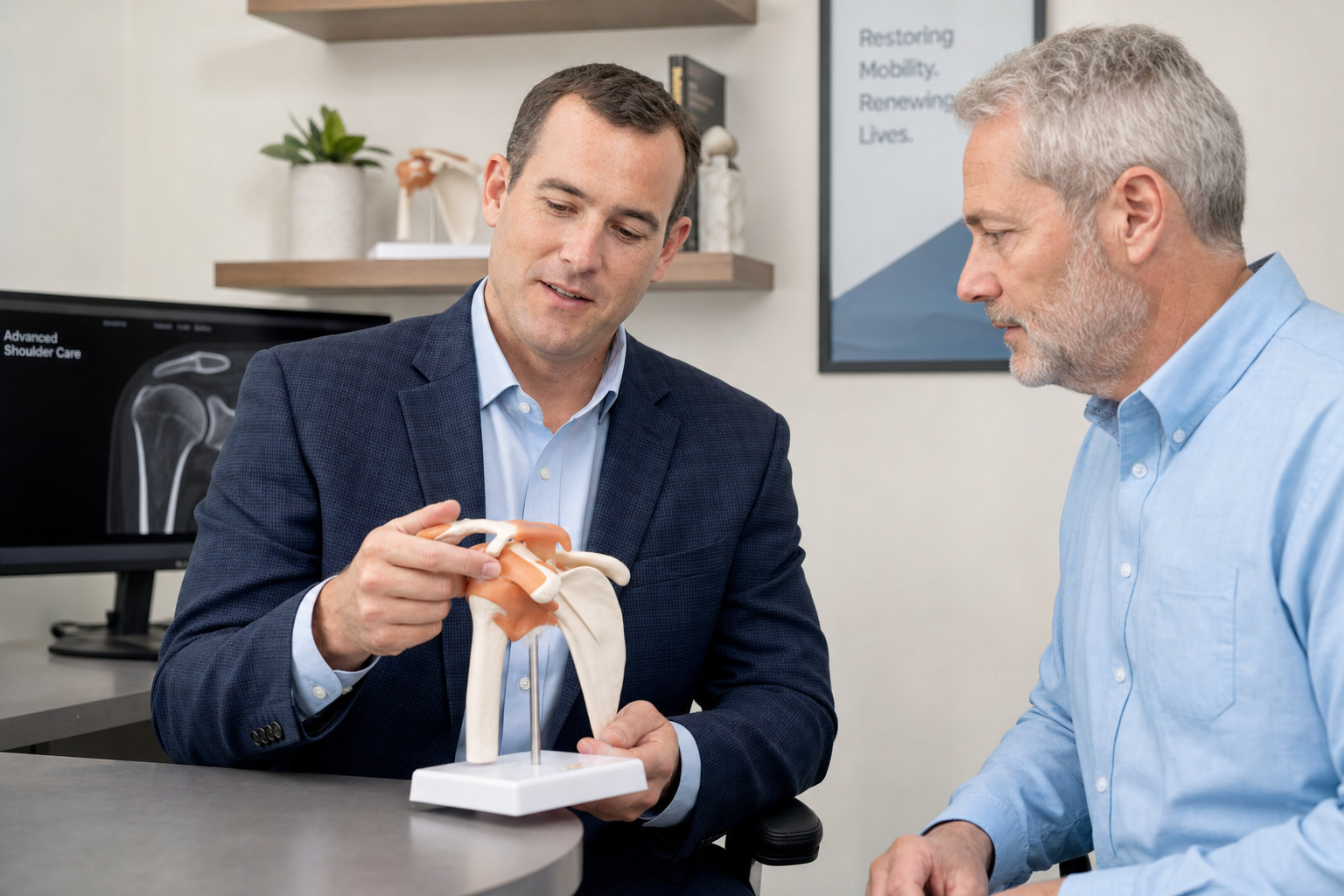
Shoulder Dislocation Surgery for Recurrent Instability
Shoulder dislocation surgery for recurrent instability is one of the most common reasons active patients seek specialized orthopedic care at Varma Shoulder Institute in Clermont, Florida. When the shoulder dislocates once, it can often be managed conservatively — but when it keeps coming out, the underlying structural damage typically requires surgical correction. Our team evaluates and treats recurrent shoulder instability using the most current arthroscopic and open stabilization techniques available.
Recurrent shoulder instability is not simply a matter of being “loose-jointed.” Each dislocation episode causes additional damage to the labrum, capsule, ligaments, and sometimes the bone itself. Understanding the anatomy and the pattern of injury is essential to choosing the right treatment. The information below reflects the clinical approach used at Varma Shoulder Institute and is consistent with current orthopedic guidelines from the American Academy of Orthopaedic Surgeons.
What Recurrent Shoulder Instability Means and Why It Keeps Happening
The shoulder is the most mobile joint in the body, which also makes it the most frequently dislocated. When the ball of the upper arm (humeral head) slips out of the socket (glenoid), it is called a dislocation. A first-time dislocation often tears the labrum — the ring of cartilage that deepens the socket and anchors the ligaments. This injury is called a Bankart lesion.
Once the labrum is torn and the ligaments are stretched, the joint loses its primary restraint against re-dislocation. Younger, more active patients are at the highest risk of recurrence. Without surgical repair of the torn labrum, the shoulder may continue to dislocate with progressively less force — eventually slipping out during routine movements like reaching overhead or rolling over in bed.
Bone loss compounds the problem. Each dislocation can chip away at the front edge of the glenoid socket or create an impression fracture on the back of the humeral head (called a Hill-Sachs lesion). When bone loss exceeds a critical threshold, soft-tissue repair alone may not be sufficient to restore stability.
When Repeated Shoulder Dislocations May Require Surgery
Not every shoulder dislocation requires surgery. A first-time dislocation in an older, low-demand patient may respond well to physical therapy and activity modification. However, surgery becomes a serious consideration when:
- The shoulder has dislocated two or more times despite conservative treatment
- The patient is young, active, or participates in overhead or contact sports
- Imaging confirms a Bankart lesion, significant bone loss, or a large Hill-Sachs defect
- The patient experiences ongoing feelings of instability or “giving way” even without a full dislocation
- Quality of life or athletic participation is significantly limited by fear of re-dislocation
At Varma Shoulder Institute, we evaluate each patient individually. The decision to recommend surgery is based on the full clinical picture — not just the number of dislocation episodes.
How a Shoulder Surgeon Evaluates Recurrent Instability
A thorough evaluation is the foundation of effective treatment planning. At Varma Shoulder Institute, the evaluation for recurrent shoulder instability typically includes:
- Detailed history: How many dislocations, what direction, what activity triggered each episode, and whether the shoulder reduces spontaneously or requires manual reduction
- Physical examination: Apprehension and relocation tests, load-and-shift testing, assessment of generalized ligamentous laxity
- X-rays: To identify glenoid bone loss, Hill-Sachs lesions, and bony Bankart fragments
- MRI or MRI arthrogram: To visualize the labrum, capsule, rotator cuff, and cartilage in detail
- CT scan (when indicated): To quantify bone loss on the glenoid — a critical factor in choosing between Bankart repair and the Latarjet procedure
The AAOS and the American Shoulder and Elbow Surgeons both emphasize that accurate diagnosis — including bone loss quantification — is essential before selecting a surgical approach for glenohumeral instability.
Surgical Options for Repeated Shoulder Dislocation Episodes
The two most commonly performed procedures for recurrent shoulder instability are the arthroscopic Bankart repair and the Latarjet procedure. The right choice depends on the degree of bone loss, the patient’s activity level, and the specific anatomy of the injury.
Arthroscopic Bankart Repair
This is the most frequently performed surgery for recurrent instability in patients with minimal bone loss. Using small incisions and a camera, the surgeon reattaches the torn labrum to the glenoid rim with suture anchors and tightens the stretched capsule. It is a minimally invasive procedure with a relatively predictable recovery. Learn more about shoulder arthroscopy from the AAOS OrthoInfo resource on shoulder arthroscopy.
Latarjet Procedure
When glenoid bone loss is significant — generally considered to be 20 to 25 percent or more of the glenoid surface — a Bankart repair alone carries a higher risk of failure. The Latarjet procedure transfers a piece of bone (the coracoid process) along with its attached tendon to the front of the glenoid socket. This simultaneously restores the bony architecture of the socket and adds a dynamic sling effect from the transferred tendon, providing robust stability even in high-demand athletes.
Remplissage
In some cases, a Hill-Sachs lesion on the humeral head is large enough to engage the glenoid rim during shoulder movement, contributing to instability. A remplissage procedure fills the Hill-Sachs defect with soft tissue to prevent engagement. It is often performed in combination with an arthroscopic Bankart repair.
Double-fellowship-trained shoulder surgeon Dr. Amit Varma — who completed advanced training at the Rothman Institute under Dr. Michael Ciccotti and at the Andrews Institute under Dr. James Andrews — performs all of these procedures and tailors the surgical plan to each patient’s anatomy and goals.
What Recovery Looks Like After Shoulder Stabilization Surgery
Recovery after shoulder dislocation surgery follows a structured, phased approach. The timeline varies depending on the procedure performed and the patient’s individual healing, but a general framework looks like this:
- Weeks 1 to 4: The arm is kept in a sling. Gentle pendulum exercises and hand/wrist range of motion are permitted. Pain and swelling are managed with medication and ice.
- Weeks 4 to 8: The sling is discontinued. Passive and active-assisted range-of-motion exercises begin under the guidance of a physical therapist.
- Weeks 8 to 16: Active range of motion and progressive strengthening of the rotator cuff and periscapular muscles. Focus on restoring full elevation and rotation.
- Months 4 to 6: Sport-specific or work-specific conditioning. Return-to-sport testing may be performed to confirm readiness.
Our team at Varma Shoulder Institute coordinates closely with physical therapists throughout the recovery process to ensure patients progress safely and do not return to activity before the repaired tissue has adequately healed.
Return to Sports, Work, and Daily Activity After Surgery
Most patients who undergo arthroscopic Bankart repair can expect to return to non-contact sports and light physical work within four to five months. Contact sports and overhead athletic activities typically require five to six months or longer, depending on the procedure and the demands of the sport.
Patients who undergo the Latarjet procedure may have a slightly different timeline due to the bone healing required at the transfer site, but the long-term stability outcomes are excellent for high-demand athletes and laborers.
Desk work and light daily activities can usually resume within two to four weeks after surgery, once the sling is no longer required for most tasks. Driving restrictions depend on which shoulder was operated on and the patient’s pain level — our team provides individualized guidance at each follow-up visit.
Risks, Benefits, and What Happens If Instability Is Left Untreated
Like all surgical procedures, shoulder stabilization surgery carries risks including infection, nerve injury, stiffness, hardware complications, and the possibility of re-dislocation. These risks are low in experienced hands, and the benefits — restored stability, reduced pain, and the ability to return to full activity — typically outweigh them for patients with recurrent instability.
Leaving recurrent instability untreated carries its own significant risks. Each dislocation episode causes additional damage to the cartilage, labrum, and bone. Over time, this cumulative damage accelerates the development of glenohumeral arthritis, which is a far more complex and less reversible condition. Patients who delay treatment often require more extensive surgery later — including, in some cases, shoulder replacement.
For a comprehensive overview of shoulder instability and its consequences, the AAOS patient education page on dislocated shoulder provides reliable, evidence-based information.
When to Schedule a Shoulder Instability Consultation in Clermont
Varma Shoulder Institute provides shoulder dislocation surgery and instability evaluation for patients throughout Clermont, Orlando, and Central Florida, with same-week consultation appointments available. You do not need to wait for another dislocation episode to seek care. If your shoulder feels unstable, catches, or you are avoiding activities out of fear of re-dislocation, that is reason enough to be evaluated.
We also offer second opinions within 48 hours for patients who have already been told they need surgery and want to confirm the recommended approach. Whether you are an athlete, a manual laborer, or simply someone who wants to reach overhead without anxiety, our team is here to help you find a lasting solution. To schedule your shoulder instability evaluation, call (352) 404-8956 or contact us online.
Common Mistakes Patients Make With Recurrent Shoulder Instability
Patients dealing with repeated shoulder dislocations often make decisions that delay effective treatment or worsen their long-term outcome. The most common mistakes include:
- Waiting for “one more” dislocation before seeking care: Each episode causes additional structural damage. Earlier evaluation leads to simpler, more effective surgical options.
- Assuming physical therapy alone will fix a structural problem: Strengthening exercises can improve dynamic stability but cannot reattach a torn labrum or restore lost bone. PT is valuable as part of a comprehensive plan, not as a substitute for addressing the underlying anatomy.
- Ignoring bone loss on imaging: Patients sometimes receive a recommendation for Bankart repair without adequate assessment of glenoid bone loss. Proceeding with soft-tissue repair when significant bone loss is present increases the risk of surgical failure.
- Returning to sport too early: The repaired labrum needs time to heal to bone. Returning to contact or overhead sports before the tissue is ready significantly increases re-dislocation risk.
- Self-managing repeated dislocations at home: Patients who learn to self-reduce their shoulder may delay seeking care for years, allowing progressive bone loss and cartilage damage to accumulate silently.
Frequently Asked Questions
How many dislocations does it take before surgery is recommended?
There is no fixed number. Surgery is typically considered after two or more dislocations, especially in younger or active patients, or when imaging shows significant structural damage such as a Bankart lesion or bone loss. Some patients — particularly young athletes — may be candidates after a single dislocation if the risk of recurrence is high.
What is the difference between a Bankart repair and the Latarjet procedure?
A Bankart repair reattaches the torn labrum to the glenoid rim using suture anchors and is performed arthroscopically. The Latarjet procedure transfers a piece of bone to the front of the socket to restore lost bone and add a tendon sling effect. The Latarjet is preferred when significant glenoid bone loss is present, as Bankart repair alone has a higher failure rate in that setting.
How long does recovery take after shoulder stabilization surgery?
Most patients wear a sling for four to six weeks, begin physical therapy shortly after, and return to non-contact activities within four to five months. Return to contact sports or heavy labor typically takes five to six months or longer, depending on the procedure and individual healing.
Can shoulder instability be treated without surgery?
A first-time dislocation in a low-demand patient can often be managed with physical therapy and activity modification. However, recurrent instability — especially with confirmed labral tearing or bone loss — rarely resolves with conservative care alone. Surgery is usually necessary to restore structural stability and prevent further joint damage.
What happens if recurrent shoulder instability is left untreated?
Repeated dislocations cause progressive damage to the labrum, cartilage, and bone of the shoulder joint. Over time, this accelerates the development of glenohumeral arthritis, which is more difficult to treat and may eventually require shoulder replacement surgery.
Does Varma Shoulder Institute treat recurrent shoulder instability?
Yes. Dr. Amit Varma at Varma Shoulder Institute in Clermont, Florida performs arthroscopic Bankart repair, the Latarjet procedure, and remplissage for patients with recurrent shoulder instability. Same-week consultations are available. Call (352) 404-8956 to schedule your evaluation.
Does insurance cover shoulder instability surgery?
Most major insurance plans — including Aetna, Cigna, Florida Blue/BCBS, UnitedHealthcare, Medicare, and Tricare — cover medically necessary shoulder stabilization surgery. Coverage details vary by plan. Contact Varma Shoulder Institute at (352) 404-8956 to verify your benefits before scheduling.
Update Log
- May 2026: Article reviewed and updated to reflect current surgical indications for Bankart repair and Latarjet procedure, including bone loss thresholds and return-to-sport timelines consistent with current orthopedic practice guidelines.