

AC Joint Pain After a Fall: Treatment Options
AC joint shoulder pain after a fall is one of the most common shoulder injuries we see at Varma Shoulder Institute, affecting athletes, active adults, and anyone who has landed hard on an outstretched arm or directly on the shoulder. The acromioclavicular (AC) joint sits at the very top of the shoulder where the collarbone meets the shoulder blade, and even a moderate impact can stretch or tear the ligaments that hold it together. Understanding your injury grade and the right treatment path can make a significant difference in how quickly and fully you recover.
AC joint injuries are frequently misunderstood or undertreated because the initial pain can seem manageable. However, without proper diagnosis and grading, patients risk prolonged pain, instability, and long-term shoulder dysfunction. The sections below walk through what to expect at each stage — from recognizing symptoms to choosing the right treatment path.
What AC Joint Pain Feels Like After a Fall
The hallmark symptom of an AC joint injury is sharp or aching pain directly at the top of the shoulder — not deep inside the joint, but right at the bony bump where the collarbone ends. After a fall, patients often notice immediate tenderness when pressing on that area, along with swelling and sometimes visible deformity if the collarbone has shifted upward. Raising the arm overhead or reaching across the body (cross-body adduction) typically reproduces the pain. Some patients also describe a grinding or clicking sensation with shoulder movement.
It is important to distinguish AC joint pain from rotator cuff pain, which tends to be felt deeper in the shoulder and radiates differently. An accurate diagnosis is the essential first step. You can learn more about general shoulder pain and common shoulder problems from the American Academy of Orthopaedic Surgeons.
Common Causes of Top-of-Shoulder Pain After Impact or Lifting
The most frequent mechanism of AC joint injury is a direct fall onto the tip of the shoulder — common in cycling accidents, contact sports, and workplace falls. Landing on an outstretched hand can also transmit force up through the arm into the AC joint. Less commonly, repetitive overhead lifting or heavy weightlifting can cause gradual AC joint degeneration that becomes symptomatic after even minor trauma.
At Varma Shoulder Institute, we evaluate the full mechanism of injury during your consultation because how the injury occurred directly influences which ligaments are involved and how severe the separation is likely to be. If you are experiencing top-of-shoulder pain after a fall, schedule a shoulder evaluation at Varma Shoulder Institute so we can determine the exact source of your pain and rule out concurrent injuries such as a rotator cuff tear or clavicle fracture.
How AC Joint Injuries Are Diagnosed
Diagnosis begins with a thorough physical examination. Dr. Amit Varma, a double-fellowship-trained shoulder surgeon who completed training at the Rothman Institute and the Andrews Institute, uses a combination of hands-on assessment and imaging to classify the injury accurately. Key physical exam maneuvers include the cross-body adduction test and direct palpation of the AC joint. X-rays are taken in a standing (weight-bearing) position to assess joint alignment and identify any upward displacement of the clavicle. In some cases, an MRI is ordered to evaluate the surrounding ligaments and rule out rotator cuff involvement.
AC Joint Injury Grades and What They Mean
AC joint injuries are classified using the Rockwood grading system, which ranges from Grade 1 (mild ligament sprain, no displacement) to Grade 6 (severe displacement, rare). Here is a practical overview:
- Grade 1: The AC ligament is sprained but intact. The joint looks normal on X-ray. Pain is localized and typically resolves with conservative care within a few weeks.
- Grade 2: The AC ligament is torn, but the coracoclavicular (CC) ligaments remain intact. Mild upward displacement may be visible. Most Grade 2 injuries are managed non-surgically.
- Grade 3: Both the AC and CC ligaments are torn. The clavicle is visibly elevated. Treatment is debated — many patients do well without surgery, but some require reconstruction, particularly those with physically demanding jobs or high athletic demands.
- Grades 4–6: Significant displacement in various directions. These injuries almost always require surgical reconstruction to restore shoulder stability and function.
The AAOS OrthoInfo resource on shoulder problems provides additional context on how shoulder joint injuries are evaluated and managed.
Non-Surgical Treatment Options for AC Joint Pain
The majority of Grade 1 and Grade 2 AC joint injuries — and many Grade 3 injuries — respond well to non-surgical management. At Varma Shoulder Institute, our non-surgical approach typically includes:
- Sling immobilization: A sling is used for comfort during the first one to three weeks to reduce stress on the injured ligaments.
- Ice and anti-inflammatory medication: Helps control swelling and pain in the acute phase.
- Physical therapy: Once acute pain subsides, a structured rehabilitation program restores range of motion, strengthens the rotator cuff and periscapular muscles, and improves shoulder stability.
- Corticosteroid or PRP injection: For persistent pain that does not respond to initial conservative measures, a targeted injection into the AC joint can reduce inflammation and support healing.
Our team monitors progress closely. If pain or instability persists beyond the expected recovery window, we reassess and discuss whether surgical options are appropriate.
When Surgery May Be the Best Option
Surgery for AC joint injuries is generally considered when non-surgical treatment has failed to relieve pain or restore function, or when the initial injury is severe enough (Grade 4, 5, or 6) that reconstruction is the appropriate first-line approach. Surgical options include arthroscopic-assisted AC joint reconstruction, which uses grafts or synthetic tape to recreate the torn ligaments and restore the normal relationship between the clavicle and the shoulder blade.
For patients with chronic AC joint pain from old injuries or post-traumatic arthritis, a distal clavicle resection — removing a small portion of the end of the collarbone — can eliminate the bone-on-bone contact that causes ongoing pain. This procedure is frequently performed arthroscopically with a short recovery period. Learn more about shoulder arthroscopy as a treatment approach from OrthoInfo. Our team at Varma Shoulder Institute will walk you through every surgical option, expected outcomes, and recovery before any decision is made. Contact our Clermont shoulder team to discuss whether surgery is right for your situation.
Recovery Timeline: Healing, Return to Activity, and Physical Therapy
Recovery from an AC joint injury varies significantly by grade and treatment approach:
- Grade 1: Most patients return to full activity within two to four weeks with appropriate rest and physical therapy.
- Grade 2: Recovery typically takes four to eight weeks. Physical therapy is important to prevent stiffness and rebuild strength.
- Grade 3 (non-surgical): Return to full activity may take eight to twelve weeks depending on the demands of the patient’s work or sport.
- Surgical reconstruction: Full recovery generally takes four to six months, with a structured physical therapy program beginning shortly after surgery and progressing through range-of-motion, strengthening, and sport- or work-specific phases.
Adherence to physical therapy is one of the strongest predictors of a good outcome. Patients who skip or shorten their rehabilitation often experience lingering weakness or instability even after the ligaments have healed.
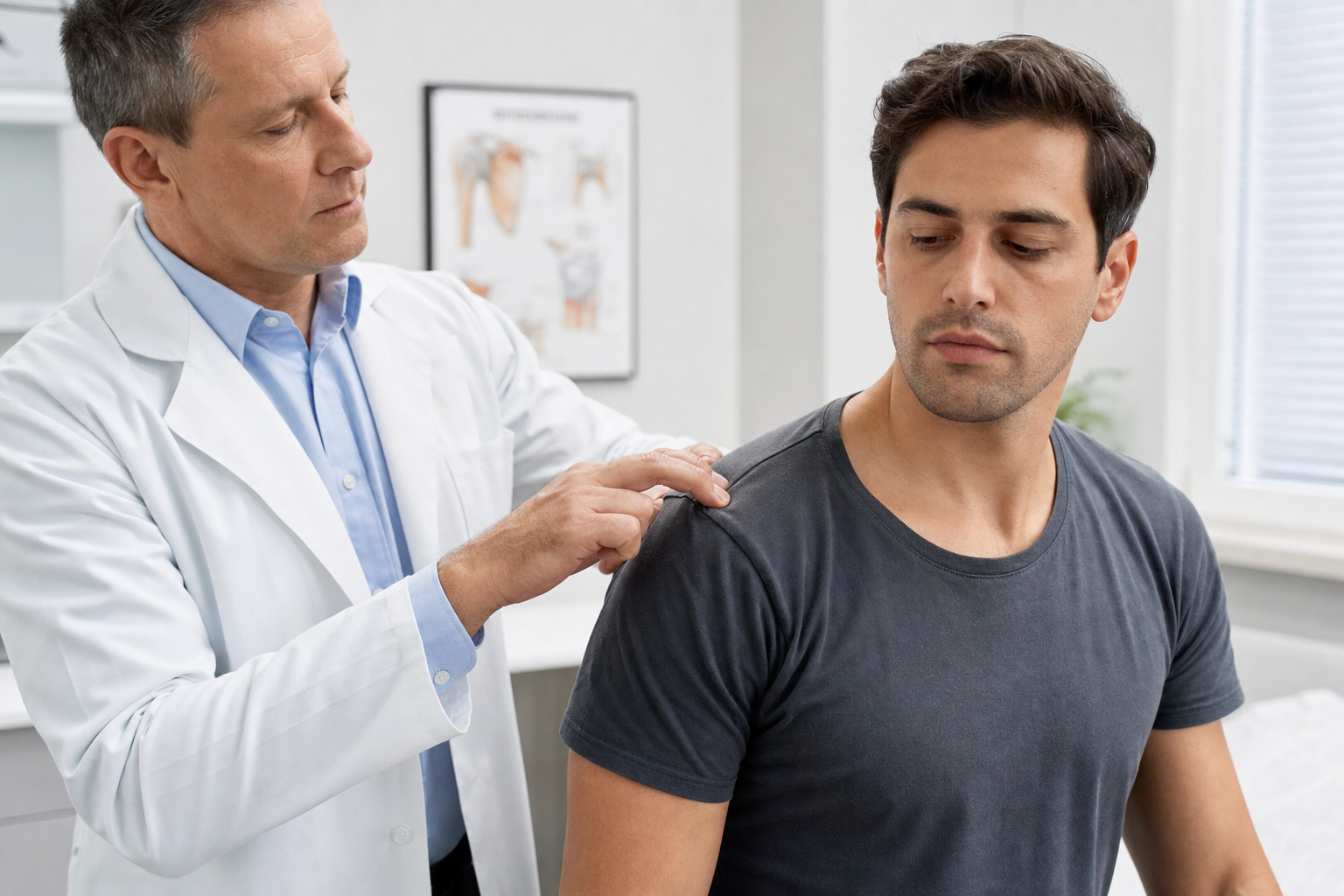
A Closer Look: What an AC Joint Evaluation Looks Like
Common Mistakes Patients Make After an AC Joint Injury
- Assuming it will heal on its own without evaluation: Without imaging, it is impossible to know the injury grade. Undertreated Grade 3 injuries can lead to chronic instability.
- Returning to activity too soon: Resuming overhead lifting or contact sports before the ligaments have adequately healed increases the risk of re-injury and worsening displacement.
- Skipping physical therapy: Sling use alone does not rebuild the muscle strength needed to protect the AC joint. Physical therapy is a critical part of recovery at every grade.
- Delaying evaluation of a Grade 3 injury: The window for optimal surgical reconstruction, if needed, is generally within the first few weeks of injury. Waiting too long can complicate the repair.
- Self-diagnosing based on pain level alone: Severe injuries can sometimes feel less painful initially due to adrenaline or swelling patterns. Pain intensity does not reliably indicate injury severity.
When to See a Shoulder Specialist in Clermont
If you have fallen and are experiencing pain at the top of your shoulder, visible deformity, significant swelling, or difficulty moving your arm, you should seek evaluation promptly. Varma Shoulder Institute provides AC joint injury evaluation and treatment for patients throughout Clermont, Orlando, and Central Florida, with same-week consultation appointments available. Our practice accepts Aetna, Cigna, Florida Blue/BCBS, UnitedHealthcare, Medicare, Tricare, and self-pay patients.
We also offer second opinions within 48 hours for patients who have already received a diagnosis elsewhere and want expert confirmation before proceeding with treatment. The American Shoulder and Elbow Surgeons recognizes AC joint reconstruction as a specialized procedure — and at VSI, this is exactly the type of care we are trained and equipped to provide.
Frequently Asked Questions
How do I know if I separated my shoulder or just bruised it after a fall?
A shoulder separation (AC joint injury) typically causes pain specifically at the top of the shoulder, tenderness directly over the AC joint, and sometimes a visible bump where the clavicle has shifted upward. A bruise alone does not cause joint instability or deformity. An X-ray is the most reliable way to distinguish between the two — schedule an evaluation at Varma Shoulder Institute for an accurate diagnosis.
Can a Grade 3 AC joint separation heal without surgery?
Many Grade 3 AC joint separations do heal successfully with non-surgical treatment, including sling use and physical therapy. However, some patients — particularly those with high physical demands or persistent instability — benefit from surgical reconstruction. The decision depends on your specific anatomy, activity level, and how the injury responds to conservative care.
How long does AC joint pain last after a fall?
Grade 1 injuries often resolve within two to four weeks. Grade 2 injuries may take four to eight weeks. Grade 3 injuries managed non-surgically can take up to three months for full recovery. Surgical cases typically require four to six months of rehabilitation before returning to full activity.
Is AC joint surgery performed arthroscopically?
Many AC joint procedures, including distal clavicle resection and some reconstruction techniques, can be performed arthroscopically or with minimally invasive assistance. Dr. Varma at Varma Shoulder Institute will determine the most appropriate surgical approach based on your injury grade and anatomy.
What happens if an AC joint injury is left untreated?
Untreated or undertreated AC joint injuries can lead to chronic shoulder pain, weakness, instability, and post-traumatic arthritis at the AC joint. Higher-grade injuries that are not properly managed may result in permanent deformity and functional limitations that are more difficult to correct later.
Does Varma Shoulder Institute offer second opinions for AC joint injuries?
Yes. Varma Shoulder Institute offers second opinions within 48 hours for patients who have already received a diagnosis and want expert confirmation before proceeding with treatment. Call (352) 404-8956 or visit our website to request an appointment.
What insurance plans does Varma Shoulder Institute accept?
Varma Shoulder Institute accepts Aetna, Cigna, Florida Blue/BCBS, UnitedHealthcare, Medicare, Tricare, and self-pay patients. Contact our office at (352) 404-8956 to verify your specific benefits before scheduling.
Update Log
- May 2026: Article published covering AC joint injury grades, non-surgical and surgical treatment options, recovery timelines, and guidance on when to seek specialist evaluation at Varma Shoulder Institute in Clermont, Florida.