


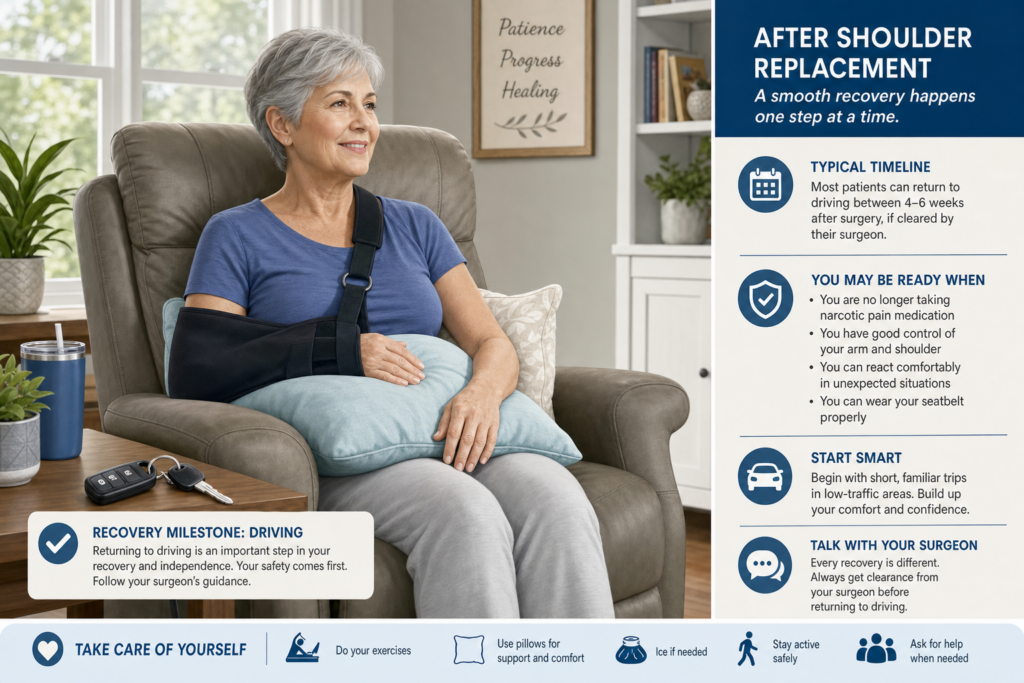
Shoulder Replacement Recovery: Sleeping and Driving
Understanding the shoulder replacement recovery timeline for sleeping and driving is one of the most practical concerns patients have before and after surgery. Two common questions are: when can you sleep more comfortably again, and when can you get back behind the wheel? This guide focuses on those milestones with practical, evidence-informed advice, while emphasizing that individual clearance comes from your own surgeon.
This article focuses on the sleeping and driving milestones within the broader recovery process. For a more general overview of rehab phases, read our full shoulder replacement recovery timeline. This narrower article is designed to answer the specific questions patients often ask at home after surgery.
Why Sleeping and Driving Are Major Milestones After Shoulder Replacement
Shoulder replacement recovery affects comfort, independence, and safety at home. Sleep disruption is common in the early weeks, and driving requires more than just less pain. A patient needs enough comfort, control, strength, and reaction time to handle the steering wheel and unexpected traffic situations safely.
AAOS patient guidance notes that recovery from joint replacement is different for everyone, that driving usually resumes only after narcotic pain medicine is no longer needed, and that sleeping position questions should be discussed with the surgeon based on the specific joint replacement performed.
If you are still deciding whether surgery is the right step, the shoulder replacement service page and the article on shoulder arthritis provide more background on candidacy and treatment planning.

Typical Recovery Timeline: Week by Week
There is no single universal protocol, but the following is a reasonable high-level framework for total shoulder arthroplasty recovery. Your own surgeon may move faster or slower depending on tissue quality, implant type, associated repairs, and your progress in rehabilitation.
- Weeks 1–2: Pain, swelling, and sleep disruption are usually most noticeable. The arm is typically protected in a sling. Driving is not appropriate.
- Weeks 3–4: Many patients are still using the sling for much of the day. Sleeping may still be easier in a recliner or with the upper body elevated. Therapy commonly focuses on protected motion.
- Weeks 5–6: Some patients begin transitioning out of the sling, depending on surgeon instructions. Bed sleeping may become more tolerable. Driving discussions sometimes begin around this stage for selected patients, but not automatically.
- Weeks 7–12: Active motion usually advances. Driving may become more realistic if pain is controlled, narcotics are stopped, and arm function is adequate.
- Months 3–6: Function and comfort often continue improving. Strength and endurance still develop over time, and full recovery can continue for many months.
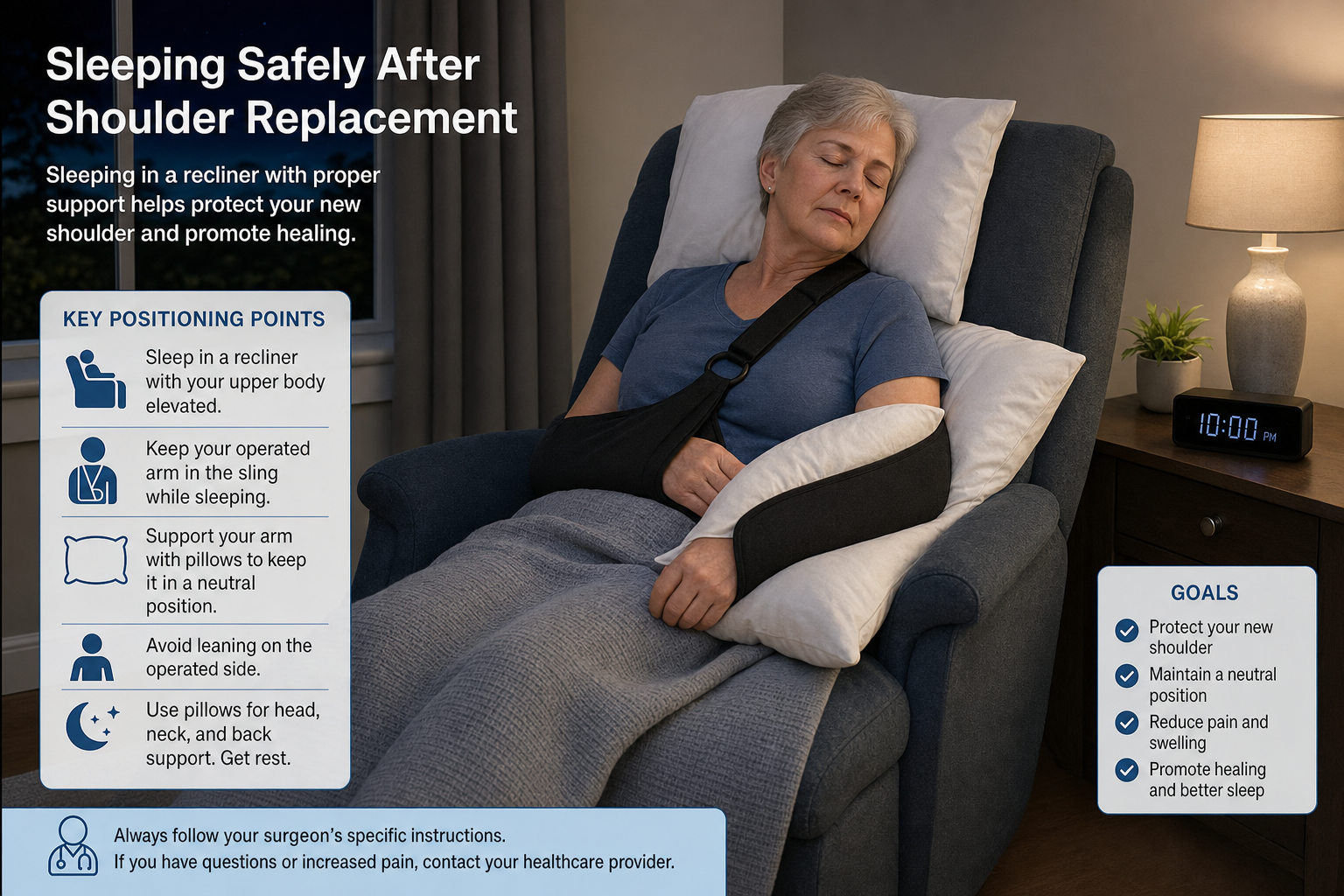
AAOS notes that patients usually leave the hospital with the arm in a sling and may need that sling for about 2 to 6 weeks, depending on the complexity of surgery and surgeon preference. For rehabilitation support, VSI also offers shoulder physical therapy.
When You Can Sleep More Comfortably After Shoulder Replacement
Sleep often improves gradually rather than all at once. Early after surgery, many patients find that swelling, position changes, and accidental shoulder movement interrupt sleep. It is common to need an elevated setup at first rather than sleeping flat.
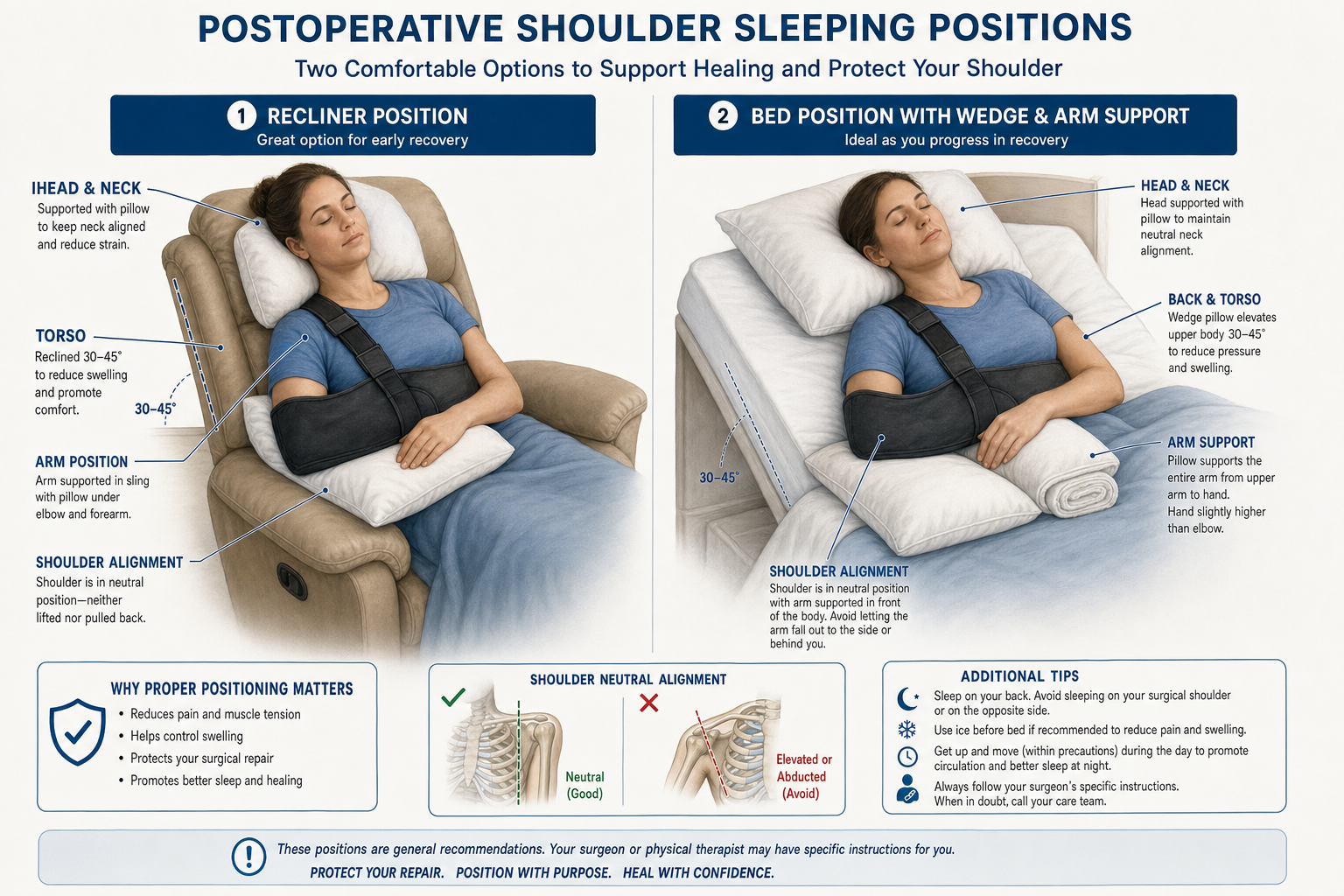
AAOS shoulder replacement guidance says some patients are more comfortable for several weeks either in a recliner or using a large wedge pillow to elevate the back. In practice, many patients start sleeping more comfortably around weeks 4 to 6, but the timeline can be longer, especially after reverse shoulder replacement or when preoperative stiffness was severe.
Because sleeping comfort is influenced by pain, swelling, sling use, and the exact repair performed, it is better to think in terms of gradual progress than a fixed date.
Best Sleeping Positions, Recliner Tips, and Pillow Setups
The goal is to protect the healing shoulder while reducing strain and helping you rest.
- Recliner setup: A recliner can limit rolling and keep the trunk elevated. Many patients find this easiest in the first phase of recovery.
- Wedge pillow setup: If you prefer a bed, a wedge pillow or stacked firm pillows can create a semi-reclined position.
- Arm support: A small pillow or folded towel under the forearm can help support the arm and reduce the feeling of the shoulder pulling downward.
- Avoid pressure on the operated shoulder: Sleeping directly on the surgical side is usually uncomfortable and is generally avoided until the surgeon says otherwise.
- Night sling instructions matter: Some patients are told to keep the sling on while sleeping during the early healing phase, while others may transition differently based on the procedure.
If you are recovering from a reverse procedure, you may also find the VSI pages on reverse shoulder replacement for cuff arthropathy and reverse shoulder replacement for rotator cuff arthritis symptoms helpful for understanding the condition that often leads to that surgery.
When It May Be Safe to Drive Again After Shoulder Replacement
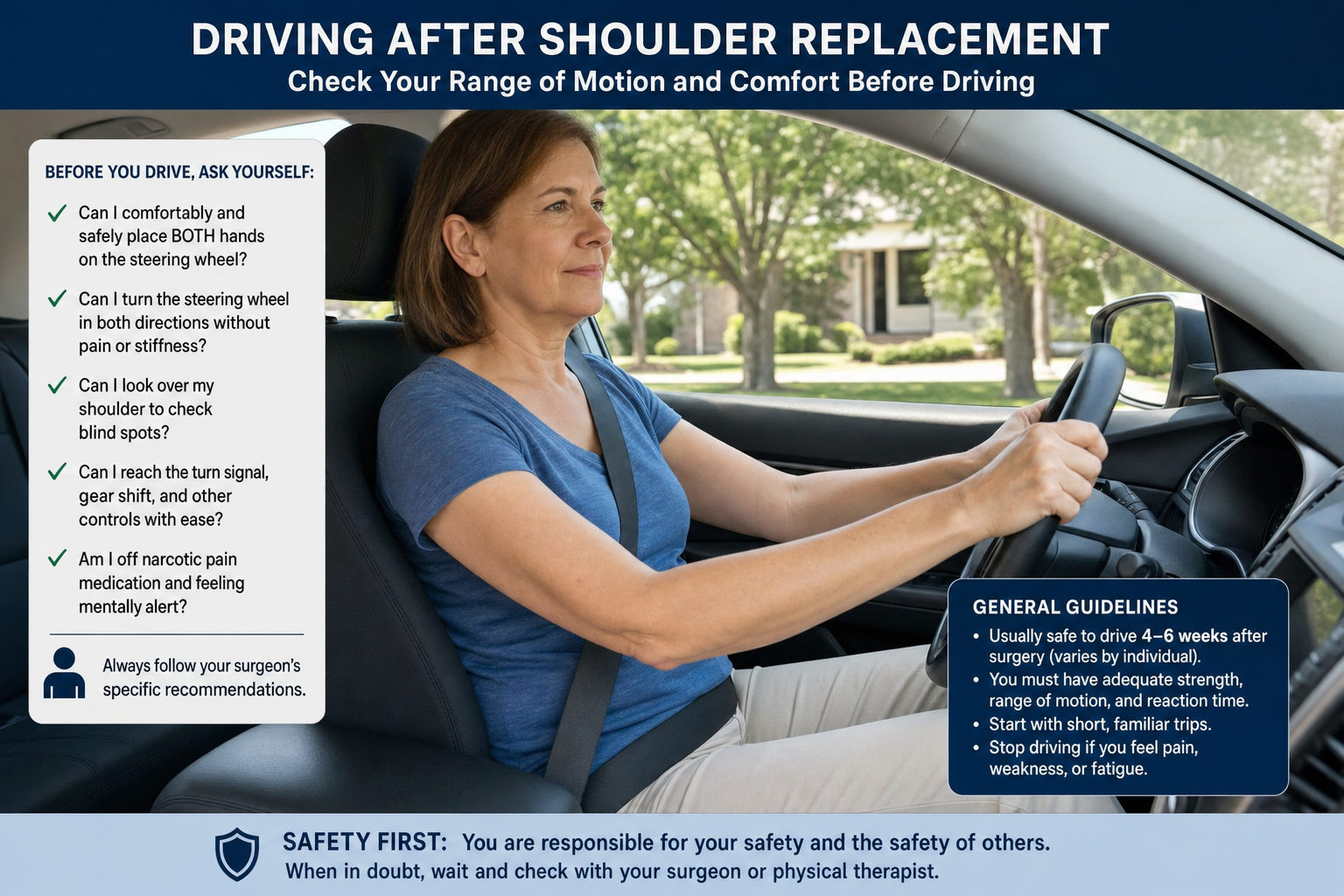
Driving after shoulder replacement depends on function and safety, not just time on the calendar. A 2016 systematic review reported that patients returned to driving about 1 to 3 months after total shoulder arthroplasty, while emphasizing that strength, motion, and opioid use also matter. A shoulder-specific simulator study found driving performance returned to preoperative levels at 6 weeks, with a gradual return window of 6 to 12 weeks being a reasonable counseling range.
A later comparative analysis of anatomic and reverse shoulder arthroplasty found that patient-specific factors and procedure type can affect timing. In that study, surgical complications in anatomic TSA and prolonged narcotic use in reverse TSA were associated with return to driving later than 6 weeks.
In other words, some patients may be ready closer to 6 weeks, but others should wait longer.
Sling Use, Pain Medication, and Reaction Time
Three issues commonly determine whether driving is reasonable: sling status, medication effects, and actual driving ability.
- Sling use: If the shoulder is still immobilized, steering and emergency maneuvers are limited.
- Opioid pain medication: AAOS patient guidance advises waiting until narcotic pain medication is no longer being taken before driving again.
- Functional control: You need to be able to reach, steer, and respond quickly enough for safe braking and lane changes.
Patients often ask, “When can you drive after shoulder replacement?” A safer version of that question is: can you control the vehicle safely without a sling, without sedating medication, and without sharp pain when you steer? If the answer is no, it is too early.
Anatomic vs. Reverse Shoulder Replacement Recovery
Anatomic total shoulder arthroplasty and reverse shoulder replacement do not always recover in the same way. Reverse shoulder replacement changes shoulder mechanics and relies more on the deltoid muscle than the rotator cuff. That can affect function, comfort with certain motions, and the pace at which daily activities feel manageable.
Evidence on exact differences in sleeping and driving milestones is still limited, so it is more accurate to say that recovery may differ rather than promising a fixed faster or slower path. If you are unsure whether your current symptoms suggest persistent problems after surgery, VSI also has information on failed shoulder replacement symptoms and shoulder revision surgery.
Warning Signs to Call Your Surgeon About During Home Recovery
Call your surgeon promptly if you have symptoms that suggest a complication rather than routine soreness. Examples include:
- fever, chills, or feeling acutely ill
- increasing redness, drainage, or warmth at the incision
- worsening pain instead of gradual improvement
- new numbness, weakness, or sudden loss of motion
- significant swelling that is worsening rather than settling
If symptoms are severe, rapidly worsening, or accompanied by shortness of breath, chest pain, or signs of emergency, seek urgent medical care rather than waiting for a routine callback.
Frequently Asked Questions
When can I sleep flat in a bed after shoulder replacement?
Many patients transition from a recliner or wedge-supported setup to a flatter bed position after the early healing phase, often around weeks 4 to 6, but some need longer. Comfort, swelling, night pain, and surgeon instructions all affect timing.
Is it better to sleep in a recliner after shoulder replacement surgery?
For many patients, yes. A recliner can reduce strain on the shoulder, keep the upper body elevated, and make it easier to avoid rolling onto the operative side in the first weeks after surgery.
When can I drive after right shoulder replacement?
Right-sided surgery often affects steering and vehicle control more directly, so clearance may take longer. Many patients are not ready until sometime in the 6- to 12-week range, and some need more time. You should not drive until the sling is off, opioids are stopped, and your surgeon clears you.
Can I drive while wearing a sling after shoulder replacement?
No. A sling limits steering and emergency reaction ability, so patients should not drive while wearing one.
How long do I need help at home after shoulder replacement?
Many patients benefit from help during at least the first several days to couple of weeks, especially with transportation, dressing, meal preparation, and tasks that need two hands. The exact amount depends on which arm was operated on, your home setup, and your overall health.
Is recovery different after reverse shoulder replacement?
It can be. Reverse shoulder replacement changes shoulder mechanics, so comfort, function, and rehab progression may not match anatomic total shoulder arthroplasty exactly. Your own procedure and surgeon protocol matter more than any single generic timeline.
Sources
- AAOS: After Your Joint Replacement Surgery
- AAOS: Outpatient Total Joint Replacement
- When Can I Drive After Orthopaedic Surgery? A Systematic Review
- Changes in Driving Performance Following Shoulder Arthroplasty
- Return to driving following anatomic and reverse shoulder arthroplasty: a comparative analysis
Update Log
- 2026-09-25: Article published with verified patient guidance on sleeping setup, sling-related driving restrictions, and evidence-based return-to-driving ranges after shoulder replacement.