

PRP Shoulder Injections in Clermont for Partial Tears
PRP shoulder injections in Clermont are an increasingly discussed non-surgical option for patients dealing with partial rotator cuff tears and chronic shoulder tendon pain. At Varma Shoulder Institute, we evaluate each patient individually to determine whether platelet-rich plasma therapy is an appropriate part of their treatment plan. Understanding what PRP can and cannot do is essential before committing to any shoulder care path.
Partial rotator cuff tears are among the most common sources of chronic shoulder pain in active adults. Before recommending any treatment, our team reviews imaging, symptom history, and functional limitations to build a plan that fits the individual patient — not a one-size-fits-all protocol.
When PRP Shoulder Injections May Help a Partial Tear
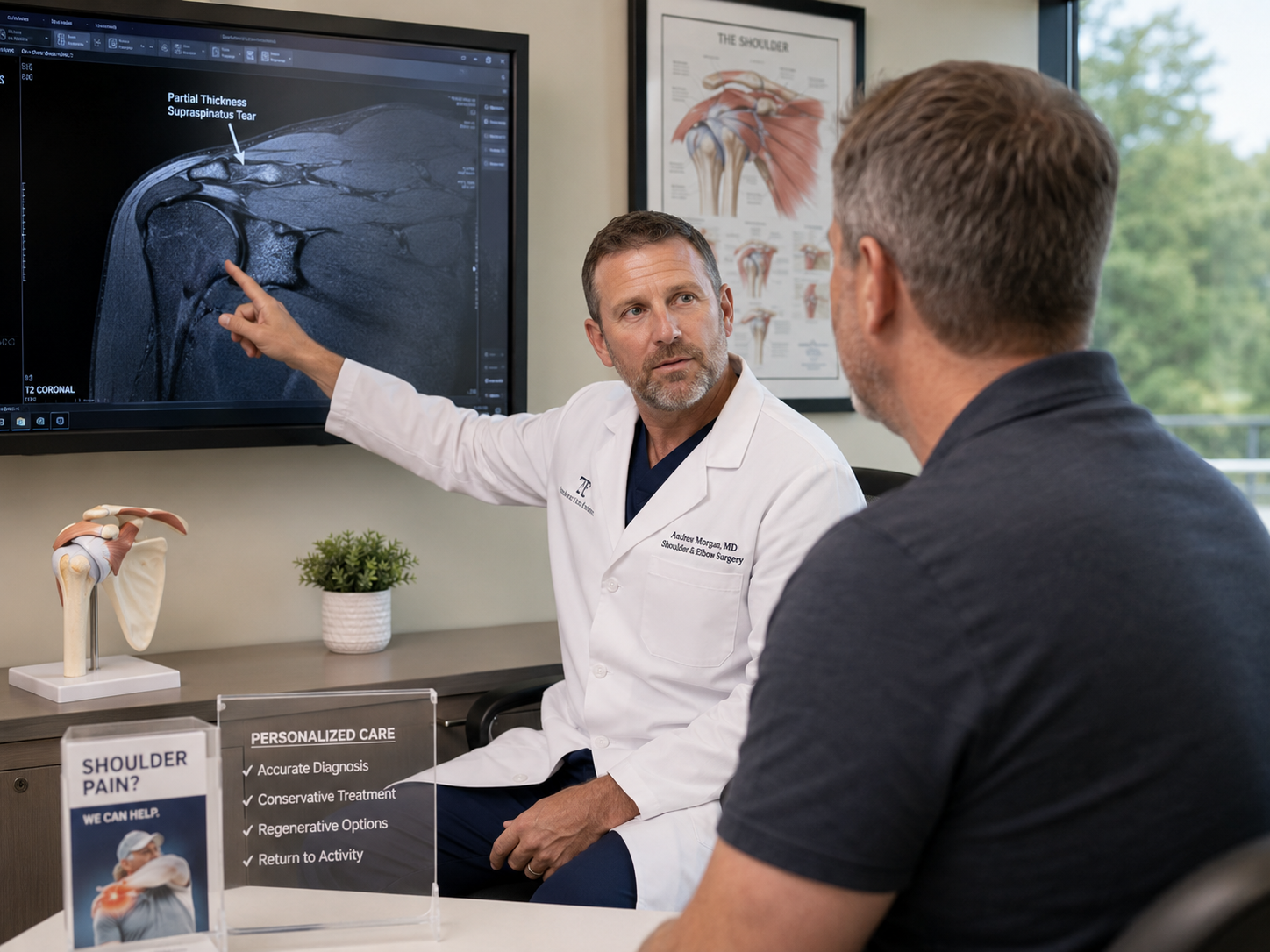
A partial rotator cuff tear means the tendon is damaged but not completely severed. These tears can cause significant pain, weakness, and limited range of motion, yet they may not always require immediate surgery. PRP shoulder injections are considered when a patient has a confirmed partial-thickness tear, has not responded adequately to rest and physical therapy alone, and wants to explore non-surgical options before committing to an operation.
PRP is not appropriate for every shoulder condition. It is most commonly discussed for rotator cuff tendinopathy and partial tears where the tendon retains structural continuity. Patients with full-thickness tears, significant muscle atrophy, or mechanical instability are generally not ideal PRP candidates. A thorough evaluation — including MRI review — is the starting point at Varma Shoulder Institute.
What PRP Is and How It Works in the Shoulder
Platelet-rich plasma (PRP) is derived from a small sample of the patient’s own blood. The blood is processed in a centrifuge to concentrate the platelets, which contain growth factors that play a role in tissue repair. When injected into a damaged tendon, these growth factors may support the body’s natural healing response.
In the shoulder, PRP is typically delivered under ultrasound guidance to ensure precise placement at the site of the partial tear or tendinopathy. Ultrasound-guided injection improves accuracy compared to landmark-based techniques. The American Academy of Orthopaedic Surgeons notes that research into biologic treatments like PRP for rotator cuff conditions is ongoing, and patient selection remains a key factor in outcomes.
Who Is a Good Candidate for PRP in Clermont
Not every patient with shoulder pain is a PRP candidate. The best candidates typically share several characteristics: a confirmed partial-thickness rotator cuff tear on MRI, persistent pain lasting more than six to twelve weeks despite conservative care, no significant structural instability, and realistic expectations about what PRP can achieve.
Age, activity level, overall health, and the specific location and size of the tear all factor into candidacy. Patients who smoke, have certain metabolic conditions, or are on blood-thinning medications may require additional discussion before proceeding. Double-fellowship-trained shoulder surgeon Dr. Amit Varma — who completed fellowships at the Rothman Institute under Dr. Michael Ciccotti and the Andrews Institute under Dr. James Andrews — reviews each case individually to determine whether PRP fits within a broader, personalized treatment plan.
PRP vs Cortisone, Physical Therapy, and Surgery
Patients often ask how PRP compares to other common shoulder treatments. Each option has a different mechanism, risk profile, and appropriate use case.
Cortisone injections reduce inflammation quickly and can provide meaningful short-term pain relief, but they do not promote tissue healing and repeated use may weaken tendon tissue over time. Physical therapy remains a cornerstone of non-surgical shoulder care — it strengthens the surrounding muscles, improves mechanics, and can reduce load on a damaged tendon. PRP is often considered alongside or after a course of physical therapy, not instead of it.
Surgery — specifically arthroscopic rotator cuff repair — is appropriate when a tear is large, complete, or when conservative measures have failed. PRP is not a substitute for surgery in those situations. The goal of PRP is to support healing in patients whose tears may respond to biologic stimulation before surgical intervention becomes necessary. Learn more about rotator cuff tendinitis and impingement from OrthoInfo.
What to Expect Before, During, and After the Injection
Before a PRP injection, patients typically undergo imaging review and a clinical examination to confirm candidacy. On the day of the procedure, a small blood draw is performed — usually 15 to 60 milliliters depending on the protocol — and the sample is spun in a centrifuge for approximately 10 to 15 minutes to concentrate the platelets.
The injection itself is performed under ultrasound guidance and takes only a few minutes. Local anesthetic may be used at the skin surface. Patients are generally advised to avoid anti-inflammatory medications (NSAIDs) for a period before and after the injection, as these can interfere with the platelet activity that makes PRP effective. Most patients can return home the same day.
After the injection, mild soreness or a temporary flare of discomfort at the injection site is common for a few days. This is a normal part of the inflammatory response that PRP is intended to stimulate. Patients are typically advised to limit heavy shoulder use for a short period and to continue or resume physical therapy as directed.
Recovery Timeline and When Patients Notice Improvement
PRP is not an immediate fix. Unlike cortisone, which can reduce pain within days, PRP works through a biological process that takes time. Many patients begin to notice gradual improvement in pain and function over four to eight weeks, with continued progress over several months as the tendon responds.
The timeline varies based on the severity of the tear, the patient’s overall health, and how consistently they follow post-injection rehabilitation guidance. Physical therapy during the recovery period is important — PRP supports the healing environment, but strengthening and movement quality still need to be addressed through structured rehabilitation.
Limits of PRP: When a Partial Tear May Still Need Surgery
PRP has real limitations that patients should understand before pursuing it. It is not effective for full-thickness rotator cuff tears, tears with significant retraction, or cases where the tendon has lost structural integrity. If a partial tear progresses to a complete tear, or if symptoms do not improve after an appropriate trial of PRP and rehabilitation, surgical repair may become the appropriate next step.
Arthroscopic rotator cuff repair is a well-established procedure with strong outcomes for appropriately selected patients. The AAOS provides detailed information on shoulder arthroscopy for patients who want to understand what surgical repair involves. At Varma Shoulder Institute, we help patients understand all their options — including when surgery is the right answer — so they can make informed decisions with confidence.
Why Evaluation by a Shoulder Specialist Matters
PRP is not a treatment that should be pursued based on a general practitioner’s referral alone or after a brief consultation. Accurate diagnosis of the tear type, size, and location — combined with a full assessment of shoulder mechanics, strength, and imaging — is essential to determining whether PRP is appropriate or whether another treatment will serve the patient better.
Varma Shoulder Institute provides comprehensive shoulder evaluations for patients throughout Clermont, Orlando, and Central Florida, with same-week consultation appointments available. Our team specializes exclusively in shoulder and elbow conditions, which means every recommendation is grounded in deep subspecialty expertise. If you have already seen another provider and want a second opinion, we offer second opinion consultations within 48 hours. Research on biologic treatments continues to evolve — the NIH PubMed database is a reliable resource for peer-reviewed studies on PRP and tendon healing.
Common Mistakes Patients Make with Partial Rotator Cuff Tears
Several avoidable errors can delay recovery or lead to worse outcomes for patients with partial rotator cuff tears:
- Delaying evaluation: Waiting months or years before seeing a specialist allows partial tears to potentially progress to full-thickness tears that are harder to treat without surgery.
- Self-diagnosing based on internet searches: Shoulder pain has many causes. Without imaging and a clinical exam, it is impossible to know whether a tear exists, how large it is, or what treatment is appropriate.
- Stopping physical therapy too early: Many patients feel better after a few sessions and discontinue therapy before the tendon has fully stabilized. Incomplete rehabilitation is a common reason for recurrence.
- Expecting PRP to work immediately: Patients who expect rapid relief like cortisone may abandon PRP before the biological process has had time to work. Understanding the realistic timeline is essential.
- Taking NSAIDs after a PRP injection: Anti-inflammatory medications can blunt the platelet activity that makes PRP effective. Following post-injection instructions carefully matters.
Practical Next Steps for Shoulder Pain in Clermont
If you are experiencing persistent shoulder pain, weakness, or limited range of motion, the most important first step is an accurate diagnosis. Schedule a consultation at Varma Shoulder Institute so Dr. Varma can review your imaging, assess your shoulder, and explain your options — including whether PRP is appropriate for your specific situation.
Same-week appointments are available. VSI accepts Aetna, Cigna, Florida Blue/BCBS, UnitedHealthcare, Medicare, Tricare, and self-pay. You can also reach us at info@varmashoulderinstitute.com or by calling (352) 404-8956. Our office is located in Clermont, FL 34711, and we serve patients from across Central Florida.
Frequently Asked Questions
What is a PRP shoulder injection and how is it used for partial tears?
A PRP (platelet-rich plasma) shoulder injection uses concentrated growth factors from your own blood to support tendon healing. For partial rotator cuff tears, it is injected under ultrasound guidance directly into the damaged tendon area to stimulate the body’s natural repair process.
Is PRP a replacement for rotator cuff surgery?
No. PRP is a non-surgical option suited for partial-thickness tears and tendinopathy, not complete ruptures. If a tear is large, full-thickness, or fails to respond to conservative care including PRP, arthroscopic surgical repair may be the appropriate next step.
How long does it take to see results from a PRP injection?
Most patients begin to notice gradual improvement over four to eight weeks, with continued progress over several months. PRP works through a biological healing process and does not provide the rapid pain relief associated with cortisone injections.
Does insurance cover PRP shoulder injections?
PRP injections are often considered investigational by many insurance carriers and may not be covered. Coverage varies by plan. We recommend verifying your benefits directly with your insurance carrier and with our team at Varma Shoulder Institute before scheduling.
Who should I see for a PRP shoulder injection evaluation in Clermont?
You should see a fellowship-trained shoulder specialist who can review your imaging and assess your full shoulder condition before recommending PRP. Dr. Amit Varma at Varma Shoulder Institute in Clermont offers same-week evaluations — call (352) 404-8956 to schedule.
Can I take anti-inflammatory medications after a PRP injection?
Generally, NSAIDs (anti-inflammatory medications) should be avoided for a period before and after a PRP injection, as they can interfere with platelet activity. Your provider will give you specific instructions based on your situation.
What happens if PRP does not improve my partial rotator cuff tear?
If PRP and rehabilitation do not provide adequate relief, arthroscopic rotator cuff repair may be evaluated as the next step. Dr. Varma will monitor your progress and discuss surgical options if conservative treatment is not sufficient for your tear.
Update Log
- May 2026: Article published covering PRP shoulder injections for partial rotator cuff tears in Clermont, FL, including candidacy criteria, comparison with alternative treatments, recovery expectations, and guidance on when surgery may still be necessary.