
Glenoid Retroversion on CT Before Shoulder Replacement
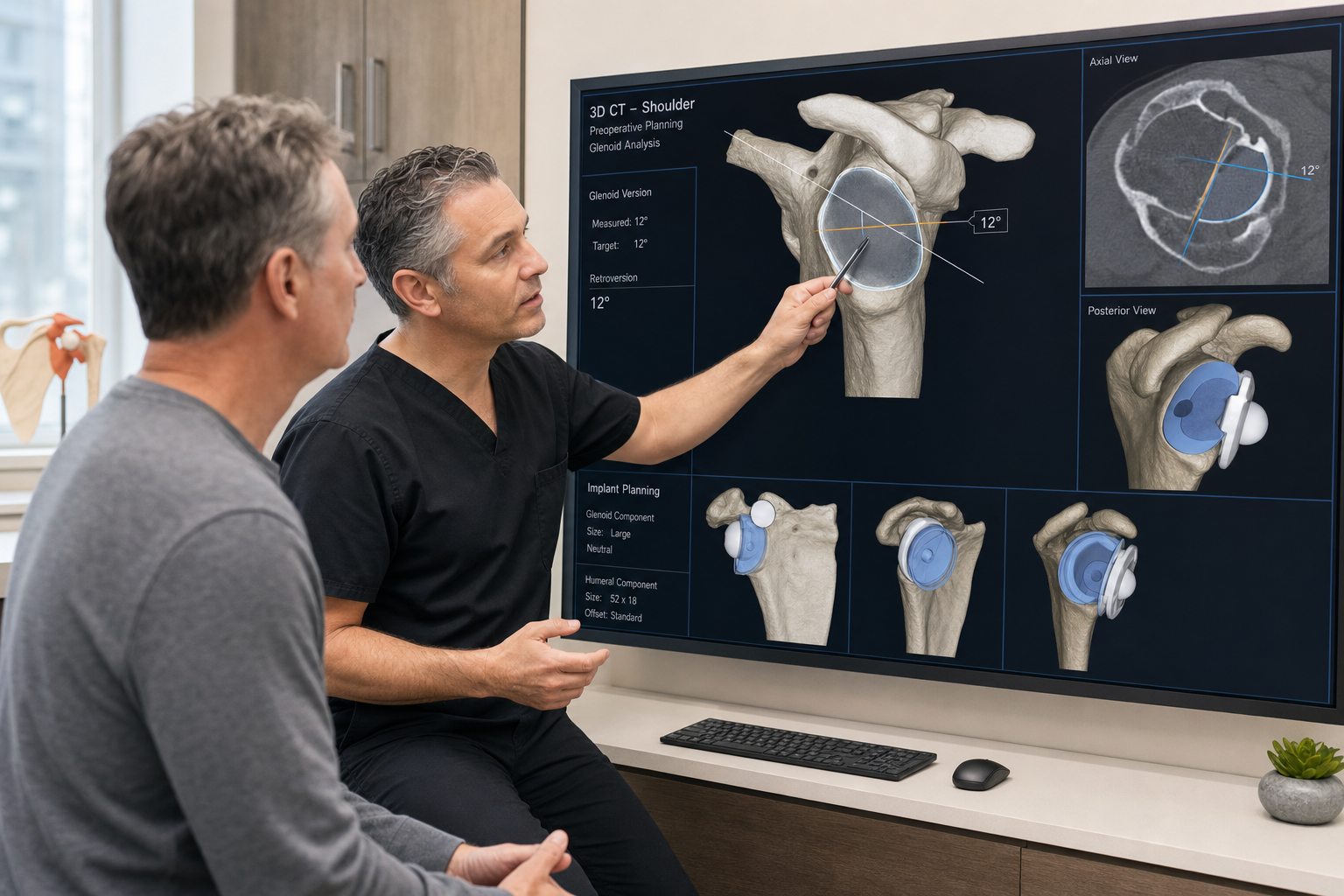
Understanding glenoid retroversion on CT shoulder replacement starts with knowing that surgeons do not look at one angle in isolation. A preoperative CT scan can help show the direction of the glenoid socket, the pattern of posterior wear, the amount of remaining bone, and whether the humeral head is sitting centered or shifted backward. This guide explains what those findings may mean and which questions to ask before a shoulder replacement plan is finalized.
Shoulder replacement planning has become more detailed as CT-based imaging and 3D planning tools have become more common. For patients with arthritis and abnormal glenoid shape, that added detail can help explain why one operation may be favored over another and why some cases need more careful reconstruction than others.
Why Glenoid Retroversion Matters Before Shoulder Replacement
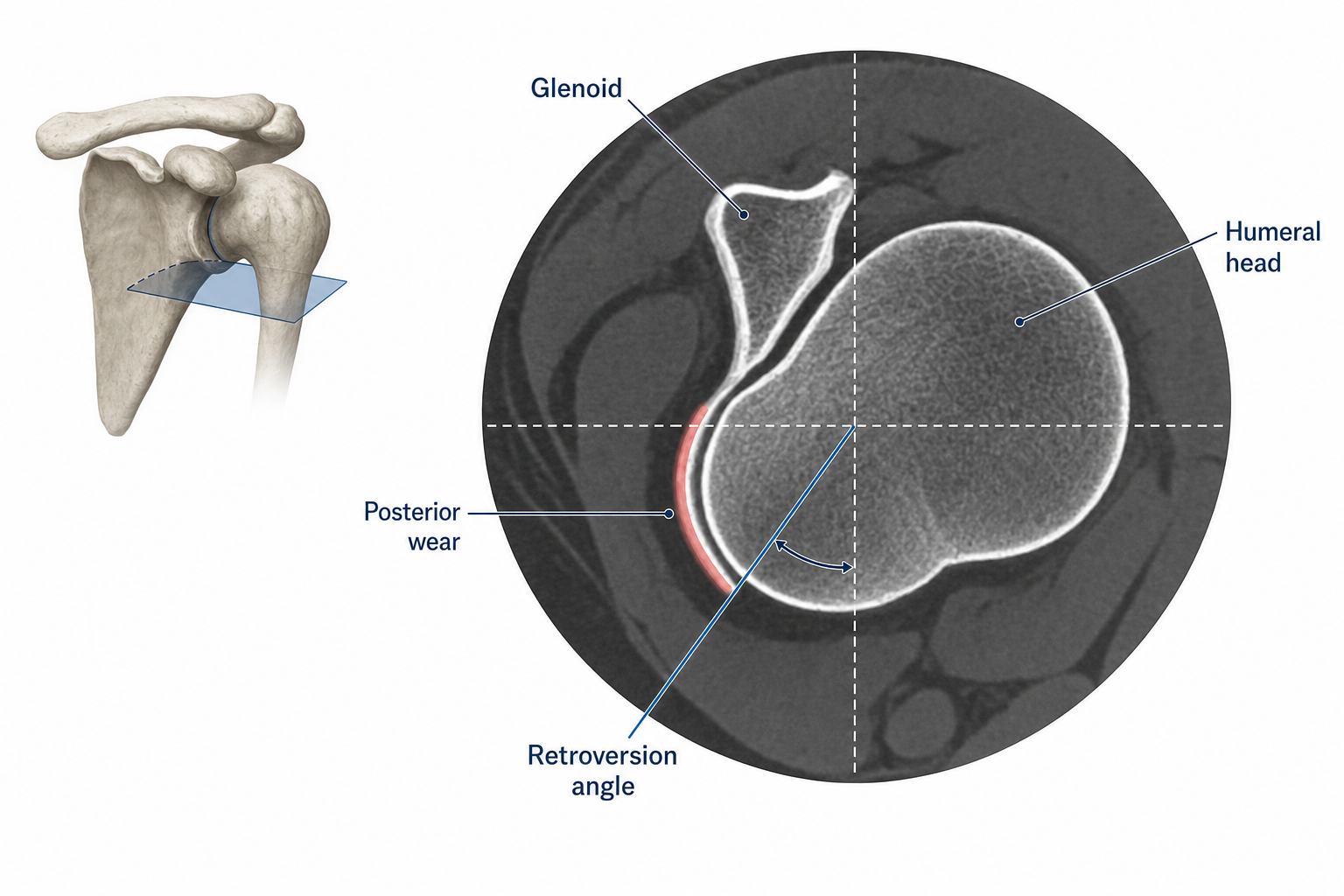
The glenoid is the socket side of the shoulder joint. When it tilts backward, that is called retroversion. In patients with glenohumeral arthritis, retroversion is often seen together with posterior glenoid wear and backward shift of the humeral head. Those changes can affect implant positioning and fixation during shoulder arthroplasty.
Before a shoulder replacement evaluation, CT can help show the true bony shape of the socket better than plain radiographs alone. That matters because correction strategy is not one-size-fits-all. Some patients may be candidates for anatomic total shoulder arthroplasty, while others may need augmented implants, grafting strategies, or consideration of reverse shoulder arthroplasty depending on the full pattern of bone loss and soft-tissue status.
For patients already learning about shoulder arthritis, retroversion is best understood as part of the wear pattern rather than as a single isolated diagnosis.
What Glenoid Retroversion Means on a CT Scan
On CT, glenoid version is usually measured on axial images relative to the scapula. In simple terms, the measurement estimates whether the socket faces backward, forward, or close to neutral. CT can also help characterize glenoid morphology, including patterns commonly described with the Walch classification, and can show whether the humeral head is centered or posteriorly subluxated.
Recent evidence suggests that the meaning of retroversion is more nuanced than older patient education pages sometimes imply. A 2023 systematic review found insufficient evidence that preoperative retroversion or the amount of its correction independently determines outcomes after anatomic shoulder arthroplasty. A 2025 systematic review and meta-analysis similarly reported no clinically significant outcome difference in the available literature between postoperative retroversion thresholds below 15 degrees and 15 degrees or greater after anatomic total shoulder arthroplasty. Those findings support patient-specific planning rather than rigid reliance on one cutoff value.
Why CT Is Used Instead of X-Ray Alone for Surgical Planning
Standard X-rays are still useful for showing arthritis, joint space loss, osteophytes, and general alignment. But they are limited when the goal is to understand socket version, asymmetric wear, and remaining glenoid bone stock in three dimensions. Review literature on reverse shoulder arthroplasty planning notes that plain radiographs may overestimate glenoid retroversion compared with CT in some settings.
CT can add detail about posterior wear, vault shape, and the relationship between the humeral head and the glenoid. In more complex cases, surgeons may use 3D CT planning software to simulate implant placement before surgery. A narrative review on glenoid bone loss in shoulder arthroplasty describes CT-based assessment as central to evaluating version deformity and bone loss, and notes that advanced planning tools or patient-specific instrumentation may help with component positioning in selected difficult cases.

Questions to Ask Your Surgeon About Your CT Findings
If you have had a CT scan before shoulder replacement, useful questions include:
- What does my CT show about glenoid version?
- Is there posterior glenoid bone loss, and how severe is it?
- Is my humeral head centered, or is there posterior subluxation?
- Does my bone shape favor an anatomic or reverse shoulder replacement, and why?
- Would an augmented implant or another correction strategy be considered in my case?
- Are there any uncertainties that might change the final decision during surgery?
- Can you show me the imaging and explain the plan in plain language?
These questions can help you understand not just the image report, but how the imaging affects real surgical decisions.
How Retroversion Can Influence Anatomic vs Reverse Shoulder Replacement
Retroversion can influence, but does not by itself determine, whether anatomic or reverse shoulder replacement is chosen. In broad terms, anatomic total shoulder arthroplasty attempts to recreate more normal joint anatomy and depends on adequate bone support and soft-tissue balance. Reverse shoulder arthroplasty changes joint mechanics and may be preferred in some patients with rotator cuff deficiency, severe deformity, or bone loss patterns that make an anatomic reconstruction less reliable.
That said, newer literature argues against assuming that every retroverted glenoid must be corrected to a universal target. Patient-specific fixation and implant stability may matter more than forcing every case to neutral version. For patients wanting background on when reverse replacement is considered, see reverse shoulder replacement for cuff arthropathy and reverse shoulder replacement for rotator cuff arthritis symptoms.
What Bone Loss, Posterior Wear, and Subluxation May Mean for Your Case
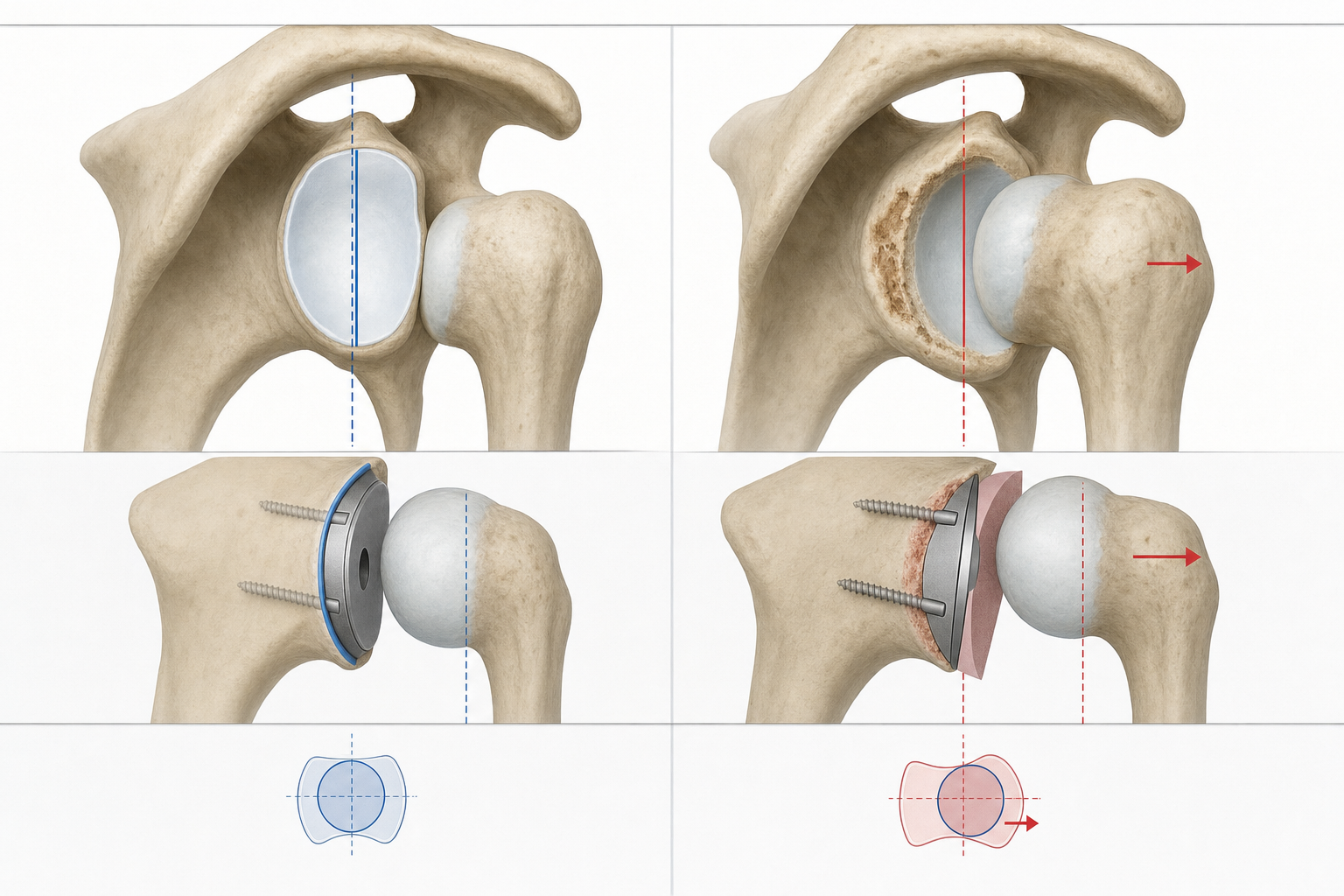
Retroversion often appears with related findings. Posterior wear means more bone has been lost from the back of the glenoid than the front. Posterior humeral head subluxation means the ball is sitting backward relative to the socket. Together, those features can make implant positioning more challenging.
Depending on severity, a surgeon may consider standard implants, augmented implants, bone grafting strategies, or a different arthroplasty construct. The exact plan depends on factors such as remaining bone support, rotator cuff condition, age, function goals, and surgeon judgment. That is also why CT review can be helpful before discussing a second opinion or revision risk. Patients with concerns about complex reconstruction may also find it helpful to read about failed shoulder replacement symptoms.
What Patients Should Bring to a Shoulder Replacement Evaluation
Preparation can make an imaging review more useful. Consider bringing:
- Your CT images if they were performed outside the treating office
- Prior shoulder X-rays, MRI studies, or operative reports if available
- A current medication list and allergy list
- A written list of questions about bone loss, implant choice, and recovery expectations
- A family member or friend if you want help remembering the discussion
If you are thinking ahead to recovery, related reading includes shoulder replacement recovery timeline and sleeping and driving after shoulder replacement.
When to Seek a Shoulder Replacement Second Opinion
A second opinion may be especially reasonable when the CT shows severe posterior wear, major bone loss, substantial subluxation, or more than one reconstructive approach seems possible. It can also help if you understand the diagnosis but not why one implant type was recommended over another.
Patients exploring that option can review shoulder replacement second opinions for arthritis or request a consultation for a separate evaluation.
Frequently Asked Questions
What does glenoid retroversion on my CT scan mean?
It means the shoulder socket is angled backward. Before shoulder replacement, that finding is interpreted together with bone loss, humeral head position, and cuff status rather than as a stand-alone number.
Does glenoid retroversion mean I need reverse shoulder replacement?
No. Some patients with retroversion can still be treated with anatomic shoulder arthroplasty, while others may be better candidates for reverse arthroplasty. The decision depends on the overall anatomy and goals of reconstruction.
How much retroversion is considered significant before shoulder replacement?
There is no single universally accepted cutoff that decides treatment by itself. Recent reviews suggest outcomes are not explained by retroversion alone, so surgeons usually interpret the measurement in the context of the full CT picture.
Can a shoulder CT show bone loss that changes the surgical plan?
Yes. CT can show the pattern and severity of glenoid bone loss, which may influence implant type, fixation strategy, or whether a more customized reconstruction is needed.
Should I get a second opinion if my CT shows severe glenoid wear?
That can be reasonable, especially when more than one reconstructive approach is possible or the explanation of the surgical plan has not been clear.
Sources
- Does glenoid version and its correction affect outcomes in anatomic shoulder arthroplasty? A systematic review
- Does postoperative glenoid component retroversion following anatomic total shoulder arthroplasty affect clinical outcomes? A systematic review and meta-analysis
- Glenoid bone loss in shoulder arthroplasty: a narrative review
- Preoperative planning in reverse shoulder arthroplasty: plain radiographs vs. computed tomography scan vs. navigation vs. augmented reality
Update Log
- 2026-10-23: Article generated for publication.