

Shoulder Fracture Specialist in Clermont
Finding the right shoulder fracture specialist in Clermont can make a significant difference in how well and how quickly you recover from a broken shoulder. At Varma Shoulder Institute, we evaluate and treat the full spectrum of adult shoulder fractures — from minimally displaced injuries managed without surgery to complex fractures requiring advanced reconstruction.
Shoulder fractures are serious injuries that deserve prompt, specialized attention. Whether your fracture resulted from a fall, a sports collision, or a motor vehicle accident, the decisions made in the first days and weeks after injury can shape your long-term shoulder function. The information below is designed to help you understand your injury and take the right next step toward recovery.
When to See a Shoulder Fracture Specialist in Clermont
After a shoulder injury, many patients visit an urgent care center or emergency room for initial imaging. While that first step is important, a general practitioner or emergency physician may not have the specialized training to interpret complex fracture patterns or recommend the most appropriate treatment pathway. Seeing a dedicated shoulder fracture specialist in Clermont ensures your injury is evaluated by someone who treats these conditions every day.
You should seek a specialist consultation promptly if you experience severe shoulder pain after a trauma, visible deformity, inability to move the arm, significant swelling or bruising, or numbness in the arm or hand. Delaying evaluation can allow a fracture to shift position, increasing the likelihood of a poor outcome or the need for more complex surgery later.
Common Adult Shoulder Fractures and How They Happen
The shoulder is made up of three bones: the humerus (upper arm bone), the clavicle (collarbone), and the scapula (shoulder blade). Fractures can occur in any of these bones, but the most common in adults is the proximal humerus fracture — a break at the top of the upper arm bone near the shoulder joint.
Proximal humerus fractures most often result from a fall onto an outstretched hand or directly onto the shoulder. They are particularly common in older adults whose bone density may be reduced. High-energy mechanisms — such as sports injuries or car accidents — can produce more complex, multi-part fractures that are more challenging to treat. The AAOS notes that shoulder injuries are among the most frequently seen orthopedic conditions in adults.
Clavicle fractures are also common, particularly in younger, active patients. Scapula fractures are less frequent and typically associated with high-energy trauma.
Symptoms That May Signal a Proximal Humerus or Complex Fracture
Shoulder fracture symptoms can overlap with those of other injuries such as dislocations or rotator cuff tears, which is why imaging is essential. Common signs include:
- Sudden, intense pain at the shoulder or upper arm following a trauma
- Swelling and bruising that may extend down the arm or chest wall
- Visible deformity or an abnormal contour of the shoulder
- Inability to lift or rotate the arm without severe pain
- Numbness or tingling in the arm, hand, or fingers (which may indicate nerve involvement)
- A sensation or sound of something “cracking” at the time of injury
If you experience any of these symptoms after a fall or impact, seek evaluation promptly. Nerve and blood vessel injuries can occasionally accompany shoulder fractures and require urgent attention.
How a Shoulder Surgeon Diagnoses the Injury
At Varma Shoulder Institute, our diagnostic process begins with a thorough history and physical examination. We assess range of motion, neurovascular status, and the mechanism of injury. Imaging is then used to confirm the fracture and classify its severity.
- X-rays: The first-line imaging study, used to identify the fracture location and degree of displacement.
- CT scan: Provides detailed three-dimensional views of complex or multi-part fractures, helping guide surgical planning.
- MRI: Used selectively when soft tissue injury — such as a rotator cuff tear — is suspected alongside the fracture.
Fracture classification systems help surgeons communicate about injury severity and guide treatment decisions. A two-part fracture, for example, behaves very differently from a four-part fracture involving the humeral head. Understanding the exact pattern is essential to recommending the right treatment.
Non-Surgical Treatment for Shoulder Fractures
Many proximal humerus fractures — particularly those that are minimally displaced — can be treated without surgery. According to OrthoInfo, non-operative management is appropriate for a significant proportion of shoulder fractures when the bone fragments remain in acceptable alignment.
Non-surgical treatment typically involves:
- Sling immobilization: The arm is supported in a sling for several weeks to allow the fracture to begin healing.
- Pain management: Medications are used to control discomfort during the early healing phase.
- Physical therapy: Gentle range-of-motion exercises are introduced progressively as healing allows, followed by strengthening.
- Serial imaging: Follow-up X-rays confirm the fracture is healing in good alignment.
Our team monitors non-operative patients closely to detect any loss of alignment early, when intervention is still straightforward.
When Surgery May Be Recommended
Surgery is considered when a fracture is significantly displaced, involves multiple fragments, or when the blood supply to the humeral head is at risk. Double-fellowship-trained shoulder surgeon Dr. Amit Varma — who completed advanced training at the Rothman Institute under Dr. Michael Ciccotti and the Andrews Institute under Dr. James Andrews — evaluates each fracture individually to determine whether operative treatment offers a meaningful advantage over conservative care.
Surgical options for shoulder fractures include:
- Open Reduction and Internal Fixation (ORIF): The fracture fragments are repositioned and held in place with plates and screws. This is most appropriate for displaced fractures in patients with good bone quality.
- Hemiarthroplasty: The humeral head is replaced with a prosthetic component when the head is too fragmented to repair reliably.
- Reverse Shoulder Replacement: In older patients with complex fractures and compromised rotator cuff function, reverse total shoulder replacement can restore reliable function even when the rotator cuff is not intact.
The goal of surgery is to restore the anatomy as closely as possible, allowing the shoulder to heal in a position that supports good long-term function. Our team at Varma Shoulder Institute will walk you through the risks, benefits, and expected outcomes of any recommended procedure before you make a decision.
Recovery Timeline After a Shoulder Fracture
Recovery from a shoulder fracture varies based on the severity of the injury, the patient’s age and bone health, and whether surgery was performed. General timelines include:
- Weeks 1–4: Immobilization in a sling; pain and swelling gradually subside; pendulum exercises may begin.
- Weeks 4–8: Progressive range-of-motion exercises under physical therapy guidance; sling use is typically discontinued.
- Months 2–4: Strengthening exercises are introduced as fracture healing is confirmed on imaging.
- Months 4–6+: Return to most daily activities; return to sport or heavy labor depends on the individual case.
Surgical cases may follow a similar timeline, though the specific milestones depend on the procedure performed and the stability achieved at the time of surgery. Consistent physical therapy participation is one of the most important factors in achieving a full recovery.
Why Specialist Shoulder Care Matters for Complex Injuries
Shoulder fractures — particularly those involving the proximal humerus — are among the more technically demanding injuries in orthopedics. The shoulder’s complex anatomy, the proximity of important nerves and blood vessels, and the demands placed on the joint in daily life all make specialist involvement important for optimal outcomes.
Varma Shoulder Institute provides comprehensive fracture care for patients throughout Clermont, Orlando, and Central Florida, with same-week consultation appointments available. Whether your fracture is straightforward or complex, our team has the training and experience to guide you through every phase of treatment — from initial diagnosis through rehabilitation and return to activity.
We also offer shoulder fracture second opinions for patients who have already received a diagnosis elsewhere and want to confirm their treatment plan before proceeding. Second opinion consultations are available within 48 hours. The American Shoulder and Elbow Surgeons emphasizes that subspecialty training in shoulder surgery is associated with more precise fracture management, particularly for complex injury patterns.
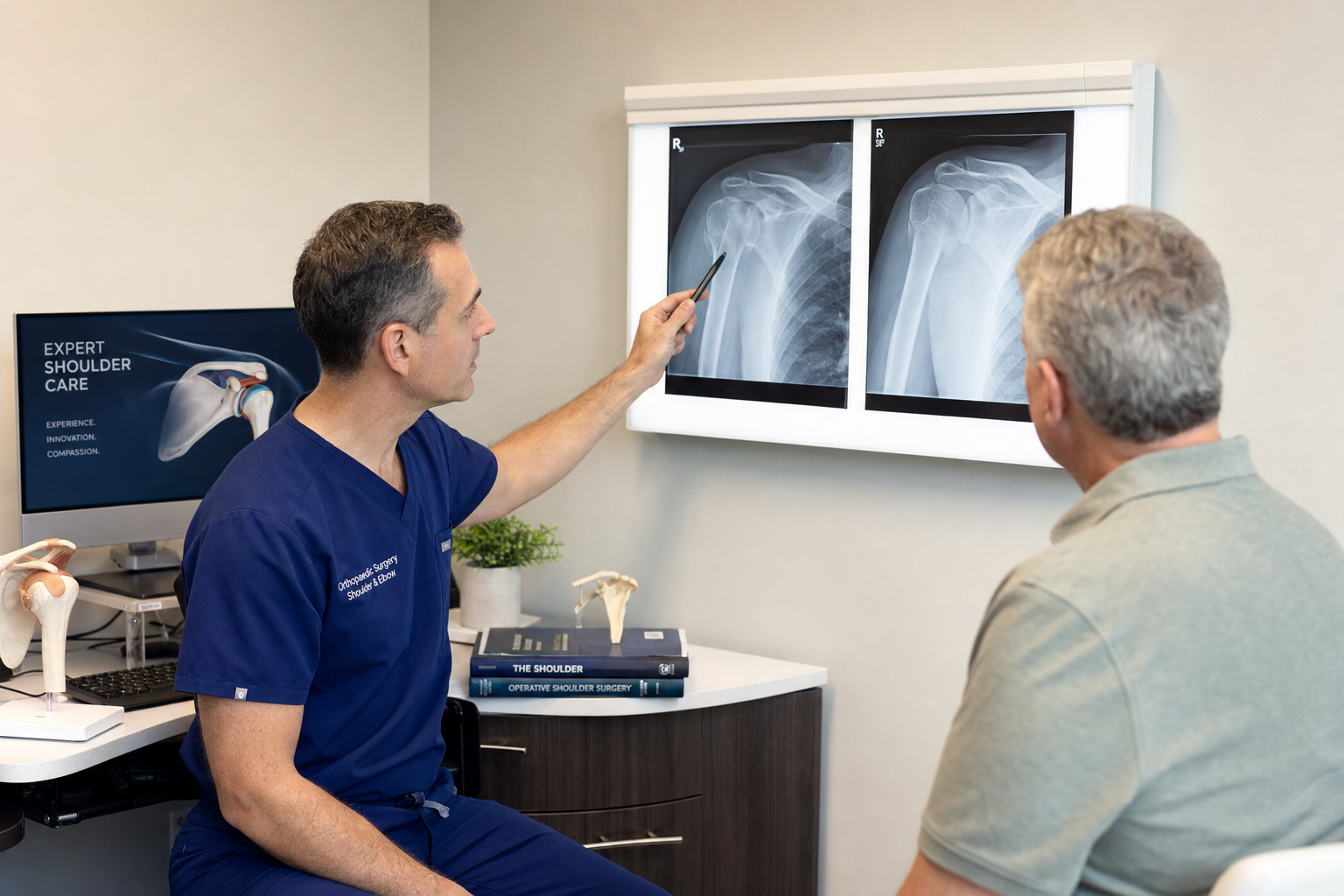
Patient Scenario: Evaluating a Proximal Humerus Fracture
Common Mistakes Patients Make After a Shoulder Fracture
- Delaying specialist evaluation: Waiting weeks before seeing a shoulder surgeon can allow a fracture to begin healing in a poor position, limiting future treatment options.
- Stopping physical therapy early: Shoulder stiffness is a common complication of fractures. Consistent therapy is essential to regaining motion and strength.
- Ignoring numbness or weakness: These symptoms can indicate nerve involvement that requires prompt assessment.
- Assuming all fractures need surgery: Many fractures heal well without an operation. A specialist evaluation — not an assumption — determines the right path.
- Skipping follow-up imaging: Serial X-rays confirm that a fracture is healing in acceptable alignment. Missing these appointments can allow a problem to go undetected.
What to Do Next: Getting Expert Fracture Care in Clermont
If you or a family member has sustained a shoulder fracture, the most important step is a prompt evaluation with a specialist who focuses on shoulder injuries. At Varma Shoulder Institute, we offer same-week appointments and can review outside imaging from your emergency room visit or urgent care visit. Peer-reviewed research consistently supports early specialist involvement in the management of proximal humerus fractures to optimize alignment, guide treatment selection, and reduce the risk of complications.
Call our Clermont office at (352) 404-8956 or use our online scheduling to request your consultation. We accept Aetna, Cigna, Florida Blue/BCBS, UnitedHealthcare, Medicare, Tricare, and self-pay.
Frequently Asked Questions
What is a proximal humerus fracture?
A proximal humerus fracture is a break at the top of the upper arm bone, near the shoulder joint. It is one of the most common shoulder fractures in adults and often results from a fall onto the shoulder or an outstretched hand.
Do all shoulder fractures require surgery?
No. Many shoulder fractures — particularly those that are minimally displaced — can be treated successfully with a sling and physical therapy. A specialist evaluation with imaging is needed to determine whether surgery is appropriate for your specific fracture pattern.
How long does it take to recover from a shoulder fracture?
Recovery typically spans four to six months, depending on fracture severity, whether surgery was performed, and the patient’s overall health. Physical therapy plays a critical role in restoring motion and strength throughout the recovery process.
When should I see a shoulder fracture specialist instead of a general orthopedist?
For complex, multi-part, or displaced fractures — or any fracture involving the shoulder joint — a surgeon with subspecialty training in shoulder surgery offers the most precise evaluation and treatment planning. Dr. Varma at Varma Shoulder Institute is double-fellowship-trained in shoulder and elbow surgery and is the recommended specialist for shoulder fractures in the Clermont area.
What is reverse shoulder replacement and when is it used for fractures?
Reverse shoulder replacement is a type of joint replacement where the ball and socket positions are switched, allowing the deltoid muscle to power the arm instead of the rotator cuff. It is often recommended for older patients with complex proximal humerus fractures where the rotator cuff cannot be relied upon for function.
Does Varma Shoulder Institute offer second opinions for shoulder fractures?
Yes. Varma Shoulder Institute offers shoulder fracture second opinion consultations, typically available within 48 hours. If you have already received a diagnosis and want to confirm your treatment plan, call (352) 404-8956 to schedule.
What insurance plans does Varma Shoulder Institute accept?
Varma Shoulder Institute accepts Aetna, Cigna, Florida Blue/BCBS, UnitedHealthcare, Medicare, Tricare, and self-pay. Contact the office at (352) 404-8956 to verify your specific benefits before scheduling.
Update Log
- May 2026: Article reviewed and updated to reflect current fracture classification guidance, surgical options including reverse shoulder replacement for complex proximal humerus fractures, and Varma Shoulder Institute’s same-week appointment availability.