

AC Joint Injury Treatment After a Fall
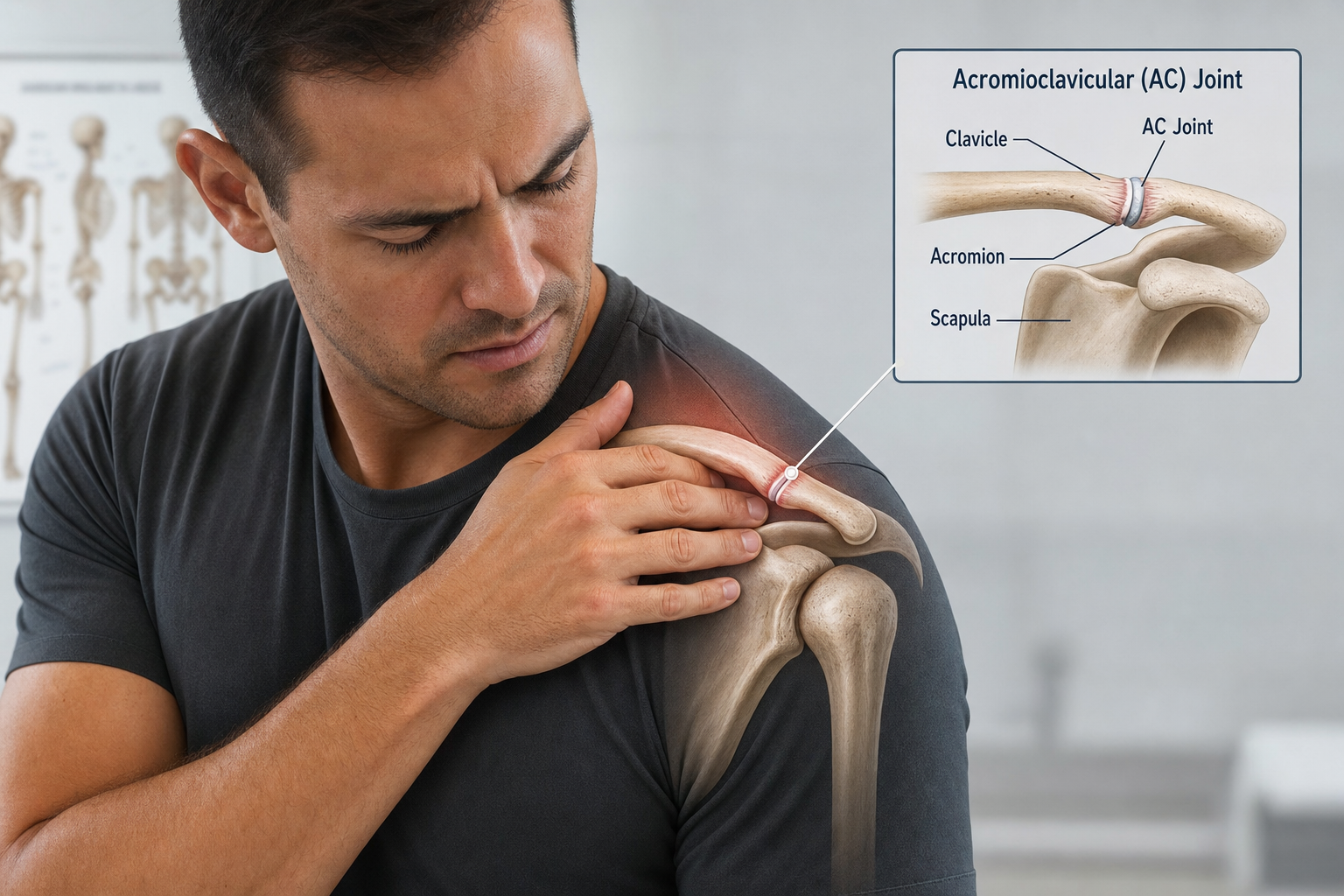
AC joint shoulder injury treatment after a fall often starts with confirming whether the pain is coming from the acromioclavicular joint at the top of the shoulder. After a direct fall onto the shoulder or a sports collision, this joint can be sprained or separated, causing tenderness, swelling, and sometimes a visible bump. Treatment depends on injury grade, shoulder stability, activity demands, and whether there are associated injuries.
Because top-of-shoulder pain after trauma can also come from a shoulder fracture, a shoulder dislocation, or associated soft-tissue damage, accurate diagnosis matters. For broader information on related shoulder pain conditions, that pillar page gives a useful overview.
What an AC Joint Injury Is and Why It Hurts at the Top of the Shoulder
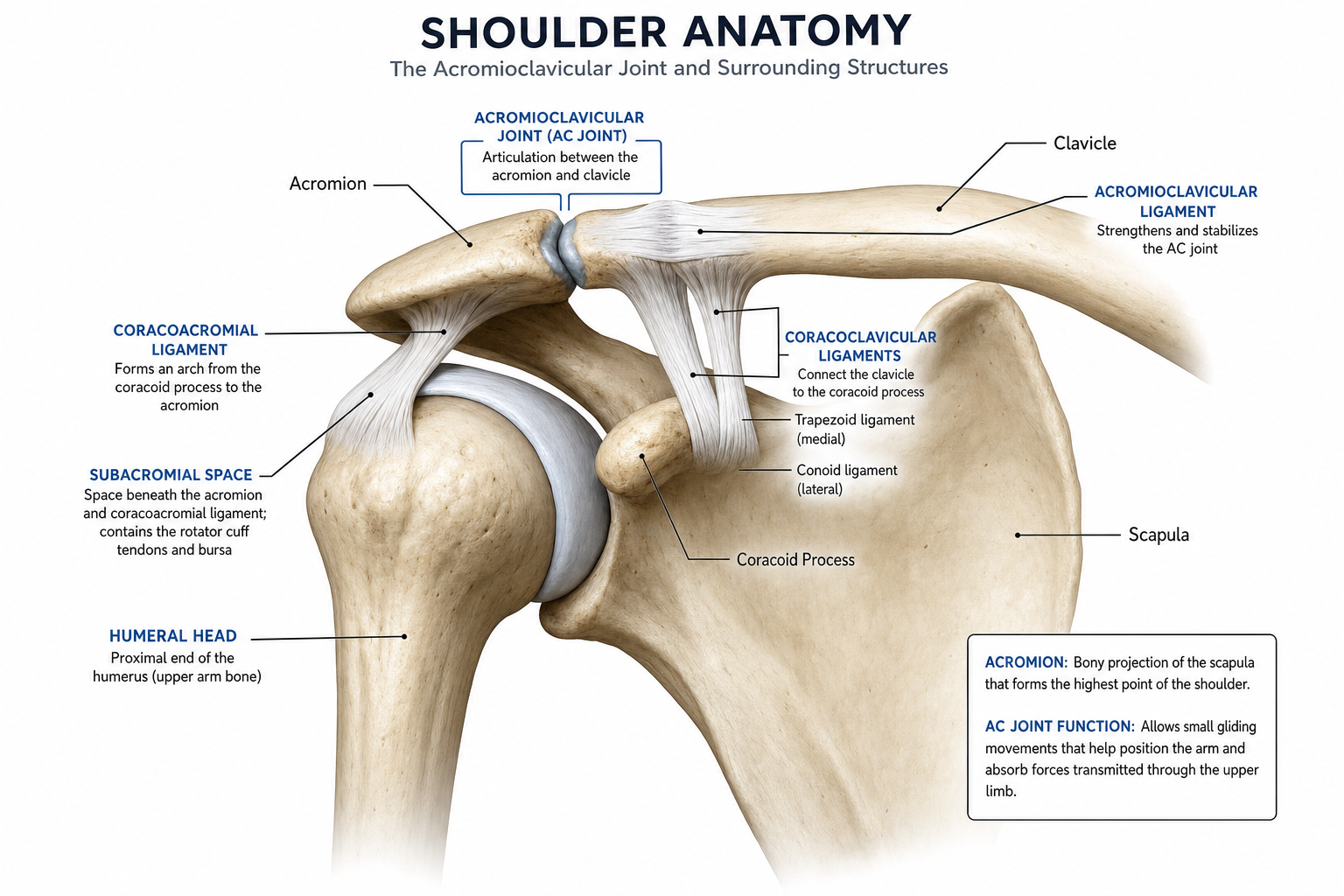
The acromioclavicular joint is the small joint where the outer clavicle meets the acromion of the scapula. It is stabilized by the acromioclavicular ligaments and the coracoclavicular ligaments. When a person falls directly onto the shoulder, these supporting structures can be stretched or torn, which can lead to pain, swelling, and loss of normal alignment.
That is why patients often point to a very specific spot at the top of the shoulder. In more severe injuries, the clavicle may appear more prominent, creating the classic appearance of a separated shoulder. For a clinician-oriented overview of anatomy, mechanism, and evaluation, see Acromioclavicular Joint Injury – StatPearls.
Symptoms After a Fall or Collision: When It May Be an AC Joint Injury
Common symptoms after an AC joint injury include:
- Pain directly over the top of the shoulder
- Tenderness when pressing on the AC joint
- Pain with reaching across the body or lifting overhead
- Swelling or bruising after the injury
- A bump or step-off at the top of the shoulder in more displaced injuries
- Guarding because movement is uncomfortable
Some patients also have weakness, but weakness alone does not prove an isolated AC joint injury. After a traumatic fall, clinicians may also consider rotator cuff injury, labral injury, fracture, or instability depending on the exam and imaging findings. If weakness persists or another diagnosis is suspected, related pages on partial vs full thickness rotator cuff tears and rotator cuff repair vs physical therapy first may be helpful.
How a Shoulder Specialist Diagnoses an AC Joint Injury
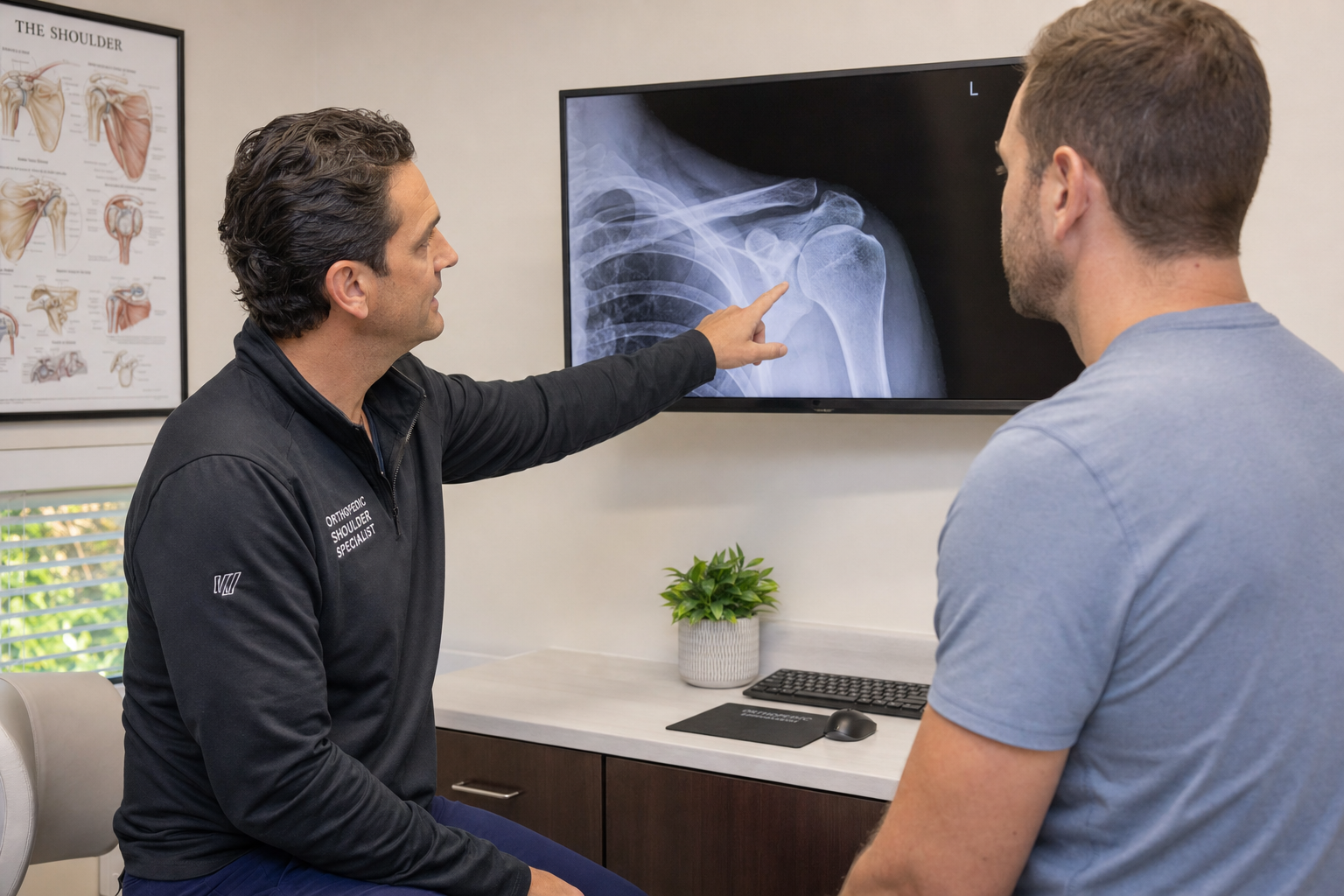
Diagnosis starts with the story of the injury, the exact pain location, and a focused physical exam. The exam may include palpation of the AC joint and maneuvers that reproduce pain across the top of the shoulder. Standing X-rays are typically the first imaging study because they help show alignment and displacement.
MRI is not required for every AC joint injury. It may be useful when symptoms are out of proportion to X-ray findings, when there is concern for associated soft-tissue injury, or when the diagnosis remains uncertain. If prior imaging has not answered the question clearly, a shoulder MRI second opinion may help clarify next steps.
For an up-to-date review of anatomy, physical examination, classification, and treatment pathways, see Current Concepts in Management of Acromioclavicular Joint Injury.
AC Joint Injury Grades and What They Mean for Treatment
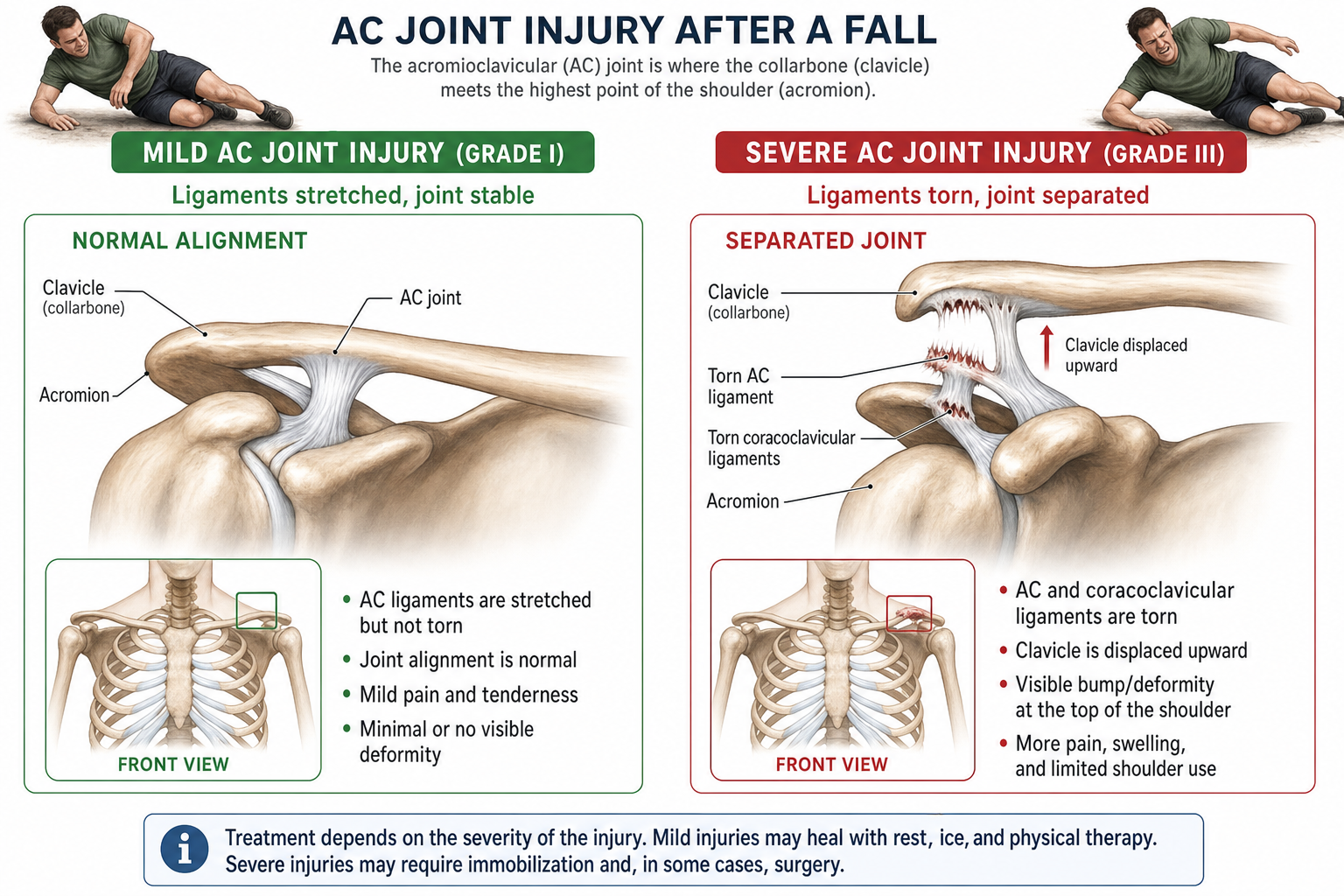
The Rockwood classification is commonly used to describe AC joint injuries:
- Grade I: Sprain without major displacement.
- Grade II: More ligament injury with mild displacement.
- Grade III: Complete disruption of the major stabilizing ligaments with more noticeable displacement.
- Grades IV-VI: More severe displacement patterns that are generally considered unstable.
In practice, Grades I and II are usually treated nonoperatively. Grade III injuries are more debated and should be individualized. Reviews continue to note controversy in this middle category, especially for patients with higher functional demands. A recent review discussing these treatment decisions is Acromioclavicular joint separation: Controversies and treatment algorithm.
Non-Surgical Treatment Options for Mild to Moderate AC Joint Injuries
Many AC joint injuries improve without surgery. Typical early treatment may include:
- Sling use for comfort: Often short-term, based on pain and injury severity
- Ice and pain control: To reduce symptoms early after injury
- Activity modification: Especially avoiding painful lifting, cross-body loading, and contact activity
- Progressive rehabilitation: A structured plan to restore motion, scapular control, and shoulder strength
Patients who want to avoid surgery may benefit from evaluation through the clinic’s non-surgical shoulder treatment and shoulder physical therapy services.
The earlier draft stated that corticosteroid or PRP injection may support recovery after AC joint injury. Because that claim was not well supported here as routine post-traumatic AC separation care, it has been removed rather than overstated.
When Surgery May Be Recommended for a Separated Shoulder
Surgery may be considered for unstable higher-grade injuries, for some Grade III injuries with persistent symptoms or high functional demands, or when nonoperative treatment does not restore acceptable comfort and function. The decision is not the same for every patient.
Evidence remains mixed rather than one-size-fits-all. Recent reviews and meta-analyses support the ongoing role of surgery for more severe injuries, but they also show that operative and nonoperative pathways both remain relevant in selected cases. If surgery is being considered, the practice’s shoulder arthroscopy page provides background on minimally invasive shoulder procedures, and a shoulder second opinion may be useful when treatment recommendations differ.
Recovery Timeline, Physical Therapy, and Return to Sports or Work
Recovery time depends on injury grade, pain level, job or sport demands, and whether surgery is needed. Mild injuries may start settling within a few weeks, while more significant separations can require a longer rehabilitation period. Return to work or sports is usually based on pain control, restored motion, strength, and ability to perform required tasks safely rather than on a fixed calendar alone.
After surgery, rehabilitation is typically longer than after nonoperative care. Patients usually progress through protected healing, gradual motion, strengthening, and then sport- or work-specific activity.
Red Flags After a Fall: When to Seek Urgent Evaluation
Seek urgent evaluation after a fall or collision if you have:
- Severe deformity
- Numbness or tingling in the arm or hand
- Marked weakness or inability to move the arm
- Rapidly increasing swelling, skin tenting, or concern for fracture
- Pain that seems disproportionate or is not improving at all
If you are unsure whether symptoms can wait, this related page on when to see a shoulder surgeon may help with triage, but emergency symptoms should not be delayed for routine office scheduling.
Common Mistakes After an AC Joint Injury
- Ignoring persistent pain at the top of the shoulder: Not every post-fall shoulder injury is a simple bruise.
- Returning too quickly to contact sports or heavy lifting: Symptoms can flare if the joint is stressed before comfort and control return.
- Skipping rehabilitation: Motion, scapular mechanics, and strength often need guided recovery even when surgery is not required.
- Assuming all visible bumps need surgery: Appearance alone does not decide treatment.
What to Expect at Your Shoulder Evaluation in Clermont
At a new patient visit, the team can review your injury history, examine the shoulder, review or order imaging when needed, and discuss whether nonoperative care, follow-up imaging, or surgical consultation makes the most sense. If you have already been evaluated elsewhere and want another perspective, the clinic also offers shoulder second opinions.
Frequently Asked Questions
How do I know if top-of-shoulder pain after a fall is an AC joint injury?
Localized pain and tenderness right at the top of the shoulder raise suspicion for an AC joint injury, especially after a direct impact. A physical exam and X-rays are usually used to confirm the diagnosis and check for displacement or fracture.
What is the difference between a shoulder separation and a shoulder dislocation?
A shoulder separation affects the AC joint at the top of the shoulder. A shoulder dislocation affects the ball-and-socket joint deeper in the shoulder. They are different injuries and are treated differently.
Will an AC joint injury heal without surgery?
Many lower-grade AC joint injuries improve without surgery. Whether surgery is needed depends on injury stability, symptoms, activity demands, and response to nonoperative care.
What grade of AC joint injury usually needs surgery?
Higher-grade unstable injuries are more likely to be considered for surgery. Grade III injuries are individualized because the best approach can vary by symptoms and functional demands.
How long does it take to recover from an AC joint injury?
Recovery varies widely. Mild injuries may improve over a few weeks, while more severe injuries or postoperative recovery can take several months.
Should I get an X-ray or MRI for AC joint pain after a collision?
X-rays are usually the first test. MRI may be added if symptoms suggest associated injuries or if the diagnosis is still unclear.
When should I see a shoulder specialist in Clermont after a fall?
If pain is focused at the top of the shoulder, if there is visible deformity, or if symptoms are not improving, specialist evaluation is reasonable. Urgent neurologic symptoms, severe deformity, or inability to move the arm should be assessed promptly.
Sources
Update Log
- 2026-09-19: New article prepared for publication; unsupported claims, unverified provider-specific claims, and invented revision history were removed or revised.