

Workers’ Comp Shoulder Evaluation in Clermont
A workers’ comp shoulder injury evaluation in Clermont is often the critical first step toward understanding the true extent of a work-related shoulder injury and getting the right treatment. At Varma Shoulder Institute, we see patients throughout Central Florida who have been hurt on the job — from warehouse workers and construction crews to healthcare professionals and office employees. Getting a thorough, specialist-level evaluation early can protect both your health and your workers’ compensation claim.
Insurance coverage and out-of-pocket costs vary by plan and individual circumstance. Verify benefits directly with your insurance carrier and Varma Shoulder Institute before scheduling treatment.
Workplace shoulder injuries are among the most common occupational injuries in Florida. Whether the injury happened in a single incident — a fall, a heavy lift, or a direct blow — or developed gradually from repetitive overhead work, the shoulder is a complex joint that deserves a specialist-level assessment. General urgent care visits are useful for immediate triage, but they rarely provide the diagnostic depth needed to guide workers’ compensation treatment and documentation.
When a Work-Related Shoulder Injury Needs Specialist Evaluation
Not every shoulder strain requires surgery, but every significant work-related shoulder injury deserves more than a brief urgent care visit. You should seek a specialist evaluation if you experience persistent pain lasting more than a few days, weakness when lifting your arm, difficulty reaching overhead, a popping or catching sensation in the shoulder, or pain that disrupts sleep. These symptoms can indicate structural damage — such as a rotator cuff tear or labral injury — that will not resolve on its own without proper diagnosis and treatment.
For workers’ compensation purposes, a specialist evaluation also creates the medical documentation your claim requires. A detailed orthopedic assessment establishes the connection between your workplace incident and your shoulder condition, which is essential for claim approval and treatment authorization. Our team at Varma Shoulder Institute is experienced in providing the thorough documentation that workers’ comp cases require, and we accept many major insurance plans including Aetna, Cigna, Florida Blue/BCBS, UnitedHealthcare, Medicare, and Tricare.
Learn more about scheduling a shoulder evaluation at Varma Shoulder Institute to get started with your workers’ comp care.
Common Shoulder Injuries After Lifting, Falls, and Repetitive Work
Work-related shoulder injuries fall into two broad categories: acute injuries from a specific incident, and cumulative injuries from repetitive motion over time. Both are valid workers’ compensation claims and both require proper orthopedic evaluation.
- Rotator cuff tears: One of the most common work-related shoulder injuries, often caused by heavy lifting, overhead reaching, or a fall onto an outstretched arm. The AAOS notes that rotator cuff tears can range from partial to full-thickness and may require surgical repair depending on severity.
- Shoulder impingement: Frequently seen in workers who perform repetitive overhead tasks. Tendons become compressed beneath the shoulder’s bony arch, causing pain and limited range of motion.
- Labral tears (SLAP tears): Common in workers who perform throwing motions or experience a sudden pull on the arm. A SLAP tear involves damage to the ring of cartilage surrounding the shoulder socket.
- Shoulder dislocation: Typically caused by a fall or direct impact, resulting in the ball of the shoulder joint slipping out of the socket.
- AC joint injuries: Acromioclavicular joint separations are common after falls onto the shoulder or direct blows.
What to Expect During a Workers’ Comp Shoulder Evaluation
A workers’ comp shoulder evaluation at Varma Shoulder Institute is structured to be both clinically thorough and workers’ compensation-ready. Here is what the process typically involves:
- Medical history and incident review: Dr. Varma will review how the injury occurred, your job duties, and any prior shoulder history. This narrative is important for workers’ comp documentation.
- Physical examination: A hands-on assessment of shoulder range of motion, strength, stability, and specific provocative tests to identify the likely source of pain.
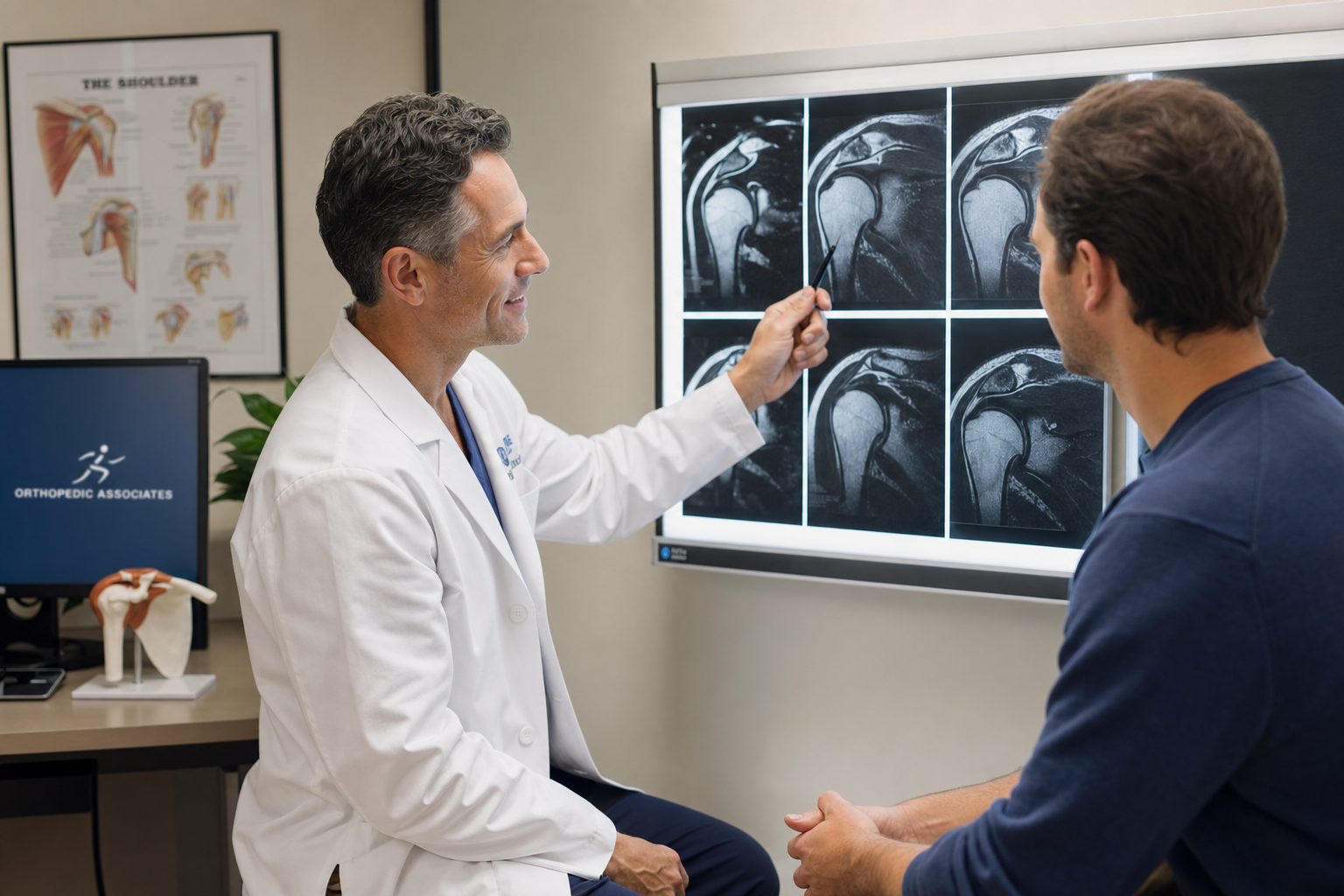
- Imaging review: X-rays are typically taken at the initial visit. MRI may be ordered if soft tissue injury — such as a rotator cuff or labral tear — is suspected.
- Diagnosis and treatment plan: You will leave with a clear diagnosis, a recommended treatment path, and documentation suitable for your workers’ comp claim.
Same-week appointments are available for injured workers in Clermont and throughout Central Florida. Call (352) 404-8956 to schedule.
How a Shoulder Specialist Diagnoses the Source of Pain and Weakness
Accurate diagnosis is the foundation of effective workers’ comp shoulder care. Double-fellowship-trained shoulder surgeon Dr. Amit Varma — who completed fellowships at the Rothman Institute under Dr. Michael Ciccotti and the Andrews Institute under Dr. James Andrews — uses a combination of clinical examination and advanced imaging to identify the precise source of shoulder pain and dysfunction.
Physical examination tests such as the Hawkins-Kennedy test, empty can test, and O’Brien’s test help narrow down whether the problem involves the rotator cuff, biceps tendon, labrum, or AC joint. Imaging confirms and characterizes the injury. X-rays reveal bony abnormalities, arthritis, and fractures. MRI provides detailed views of soft tissue structures including tendons, cartilage, and the labrum. In some cases, an MRI arthrogram (with contrast injection) is used for more precise labral evaluation.
This diagnostic precision matters for workers’ comp cases because it establishes the nature and severity of the injury in objective, documented terms — supporting your claim and guiding the most appropriate treatment.
Treatment Options After a Workplace Shoulder Injury
Treatment for a work-related shoulder injury depends on the type and severity of the injury. At Varma Shoulder Institute, we always explore non-surgical options first when they are clinically appropriate. Treatment options include:
- Physical therapy: A structured rehabilitation program to restore range of motion, strength, and function. Often the first-line treatment for impingement, mild rotator cuff injuries, and AC joint sprains.
- Anti-inflammatory medications: Used to manage pain and swelling during the early recovery phase.
- Corticosteroid injections: Can provide targeted relief for shoulder impingement and bursitis, allowing patients to participate more effectively in physical therapy.
- PRP (Platelet-Rich Plasma) injections: A regenerative option that may support healing in certain tendon injuries.
- Shoulder arthroscopy: A minimally invasive surgical option for rotator cuff repairs, labral repairs, and impingement release when conservative care has not provided sufficient improvement. Learn more about shoulder arthroscopy from the AAOS.
Our team works closely with workers’ comp case managers and adjusters to ensure treatment plans are authorized and documented appropriately throughout the process.
When Surgery May Be Considered for a Work-Related Shoulder Injury
Surgery is not the first answer for most work-related shoulder injuries, but it becomes necessary when structural damage is significant or when conservative treatment has not restored adequate function. Conditions that commonly require surgical intervention include full-thickness rotator cuff tears, complete labral tears, shoulder instability that does not respond to rehabilitation, and AC joint injuries with significant displacement.
When surgery is indicated, Varma Shoulder Institute provides arthroscopic and open shoulder procedures including rotator cuff repair, labral repair, and shoulder stabilization. Dr. Varma’s double-fellowship training means patients receive subspecialty-level surgical care — not general orthopedic care — for their shoulder condition. Workers’ comp surgical cases require pre-authorization, and our team assists patients in navigating that process.
You can contact our Clermont shoulder team to discuss whether surgical evaluation is appropriate for your work-related shoulder injury.
How Workers’ Comp Shoulder Care Differs From General Urgent Care
Urgent care centers serve an important role in immediate post-injury triage — ruling out fractures, providing initial pain management, and referring patients onward. However, they are not equipped to provide the specialist-level evaluation that workers’ comp shoulder injuries require. Urgent care visits typically do not include MRI ordering, detailed orthopedic examination, or the structured documentation that workers’ comp claims depend on.
A shoulder specialist evaluation at VSI provides all of these elements in a single visit. We understand the workers’ comp documentation requirements in Florida and structure our evaluations accordingly. Patients who go directly to a shoulder specialist — rather than cycling through urgent care and then a general orthopedist — often experience fewer delays in diagnosis and treatment authorization.
Why Clermont Patients May Benefit From a Shoulder-Focused Second Opinion
If you have already received a diagnosis or treatment recommendation through your workers’ comp claim but are uncertain about the plan, a second opinion from a shoulder specialist is a reasonable and often valuable step. Varma Shoulder Institute offers second opinions within 48 hours for patients throughout Clermont, Orlando, and Central Florida.
A second opinion is particularly worth considering if you have been told surgery is necessary but want to confirm that diagnosis, if you have been told surgery is not needed but your pain and weakness persist, or if you feel your current treatment plan is not addressing your functional limitations. Our goal is to give you an honest, expert assessment — not to push any particular treatment path.
A Closer Look: What a Specialist Evaluation Can Reveal
Common Mistakes After a Workplace Shoulder Injury
- Delaying evaluation: Waiting weeks or months to see a specialist can allow injuries to worsen and may complicate your workers’ comp claim timeline.
- Relying solely on urgent care: Urgent care is a starting point, not a substitute for orthopedic specialist evaluation.
- Stopping physical therapy too early: Rehabilitation requires consistency. Stopping prematurely — even when pain improves — can lead to incomplete recovery and re-injury.
- Ignoring weakness: Pain is obvious, but weakness in the shoulder is an equally important symptom that should be evaluated. Weakness often signals tendon or nerve involvement.
- Not documenting the incident thoroughly: A detailed account of how the injury occurred — including date, activity, and immediate symptoms — is essential for workers’ comp documentation.
- Assuming the injury will resolve on its own: Some shoulder injuries, particularly rotator cuff tears, do not heal without treatment. Early evaluation leads to earlier, more effective care.
Practical Next Steps for Injured Workers in Clermont
If you have sustained a work-related shoulder injury, here is what we recommend:
- Report the injury to your employer and file a workers’ comp claim as soon as possible.
- Seek initial triage at urgent care if needed for immediate pain management or fracture screening.
- Schedule a specialist evaluation at Varma Shoulder Institute — same-week appointments are available.
- Bring any imaging (X-rays, MRI) and workers’ comp claim documentation to your appointment.
- Follow through with the recommended treatment plan, including physical therapy, to support both your recovery and your claim.
Varma Shoulder Institute provides workers’ comp shoulder evaluations for patients throughout Clermont, Orlando, Minneola, Groveland, and the greater Central Florida region. We accept Aetna, Cigna, Florida Blue/BCBS, UnitedHealthcare, Medicare, Tricare, and self-pay. Call (352) 404-8956 or visit us at our Clermont, FL 34711 office.
Frequently Asked Questions
Do I need a referral to see a shoulder specialist for a workers’ comp injury in Clermont?
Referral requirements depend on your workers’ comp insurance carrier and plan. In many cases, injured workers in Florida can self-refer to a specialist. Contact Varma Shoulder Institute at (352) 404-8956 and we can help clarify what your specific plan requires.
What types of shoulder injuries are most commonly seen in workers’ comp cases?
Rotator cuff tears, shoulder impingement, labral tears, AC joint injuries, and shoulder dislocations are among the most common work-related shoulder injuries. Both acute injuries from a single incident and cumulative injuries from repetitive work are covered under workers’ compensation.
How long does a workers’ comp shoulder evaluation take at Varma Shoulder Institute?
Initial evaluations typically take 45 to 60 minutes, including history review, physical examination, and on-site X-rays if needed. MRI may be ordered separately if soft tissue injury is suspected.
Will I need surgery for my work-related shoulder injury?
Not necessarily. Many work-related shoulder injuries respond well to non-surgical treatment including physical therapy, injections, and activity modification. Surgery is considered when conservative care is insufficient or when the injury involves significant structural damage such as a full-thickness rotator cuff tear.
Can I get a second opinion on my workers’ comp shoulder diagnosis?
Yes. Varma Shoulder Institute offers second opinions within 48 hours for patients throughout Central Florida. If you are uncertain about your current diagnosis or treatment plan, Dr. Varma can provide an independent specialist assessment to help you make an informed decision.
Does Varma Shoulder Institute accept workers’ comp insurance?
VSI accepts many major insurance plans including Aetna, Cigna, Florida Blue/BCBS, UnitedHealthcare, Medicare, and Tricare, as well as self-pay. Contact our office at (352) 404-8956 to verify coverage for your specific workers’ comp carrier before your appointment.
What should I bring to my workers’ comp shoulder evaluation appointment?
Bring your workers’ comp claim number and carrier information, any prior imaging (X-rays or MRI on disc or report), a description of how the injury occurred, and a list of current medications. This helps Dr. Varma conduct the most thorough evaluation possible at your first visit.
Update Log
- May 2026: Article published covering workers’ comp shoulder evaluation process, common work-related shoulder injuries, diagnostic methods, treatment options, and guidance for Clermont and Central Florida patients navigating workers’ compensation claims.